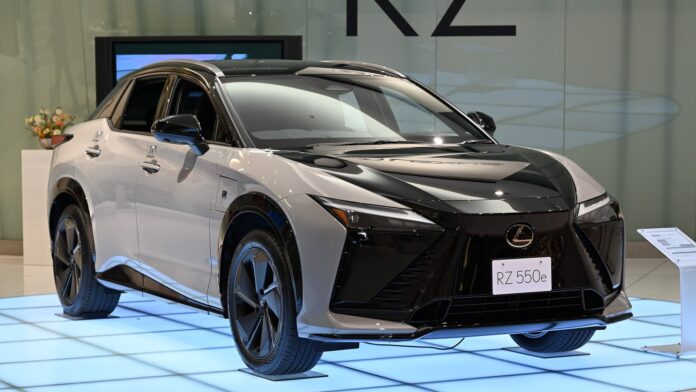

Lexus has updated the RZ, its electric SUV, in Japan, and the headline change is a sound. Starting Nov. 12, the RZ550e’s Interactive Manual Drive mode plays a newly developed engine note in SPORT, so the electric crossover’s simulated eight-speed gearbox now comes with something that sounds like a combustion engine.
The updated RZ went on sale Thursday through Lexus dealers nationwide. Prices including 10% consumption tax are ¥9.75 million (about $61,100 USD) for the RZ550e F SPORT AWD, ¥8.75 million (about $54,900 USD) for the RZ500e version L AWD and ¥8.15 million (about $51,100 USD) for the front-drive RZ350e version L, according to the company’s official announcement.
What Interactive Manual Drive actually does
Interactive Manual Drive (IMD) arrived with the big 2025 RZ update, along with the RZ550e F SPORT and steer-by-wire. It’s software. Press the M MODE button on the center console while in D, and the car starts acting as if it had a gasoline engine and a gearbox. Lexus’s RZ F SPORT page describes a “virtual power source” and an eight-speed “virtual transmission.” The car calculates a virtual engine torque from throttle position and speed, multiplies it by the ratio of whichever virtual gear you picked with the paddles, and sends that much drive to the wheels. A shift-guide meter mixes a tachometer with a power meter and shows the gear you’re in.
The car always made noise in this mode. Until now, though, it was a more abstract “Interactive Manual Drive Sound” played through the front and rear speakers in sync with speed and drive force. The update keeps that sound for NORMAL, ECO and RANGE, and gives SPORT the new “Interactive Manual Drive Engine Sound,” which Lexus says brings in the uplifting engine character the brand is known for. The aim, in Lexus’s words, is to let drivers enjoy a deeper “dialogue with the car,” with drive-force control that feels like working a manual and sound to match.
It is a pretty Japanese idea of fun. The RZ550e F SPORT already makes 300 kW and is rated at 582 km on Japan’s WLTC cycle, per Lexus. None of that changes. What changes is how it feels and sounds when you choose to play.
The rest of the list
Everything else in the update is smaller, and Lexus’s announcement lists all of it:
- Black shark-fin antenna on every grade. Pure styling.
- Digital inner mirror standard on every grade. The camera-based rearview mirror is now standard equipment rather than an option.
- New “Grayscale” L tex interior for the RZ500e and RZ350e. L tex is Lexus’s synthetic leather, chosen for durability and feel.
Lexus didn’t say whether existing RZ550e owners can get the new SPORT sound through a software update. As announced, it’s part of the updated model on sale from Nov. 12.
Some context on where the RZ sits. It launched in 2023 as Lexus’s first model built only as a battery EV, and Car Watch describes it as the starting point of the brand’s shift toward BEVs. The 2025 update replaced the whole BEV system for more power, range and charging speed, and retuned the DIRECT4 all-wheel-drive system, so this round is a light touch by comparison.
Why fake an engine at all
Lexus isn’t the only one. Hyundai’s Ioniq 5 N, which Hyundai also sells in Japan, does a similar trick with a simulated gearbox and synthetic sound, and it won over plenty of skeptics. The logic is the same in both cases. A fast EV is quick and quiet, and a lot of enthusiasts find that combination a little boring. Simulated gears give you something to do with your hands. Simulated sound tells you what the car is doing without looking at a screen.
Tesla takes the opposite approach. Its sporty cars offer more launch modes and track settings, not pretend gears, and it puts its software effort into FSD (Supervised) and over-the-air features rather than engine noise. Both companies are betting on software. They just want it to do very different things.
The EVX Take
The update tells you who Lexus thinks the RZ buyer is. At ¥8–10 million, it’s competing in Japan with imported premium EVs and with Lexus’s own hybrids, and most of its likely buyers have years of driving combustion cars behind them. A familiar engine note is a low-cost way to make a quiet EV feel less foreign to those drivers, and it costs Lexus a sound file rather than new hardware. The digital mirror becoming standard is probably the more practical change for daily driving in Japan’s tight parking lots. Japan’s EV market just passed 100,000 sales in a year for the first time while the national CEV subsidy is set to shrink from January (our report), so a ¥8 million EV needs every selling point it can get. Registered BEVs were still only 5.9% of the market in October (October numbers here). Toyota’s own numbers show where its money is coming from, and it’s mostly hybrids (Toyota’s first-half results). An engine-sound mode won’t change that. It might keep a few loyal Lexus drivers from going back to gasoline.
Sources: LEXUS announcement via JCN Newswire (Nov. 12); Lexus Japan, RZ F SPORT page (IMD details, output and range); Car Watch; Response; Motor-Fan. Currency conversions at about ¥159.5 per dollar.
— The EVX News team
Featured image: A Lexus RZ550e F SPORT in two-tone gray and black on display. Image: TTTNIS via Wikimedia Commons, CC0 (cropped).

