
BAIC’s off-road unit launched its boxy Xingtan 5X SUV on Thursday, Nov. 12, at a limited-time starting price of 126,900 yuan (about $18,980 USD), with Huawei’s Qiankun ADS 5 Pro driver assistance on most of the trims buyers are actually choosing. The company says 30,208 orders came in over 23 days of pre-sales.
The Xingtan 5X (星钽5X) is the first model from Xingtan, a new sub-brand of Beijing Off-road (北京越野), BAIC Group’s off-road division. It comes in seven variants, three battery electric and four plug-in hybrid. Official guide prices run from 129,900 yuan (about $19,430 USD) to 174,900 yuan (about $26,160 USD), and each one gets a 3,000-yuan (about $450 USD) launch discount, so the limited-time range is 126,900 to 171,900 yuan (about $18,980 to $25,710 USD), as IT Home (IT之家) and NetEase Auto (网易汽车) reported from the launch.
“Good technology shouldn’t sit on a pedestal, and a good life shouldn’t cost a ridiculous amount,” BAIC Group vice president Zhang Guofu said at the event, according to Sina Finance.
Huawei, cheaply
The Huawei system is the selling point. The ADS versions use Qiankun ADS 5 Pro with a solid-state lidar mounted inside the cabin behind the windshield, so there’s no hump on the roof. The full sensor suite is 27 pieces of hardware: 11 cameras, one lidar, three 4D millimeter-wave radars and 12 ultrasonic sensors. NetEase Auto reports that highway navigation assist (NCA) is standard on the ADS versions, while city NCA is sold as a subscription. The system can also reverse along a recorded path for up to 120 meters, park by remote and park itself after the driver gets out.
The cheapest way into Huawei’s system is the 625 km battery-electric ADS version at 146,900 yuan (about $21,970 USD) on the launch discount. According to Sina Finance, 82% of buyers picked an ADS version, and BitAuto (易车) also put the share above 80%.
The numbers
It’s a big box. The 5X measures 4,865 mm long, 2,000 mm wide and 1,910 mm tall on a 2,875 mm wheelbase, and the optional spare wheel hung on the side-opening tailgate takes the length to 5,005 mm. The specs from the launch, confirmed across IT Home, NetEase Auto and D1EV (第一电动):
- Battery electric: a 227 kW rear motor, an 81.9 kWh battery and 625 km of CLTC range, on an 800-volt platform that charges from 30% to 80% in 14.5 minutes.
- Plug-in hybrid: a 1.5-liter turbo engine rated at 105 kW. The two-wheel-drive version has one 200 kW motor, and the AWD version has 200 kW motors front and rear for a combined 400 kW. CLTC electric-only range is 310 km for 2WD and 285 km for AWD, with up to 1,350 km of combined range.
- Off-road hardware: 228 mm of ground clearance, 26° approach and 28° departure angles, 600 mm wading depth, and on AWD versions, a rear differential lock and 14 terrain modes.
BitAuto describes it as a light off-roader rather than a hardcore trail rig, which fits the unibody construction. The cabin is family-first: front seats that fold flat, a rear bench that takes two child seats with room for an adult in the middle, a 96-liter front trunk on the battery-electric version, and a cooler box. Higher trims use Qualcomm’s 8295P chip and twin 15.6-inch screens, and an over-the-air update will bring ByteDance’s Doubao large language model to the voice assistant.
Deliveries start right away. Sina Finance reports that handovers began in 16 cities, starting in Beijing, the day after launch, with a “hundred cities, ten thousand cars” push to follow. A special edition will appear at the Guangzhou auto show later this month.
A crowded box
The 5X is walking into a busy segment. BYD’s Fang Cheng Bao Tai 7 and Chery’s iCar V27 also sell the boxy-SUV look, and BAIC isn’t the name most Chinese EV shoppers think of first. Thirty thousand orders in 23 days is a solid start for a brand-new nameplate. Still, pre-sale orders aren’t deliveries, and the November and December numbers will say more. The bigger domestic picture is not friendly either. China’s domestic NEV sales fell 8.6% in October even as exports set a record (our October CAAM report), so every new model is fighting for a share of a shrinking home market.
The EVX Take
The Japan comparison is uncomfortable. In China, BAIC can put lidar and a Huawei navigate-on-autopilot system into a family SUV for under 150,000 yuan (about $22,000 USD), because hands-off highway and city driver assistance is now expected in this price range (China already counts 15 million cars that can follow a route on their own, as we reported). In Japan, Toyota’s hands-off Advanced Drive debuted only on the Lexus LS and Mirai, and Nissan’s ProPILOT 2.0 has been kept to a handful of models. Japan also loves a boxy SUV. The Jimny, Land Cruiser and Delica all sell on looks like the 5X. BAIC has no plans for Japan that we know of, but BYD is already here, and Huawei-level driver assistance at this price is what Japanese automakers will have to answer if Chinese SUVs like this one ever come to Japan. Huawei has also worked with CATL on automated battery swapping (that story here), so its reach in China’s car industry keeps growing.
Sources: IT Home (IT之家) (variant prices, sensors, powertrain); NetEase Auto (网易汽车); Sina Finance (新浪财经) (Zhang Guofu quote, order mix, deliveries); BitAuto (易车); D1EV (第一电动); CnEVPost (rival models). Currency conversions at about 6.69 yuan per dollar.
— The EVX News team
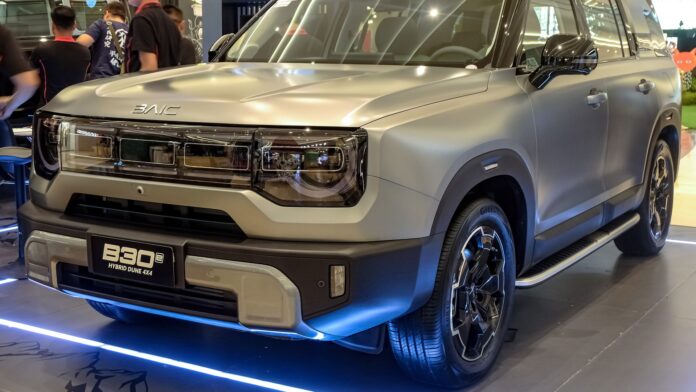
Featured image: A Beijing Off-road B30e in matte gray on display, a sibling model from the same BAIC off-road division, not the Xingtan 5X. Image: Ethan Llamas via Wikimedia Commons, CC BY-SA 4.0 (cropped).

 with Huawei ADS 5 Pro and lidar. Orders hit 30,208 in 23 days.)