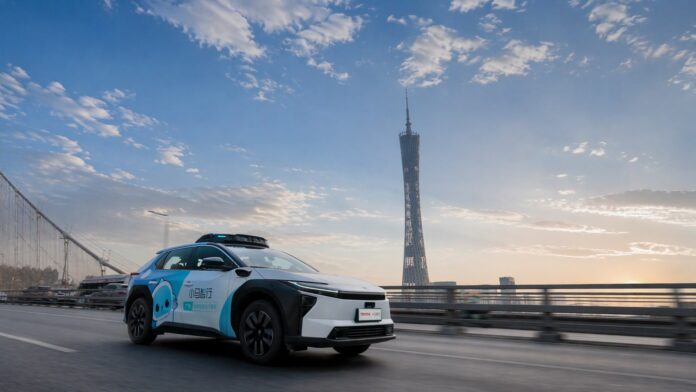

Toyota’s bZ4X is now driving itself for paying riders in China. Pony.ai and Toyota said on Monday, Nov. 16 that their jointly developed Gen-7 bZ4X Robotaxi has joined Pony.ai’s fully driverless commercial fleet in Guangzhou, starting in the Nansha district, with rides bookable 24 hours a day. The partners are working toward a fleet of about 1,000 bZ4X robotaxis across major Chinese cities.
Pony.ai posted the news at 1:31 PM JST on Monday (11:31 PM ET / 8:31 PM PT on Sunday, Nov. 15), alongside its official announcement.
What launched, and where
Riders in Guangzhou can hail the car through the PonyPilot app or through Pony.ai mini-programs inside WeChat and Alipay. The service starts in Nansha, the district that is home to GAC Toyota’s headquarters, according to Toyota China’s statement as reported by National Business Daily (每日经济新闻) and China Daily’s Chinese-language site. The model is also being tested in other major Chinese cities ahead of deployment there.
One wording difference is worth flagging. Pony.ai’s English release calls this a “fully driverless commercial” service. Toyota China’s Chinese statement calls it the start of 示范运营, or demonstration operations, a permit category Chinese cities use for robotaxi services. CnEVPost described it as pilot operations. Either way, there’s no one behind the wheel and members of the public can book it.
Neither company said how many bZ4Xs are carrying riders today, what a ride costs, or when the 1,000-car target will be reached. That last point matters. China Daily notes the joint venture had planned to deploy a thousand-unit fleet during 2026. With six weeks left in the year and no date attached to the number anymore, it’s safer to read 1,000 as a 2027 story.
Seven years and three generations to get here
Pony.ai and Toyota started working together in 2019. Earlier generations of their robotaxis were built on Lexus models and the Sienna minivan, and the partners have run testing and services in Beijing, Shanghai, Guangzhou and Shenzhen. In August 2023, Pony.ai, Toyota Motor China and GAC Toyota agreed to put more than 1 billion yuan (about $150 million) into a joint venture to design, mass-produce and operate a dedicated Level 4 car.
That car is this bZ4X. It’s one of Pony.ai’s three Gen-7 robotaxi models and, per Toyota China, Toyota’s first mass-produced battery-electric robotaxi. The first production unit came off the line in February 2026, and Gasgoo reports it was built on GAC Toyota’s fifth production line. The companies say the car was engineered for Level 4 from the start, with redundant, fail-operational vehicle controls so it can keep driving safely if a component fails. Riders get Bluetooth unlocking, a voice assistant, in-car entertainment and climate controls they can set ahead of time.
“Bringing the bZ4X Robotaxi into commercial service demonstrates what can be achieved by combining Pony.ai’s proven Level 4 autonomous driving technology with Toyota’s world-class vehicle engineering and manufacturing expertise,” said Pony.ai vice president Luyi Mo.
The deal also covers the unglamorous parts. Pony.ai brings its fleet operations, and Toyota brings its service network for maintenance, charging and routine servicing. Anyone who has followed Tesla’s Robotaxi rollout knows those depots and charging bays decide how fast a fleet can grow.
Two ways to build a robotaxi
The comparison with Tesla is useful. Tesla designs the car, the chip and the driving software itself, and it’s running camera-only Model Ys and a 24/7 service in eight US cities, with the purpose-built Cybercab coming behind them. Toyota is taking the opposite route: build a durable, mass-produced car and hand the driving to specialist partners. In China the partner is Pony.ai. In Japan it’s Waymo. Chinese players are crowding the same streets, too. Xpeng’s robotaxi got approval to run across all of Guangzhou in October.
The EVX Take
The bZ4X is turning into Toyota’s robotaxi workhorse on both sides of the East China Sea. The same model is the base for the driverless cars Toyota will build for Waymo at its Takaoka plant in Toyota City, which start testing in Japan in 2027. It’s a car Japanese buyers already know well: the refreshed bZ4X is Japan’s best-selling EV this year, with 24,688 sales from January through October, as we noted in our Japan EV sales report. So Guangzhou is, in effect, an early look at the kind of car Japanese riders may hail in Tokyo, with one important difference: different software, from a different partner. For Toyota, getting fleet-maintenance experience in Nansha now is valuable before Waymo’s Japan fleet arrives. For Japanese taxi operators short on drivers, the question is no longer whether a Toyota can run driverless. It already does, in China, every hour of the day.
Sources: Pony.ai announcement and X post; Toyota China statement via National Business Daily (每日经济新闻); China Daily (Chinese edition); CnEVPost; Gasgoo. Featured image: Pony.ai and Toyota’s Gen-7 bZ4X Robotaxi in Guangzhou with Canton Tower behind. Image: Pony.ai.

