
Japan has sold more than 100,000 electric cars in a single year for the first time, and the year still has two months to go. From January through October 2026, buyers took 111,876 battery-electric passenger cars, according to dealer and kei-car association data reported by the Sankei Shimbun. That splits into 95,614 registered cars and 16,262 kei cars. All of 2025 came to 60,677.
October alone added 14,644 EVs, 2.5 times the 5,858 of a year earlier, according to a tally of the same association data by the business magazine Alterna. The overall passenger market slipped 2.9% to 318,813, so EVs reached a record 4.6% share, up from 4.5% in September and 1.8% a year ago. The trade daily Nikkan Jidosha Shimbun counts 14 straight months of year-over-year growth, and both it and the Nikkei point at the same likely cause: people buying before the subsidy runs dry.
Last week we covered the registered-car half of October (12,733 BEVs) and left the kei side blank until the model data landed. The full count fills it in. Kei EVs came to roughly 1,900, and Alterna says kei EV sales dipped 2.0% from a year earlier as Honda’s N-ONE e: launch bump wore off. Registered EVs more than tripled. Big cars did the heavy lifting this month.
Toyota passes Nissan for the year
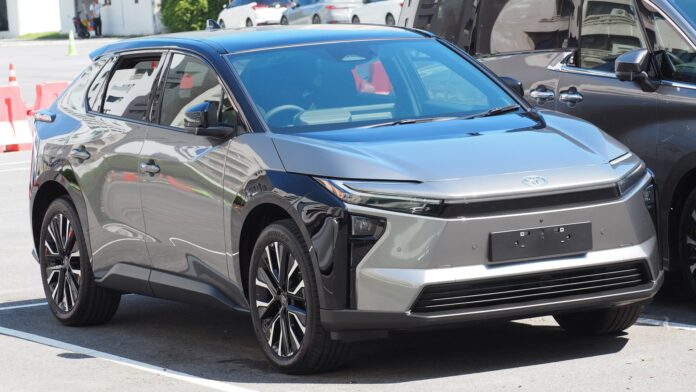
The brand table has a first. By Alterna’s count, Toyota has now sold 27,549 EVs in Japan this year, ahead of Nissan’s 26,642. Through September, Nissan had been 1,011 units in front. Alterna has tracked monthly data since 2022 and says Toyota has topped single months before but never led the year-to-date race. The car doing it is the refreshed bZ4X, with 3,142 sales in October and 24,688 since January, or more than a fifth of the whole EV market.
October by brand, kei included: Toyota 4,108 (3.7 times a year earlier), Honda 2,525 (2.2 times) and Nissan 2,190 (2.4 times). Honda’s number mixes the new Super-ONE with the N-ONE e:. Nissan’s mixes the new Leaf with the Sakura kei car. Tesla doesn’t publish Japanese sales, but the import-registration line that usually tracks it came in at 2,162 for October, up 92% from a year earlier, as we reported last week.
The subsidy clock, in yen
Here’s the part buyers should care about. Japan’s main EV incentive, the CEV subsidy, is funded this year by about ¥110 billion (about $695 million) from the government’s fiscal 2025 supplementary budget. The Ministry of Economy, Trade and Industry says applications are expected to close sometime between early and late December 2026, well before the official final deadline of Feb. 12, 2027. Applications are first come, first served, and the window shuts the business day before the money runs out.
On Oct. 21, METI also published a revised subsidy schedule for any car newly registered on or after Jan. 1, 2027, if the program is still taking applications by then. The stated aim is to stretch the remaining budget as long as possible. The top EV tier drops from ¥1.25 million (about $7,900) to ¥750,000 (about $4,740), and the maximum bonus for automakers’ green-steel efforts falls from ¥50,000 to ¥30,000.
The model-by-model table from the Next Generation Vehicle Promotion Center (updated Nov. 6) shows what that means in practice:
- Tesla Model 3 and Model Y (all trims, including Model Y L): ¥1.27 million (about $8,020) now, ¥762,000 (about $4,810) from January
- Toyota bZ4X and Honda Super-ONE: ¥1.3 million (about $8,210) now, ¥780,000 (about $4,930)
- Nissan Leaf: ¥1.29 million (about $8,150) now, ¥774,000 (about $4,890)
- Tesla Model S and Model X: ¥1.016 million (about $6,420) now, ¥609,000 (about $3,850)
- Honda N-ONE e: (kei): ¥580,000 (about $3,660) now, ¥458,000 (about $2,890)
- BYD models, including the RACCO kei car: ¥150,000 (about $950) now, ¥90,000 (about $570)
The subsidy is tied to the registration date, not the order date, a trap we walked through in our guide to the Tesla subsidy deadline. A Model Y ordered in November but registered on Jan. 5 would get ¥508,000 (about $3,210) less, and that’s assuming the budget lasts into January at all.
The EVX Take
October’s 4.6% looks like a pull-forward month, and November and December probably will too. That makes the first quarter of 2027 the real test. If EV share holds near 4% with a top subsidy of ¥762,000 instead of ¥1.27 million, Japan has a market. If it drops back toward 2%, it had a promotion. The cut is about 40% for every full-size EV on the list (kei cars lose about 21%), so the pecking order barely moves. Tesla, Toyota, Honda and Nissan each lose roughly half a million yen per car, and the Model 3 and Model Y stay within a whisker of the top payout before and after January. BYD’s small grant stays small. Toyota leading the year is good news too. The domestic giants are now selling EVs at volume, so EV demand here isn’t resting on one brand.
Sources: METI CEV subsidy page and Oct. 21 revision, Next Generation Vehicle Promotion Center model table, Japan Automobile Dealers Association and Japan Light Motor Vehicle and Motorcycle Association data via Sankei Shimbun and Alterna, Nikkan Jidosha Shimbun, Nikkei. Rate used: about ¥158 per dollar.
— The EVX News team
Featured image: A 2025 Toyota bZ4X AWD (refreshed) at Toyota Alive Space in Bangna, Bangkok. Photo: Chanokchon via Wikimedia Commons, CC BY-SA 4.0 (resized).

