
Tesla’s Robotaxi network grew again on Monday, and this time the map is the biggest it has ever opened with. Unsupervised rides started in San Antonio, Texas, at 5:00 AM local time on Nov. 9, which was 6:00 AM ET / 3:00 AM PT (8:00 PM JST Monday). By Not a Tesla App’s measurement, the launch zone covers roughly 275 square miles (about 712 km²), a hair larger than Austin’s 272 after more than a year of expansion there.
That makes San Antonio the eighth U.S. city where Tesla runs Robotaxi rides with nobody in the driver’s seat, and the second new one in eight days. Fort Worth opened on Nov. 2.
The announcement was the usual one-liner from Tesla’s official Robotaxi account: “Robotaxi available in San Antonio starting tomorrow, 5am.” It went up at 12:27 AM CT on Monday (1:27 AM ET Monday / 10:27 PM PT Sunday, or 3:27 PM JST Monday), so “tomorrow” turned out to mean about four and a half hours later. The attached map, labeled “Launch geofence,” is a single dark-blue polygon wrapped around downtown.
A launch map that skips the baby steps
According to Not a Tesla App, the zone takes in all of Downtown San Antonio and nearly everything inside Loop 410, then pushes past it in most directions: north to Loop 1604 between I-10 and US-281, west beyond State Highway 151, east past I-35 and south below I-410 toward I-37. Tesla Oracle points out that San Antonio International Airport sits inside the polygon, although nobody has confirmed airport pickups or drop-offs yet.
Here is the network by advertised size, using the figures Sawyer Merritt posted after the launch (these are outside estimates from Tesla’s maps, not numbers Tesla publishes):
- San Antonio: about 275 sq mi (new, Nov. 9)
- Austin: 272
- Houston: 254
- Fort Worth: 143
- Dallas: 81
- Miami: 31
- Orlando: 26
- Tampa: 24
Add it up and the unsupervised map is now about 1,106 square miles, up from 831 a week ago. Merritt also estimates the zones now cover about 4.2 million people, or 1.2% of the U.S. population, up from 1.0% last week. Again, his math. Advertised zones and real ones aren’t always the same thing, either. An owner’s mapping project found that actual pickup and drop-off areas in Texas run 22% to 41% smaller than the advertised outlines, as Not a Tesla App reported last week.
San Antonio didn’t come out of nowhere. Tesla named it on its first Robotaxi safety report in October as one of four “coming soon” cities, with Las Vegas, Jacksonville and Phoenix. Local station KSAT reported back in September that the City Council had approved Tesla’s use of a parking lot near the airport, where gold Cybercabs were already parked. Three cities from that list are still waiting.
What Tesla didn’t say
The fine print is thin, as usual. Tesla hasn’t said how many cars serve San Antonio, what the hours are, or whether any Cybercabs are in the mix. Both Not a Tesla App and Tesla Oracle report that the launch fleet is Model Y. TechCrunch, citing Texas registration data and an independent tracker, notes that outside Austin (400-plus registered autonomous vehicles) Tesla’s city fleets have ranged from a handful to a few dozen, for example 24 cars in Fort Worth and five in Miami. So expect a big map with a modest number of cars at first. That’s the pattern Tesla has used since Fort Worth’s 143-square-mile debut.
It isn’t an empty market. Waymo already runs driverless rides in San Antonio and restarted service there after a pause of about five months tied to flooded-road incidents, per TechCrunch. We covered Waymo dropping its waitlist in San Antonio last month. Tesla’s pitch is cameras-only cars and a much larger zone on day one.
Meanwhile, the Cybertruck line is being cleared for Cybercab
The same morning, Elon Musk added detail to last week’s news that the Cybertruck is winding down at Giga Texas. “The Cybertruck order rate far exceeds our production rate,” he wrote on X at 4:20 PM JST Monday (2:20 AM ET / 11:20 PM PT Sunday). Tesla will try to build as many as possible before the line shuts in about eight months, he said, “but will have to return deposits for a lot of people.” Musk also said the truck isn’t being dropped for being unprofitable. The issue, in his words, is that “the opportunity cost of the complexity of Cybertruck is vastly outweighed by the value of incremental Cybercab production.” Every new 275-square-mile map is the reason that trade looks good on paper.
The EVX Take
Put the San Antonio zone over Japan and it is bigger than all 23 wards of Tokyo (about 627 km²) with room to spare. Tesla’s eight unsupervised zones together, roughly 2,860 km², would cover the 23 wards more than four times. In Japan, FSD (Supervised) still isn’t approved for customer cars, and Level 4 driverless service has mostly meant small shuttles on fixed routes. The rulebook is moving, though. The transport ministry is preparing a single standard for cars with no steering wheel or pedals, expected from December. Robotaxi operators can now point to a U.S. program that adds a city a week at whole-metro scale, and that gives Tesla a stronger case once Japan’s standard actually opens the door to cars like Cybercab.
Sources: Tesla Robotaxi on X, Elon Musk on X, Not a Tesla App, Tesla Oracle, TechCrunch, Sawyer Merritt on X (geofence sizes, population), KSAT.
— The EVX News team
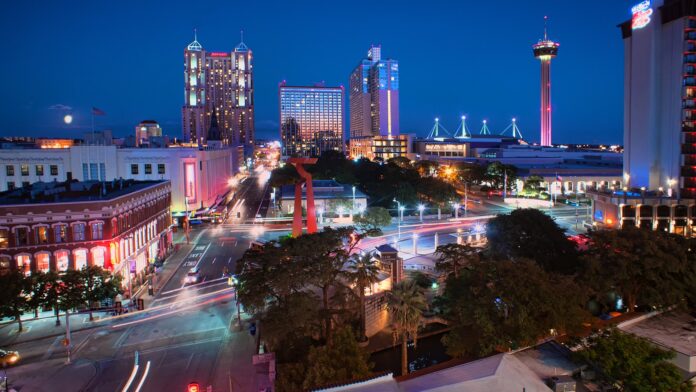
Featured image: Downtown San Antonio at blue hour, with the Tower of the Americas on the skyline. Photo: Katie Haugland Bowen via Wikimedia Commons, CC BY 2.0 (cropped).

