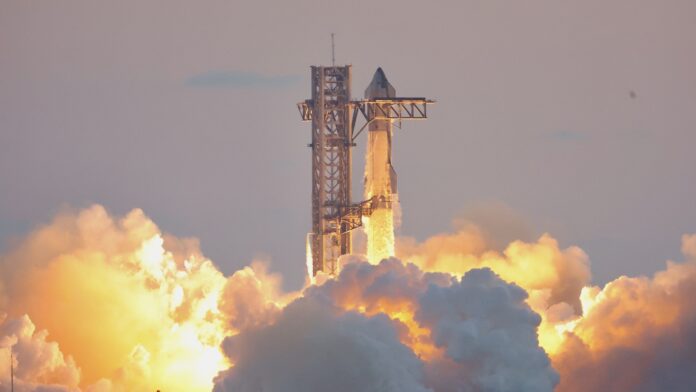


SpaceX has posted an official mission page for Starship Flight 15 and, on Saturday, Nov. 7 at 10:44 a.m. ET / 7:44 a.m. PT (Sunday, Nov. 8 at 12:44 a.m. JST), said so itself on X: the next Starship is targeting a launch as early as Friday, November 13, pending regulatory approval. It is the first flight the company has planned to bring both Starship and Super Heavy back to the launch site for a catch. If that works, SpaceX says, it would mark the first full recovery of an orbital launch system.
The official Flight 15 page lists a 75-minute launch window from 5:45 to 7:00 p.m. ET / 2:45 to 4:00 p.m. PT on Friday, Nov. 13 (Saturday, Nov. 14, from 7:45 to 9:00 a.m. JST). SpaceX also writes that the window opens at 4:45 p.m. CT, which is the same moment as 5:45 p.m. ET. U.S. clocks are on standard time; daylight saving ended Nov. 1. A live webcast is set to start about 30 minutes before liftoff on spacex.com and @SpaceX, or about 5:15 p.m. ET / 2:15 p.m. PT on Nov. 13 (Saturday, Nov. 14, at 6:15 a.m. JST) if they fly at the opening of the window. As always, SpaceX notes that the schedule is dynamic.
That official date replaces the earlier planning figure we reported in mid-October. Our Flight 15 explainer still carries a “no earlier than November 8” target drawn from a CADENA planning slide. SpaceX’s own window supersedes it. Teslarati confirmed the new timeline on Nov. 8, Sawyer Merritt posted the official window and a longer recap of the company’s flight notes, and SpaceNews had already reported a Nov. 13 target once the page appeared.
The booster’s job is the one SpaceX has practiced, with a twist. After liftoff, ascent, hot-staging and a boostback burn, Super Heavy is supposed to come back to the tower for a catch about 6 minutes and 35 seconds after launch. It will be the first return-and-catch attempt for a Super Heavy V3 booster. Three V1 boosters were caught on earlier flights, and two of those flew again.
The ship has a longer day. SpaceX expects it to orbit at about 275 km, complete roughly 14 orbits, and fly for more than 22 hours. The catch is on the timeline at about T+22 hours 32 minutes. If they light the engines at 5:45 p.m. ET on Nov. 13, that works out to about 4:17 p.m. ET / 1:17 p.m. PT on Saturday, Nov. 14, which is Sunday, Nov. 15 at 6:17 a.m. JST. Treat that clock time as approximate; it moves with the actual liftoff.
Riding along are 26 Starlink V3 satellites. SpaceX says each V3 adds 1 terabit of capacity to the constellation, and that all 26 equal about 10 Starlink V2 Mini launches on Falcon 9. After they unfold their antennas and solar arrays, check in over radio and laser links, and raise their orbits, they should begin serving customers as soon as a few weeks after launch. Three of the satellites carry cameras to scan Starship’s heatshield and send the pictures down, one of several checks the company will use before it commits the ship to a return.
The heatshield itself picks up changes from Flight 14: extra retention hardware on tiles most likely to come off during ascent, work on spots where plasma could sneak behind the tiles, and a large section of curved tiles that have cut heating in the gaps. Starship will only head back to the launch site if the team is satisfied that the systems needed for reentry, the landing burn and the tower approach are healthy. There are backup options to deorbit safely over pre-cleared stretches of ocean.
The vehicles have already done their homework on the ground. In late October we covered Ship 42 finishing its static fires, a full six-engine burn and a single-engine firing meant to mimic a deorbit burn. On the October earnings call, SpaceX had already said Flight 15 would try to catch both stages. A working double catch is also what products that depend on a busy Starship, including the Starfall microgravity capsule, are waiting on.
The EVX Take
The official window matters in Japan for a simple reason: the clock. If SpaceX opens it on time, this is a Saturday morning launch here, 7:45 a.m. JST on Nov. 14, with the webcast starting around 6:15 a.m. JST. The ship catch, if they go for it after more than 22 hours, would come around 6:17 a.m. JST on Sunday, Nov. 15, give or take whatever delay slips into liftoff. That is early, not impossible. The payload is the longer story. Each of those 26 V3 satellites adds a terabit of constellation capacity, and SpaceX says the stack matches about ten Falcon 9 flights of V2 Minis. Japan already uses that network. KDDI said in September that it has adopted Starlink as backhaul for au base stations, offers au Starlink Direct, and signed an Asia-first contract for next-generation Starlink Mobile V2 satellites aimed at faster direct-to-phone service in 2027. Those Mobile V2 spacecraft are not the V3 broadband satellites on Flight 15. They sit on the same bet, though: more Starship flights, more satellites, more capacity over Japan. Catching both stages is how “more flights” stops being a slide.
Lester’s take
I’m a Tokyo photographer on my fourth Tesla in five years (three Model Ys and a Model X; the current one is a Juniper). I started the YouTube channel Teslaloha in 2020, one of the first Tesla news channels in Japan, and I bought FSD on all four cars before moving to a country that still has not approved it. Waiting on other people’s timelines is sort of my hobby. SpaceX putting Friday the 13th on the official page for the first time a rocket tries to catch both of its own stages feels about right. From over here that window opens on a Saturday morning, which is usually when I am loading cameras into the Y, not refreshing a launch blog. I will still take a company that finally prints a real clock over another planning slide that said “NET November 8.”
Sources: SpaceX Flight 15 mission page, SpaceX on X, Teslarati, Sawyer Merritt (2), SpaceNews, KDDI.
— Lester Miyashiro, EVX News
Featured image: Starship lifting off from the tower during Flight 5 at Starbase, Texas, Oct. 13, 2024. Photo: Steve Jurvetson via Wikimedia Commons, CC BY 2.0 (cropped).