
SpaceX has opened a storefront for Starfall, its disk-shaped reentry capsule, though there are no prices in it yet. A commercial page at spacex.com/starfall now spells out what customers get: up to 1,000 kg (about 2,200 lb) of payload, 1 kW of power, an Ethernet data link and a live Starlink connection for the whole mission, with “weeks of continuous microgravity” on flights that launch on Starship. On Monday, the company also added a Starfall T-shirt to its online store.
That’s a big change for a vehicle SpaceX barely talked about six months ago. Before its first flight in June, almost everything known about Starfall came from FAA and FCC filings describing a disk about 10.2 feet (3.1 m) wide and 2.5 feet (0.76 m) tall that can bring back around 2,200 pounds of cargo, Teslarati reported. The second flight rode on the Bandwagon-5 rideshare in October, still with no word on what it carried.
What’s on the page
SpaceX pitches Starfall at three kinds of customers. Biomedical researchers can grow induced pluripotent stem cell (iPSC) organoids, replacement tissue and layered biomaterials. Drug companies are told that proteins and small-molecule drugs “form smaller, more uniform crystals” without gravity-driven convection. And materials scientists get vacuum plus microgravity for semiconductors and other next-generation materials.
The sales pitch is mostly about time. “Drop towers and parabolic flights last seconds,” the page says. Starfall offers weeks, with mission length “tailorable to payload requirements.” The Starlink link matters more than it sounds, too. Researchers can pull data off an experiment while it’s still in orbit instead of waiting for splashdown to find out whether it worked.
Missing from the page: a price and a first customer flight date. SpaceX first posted the Starfall pitch on X on Oct. 20, the same day its third-quarter results said it had signed three commercial Starfall missions during the quarter, TeslaNorth noted. On the earnings call, President Gwynne Shotwell described Starfall as “routine relatively low cost access to microgravity environments for scientific research, including improving our understanding of diseases like cancer and diabetes,” and said the new missions would fly on Starship (our Q3 call story).
Who’s already booked
Two customers have gone public. Redwire’s SpaceMD unit signed in August to fly up to 32 of its PIL-BOX drug-crystallization labs on a dedicated 2028 Starfall mission, Payload reported, the largest dedicated commercial microgravity research flight announced so far. PIL-BOX isn’t new to space. Fifty-four of the mini-labs have flown to the International Space Station since 2023 and crystallized 45 different compounds.
In September, Luxembourg-based Space Cargo Unlimited booked its own 2028 Starfall mission on Starship. CEO Nicolas Gaume told Payload it had already sold a third of the capsule’s 1,000 kg and expected to have half booked by the end of the year. “The level of volume and power offered by Starfall is a paradigm shift,” he said. Space Cargo says Starfall lets it fly up to 10 times more customer payloads than the other reentry vehicles it uses.
That puts SpaceX in an odd spot with Varda Space Industries, the company that has done most to build this market. Varda’s W-Series 7 capsule flew on the same Bandwagon-5 rideshare as Starfall in October, and Varda’s capsules are about three times smaller, Teslarati noted. SpaceX gives both of them their ride to orbit, and now it’s competing with one of them for customers.
It all runs on Starship
“By launching on Starship, Starfall brings a reliable and scalable cadence previously unavailable to the market,” SpaceX writes. That makes Starship the schedule risk. SpaceX finished static fires of Ship 42 and its Super Heavy booster in late October and is getting ready for Flight 15, where it hopes to catch both stages with the tower. Starfall’s business case depends on Starship flying often, and the booked customer missions are still two years away.
The EVX Take
Starfall is a direct challenge to a business Japan is building too. ElevationSpace, a Tohoku University spinoff in Sendai, is developing its own return capsule, ELS-R, to bring experiments and products back from orbit. Its first unit, Aoba, is set to fly on Isar Aerospace’s Spectrum rocket, and in September it signed with Mitsubishi Heavy Industries to put a second ELS-R on an H3 rideshare in 2027, the company said. Space Cargo Unlimited has booked a mission with ElevationSpace as well as with SpaceX, so the two aren’t strictly rivals yet. They’re shelves in the same store. But 1,000 kg per flight, a live Starlink link and Starship’s planned flight rate set a high bar for any smaller capsule. Japan’s drug and materials researchers, who have years of protein-crystal work on the ISS’s Kibo module behind them, will soon be able to shop around, and with the ISS due to retire around 2030, they’ll need somewhere new to fly.
Sources: SpaceX Starfall page, Teslarati, TeslaNorth, Payload (Redwire SpaceMD), Payload (Space Cargo Unlimited), Reuters, ElevationSpace. Not a Tesla App had not covered Starfall at the time of writing.
— The EVX News team
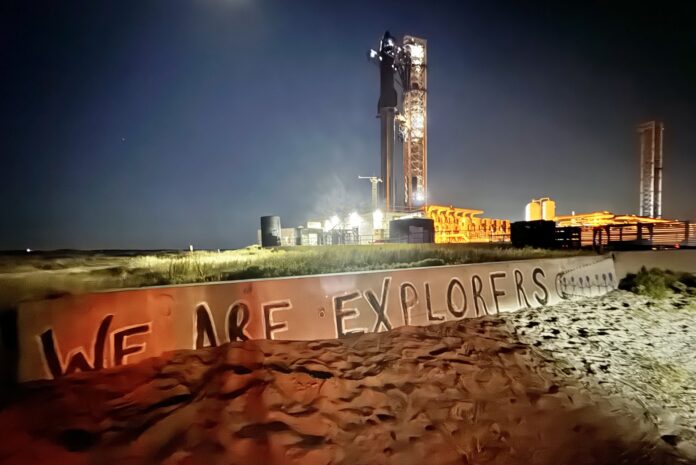
Featured image: Starship stacked on the launch tower at Starbase, Texas, the night before Flight 5 (October 2024). Photo: Steve Jurvetson / Wikimedia Commons (CC BY 2.0).

