
Tesla’s Robotaxi service no longer closes for the night. The company said late Wednesday that rides now run 24 hours a day, seven days a week, in every city where the service is available: Austin, Dallas, Fort Worth, Houston and San Antonio in Texas, plus Miami, Orlando and Tampa in Florida.
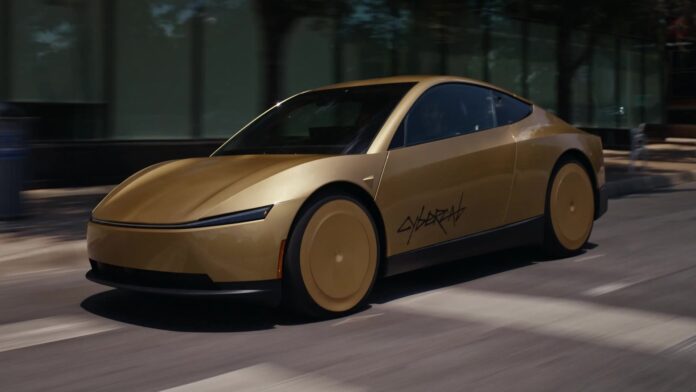
“Robotaxi now runs 24/7. Every city we’re available in,” the official @robotaxi account posted at 11:31 PM ET / 8:31 PM PT on Wednesday, Nov. 11 (1:31 PM JST on Thursday, Nov. 12), over a short clip of a gold Cybercab cruising down a city street at night. Elon Musk quoted it about 40 minutes later with his own math: “Robotaxi works 168 hours a week.”
Nothing else changed in the announcement. Tesla didn’t add a city, redraw a service map or mention highways. It simply removed the last overnight gap, and on an autonomy program that grows by small increments, the gap was a big part of what was left.
From 16 hours a day to all of them
The hours have been creeping out for months. On Aug. 26, the @robotaxi account said the service ran from 6 AM to 10 PM. By Oct. 12 it was 6 AM to 11 PM. Tesla’s third-quarter update on Oct. 21 put Austin at 6 AM to midnight, and at the end of October the window stretched to 6 AM to 2 AM, along with app changes that let riders share trip details and see the rear camera feed. When San Antonio opened on Nov. 9 (our report on Tesla’s biggest launch map yet), riders there could book from 5 AM. So the final step closed a three-hour hole between 2 AM and 5 AM.
Tesla had promised this. On the Q3 earnings call, AI software chief Ashok Elluswamy said hours were being extended as “driven by the capability of the AI software,” and that “over the rest of this year we’ll unlock 24/7 operation, go to higher-speed roads.” He also gave the rule the team works under: “We just want to make sure that there’s not a single safety incident.” With seven weeks left in 2026, half of that promise is done. Higher-speed roads are the half still waiting.
The usual fine print applies. A ride still has to start and end inside a service area, and a car has to be free. Overnight demand is thinner, so the real test is whether Tesla keeps enough cars on the road at 3 AM that wait times stay reasonable.
The fleet is now bigger than Waymo’s in Texas, on paper
The timing lines up with another milestone. As of Nov. 10, the Texas DMV’s automated vehicle registry listed 1,302 vehicles under Tesla Robotaxi, LLC, against 1,297 for Waymo, Teslarati reported. Tesla’s Texas list is 729 Model Ys and 573 Cybercabs. When the registry first went public in late May, Tesla had 42 vehicles on it. On Oct. 31, we covered the day it was still 55 cars behind (here’s that story).
A registration is permission to run a car, not proof that it’s carrying riders, and a five-car lead can flip with the next batch from either side. Still, the trend is hard to miss. Waymo has run around the clock for years, and Tesla now matches it on hours in every market it serves, including most of the cities where the two compete head to head.
Musk’s “168 hours” line is about money as much as convenience. A robotaxi that sleeps from 2 AM to 5 AM is a capital asset sitting idle for an eighth of every day. Running all night spreads the cost of each Cybercab over more paid miles. That’s the core of the economics Tesla keeps pitching investors, and it’s why the Cybercab, a two-seater with no steering wheel or pedals, is getting factory space that used to belong to the Cybertruck.
The EVX Take
Japan should look hardest at the overnight hours. In Tokyo, taxis charge a 20% late-night surcharge from 10 PM to 5 AM, and those are the shifts that are hardest to staff as the driver workforce ages. Japan’s limited ride-share program, launched in April 2024, was designed around exactly those times and places where taxis run short. A driverless car doesn’t need a premium to work at 3 AM, and that’s the real argument for robotaxis in a country with too few drivers (we made the longer case in our column on Japan’s aging population). Waymo plans to start testing driverless Toyota bZ4X taxis in Japan in 2027 (our report). Tesla hasn’t given a Japan timeline for Robotaxi, and FSD (Supervised) still isn’t approved here. When Japanese regulators do decide how driverless taxis will run, a fleet that already works all night in eight US cities is useful evidence.
Sources: @robotaxi on X; Elon Musk on X; Tesla Robotaxi page (city list); EV (eletric-vehicles.com) (hours timeline, Q3 call quotes); TeslaNorth; Benzinga; Teslarati (Texas DMV registry).
— The EVX News team
Featured image: A gold Tesla Cybercab driving down a city street at night, a still from Tesla’s 24/7 announcement video. Image: Tesla (@robotaxi on X) (cropped).

