

Japan recorded 287,023 traffic accidents in 2025, and 2,547 people died on its roads, the fewest since records began in 1948 (National Police Agency, e-Stat). Read the headlines about those crashes and you’ll almost never learn what anyone was driving. Read a Japanese headline about a Tesla crash and the brand is usually the first word. Almost always, that crash happened in America.
This started with an X post from Captain Eli (@TheCaptainEli) that has passed 1.5 million views. His point: a Toyota crash becomes “Driver injured in crash,” a Ford becomes “Two cars collide,” and a Tesla becomes “TESLA crashes.” He was talking about US media. I wanted to know whether Japan does the same, so I counted.
What I counted
I went through 153 Japanese-language crash headlines from November 2025 to October 2026, pulled from Google News Japan: 27 about Tesla crashes and 126 about ordinary crashes, taken in search order month by month, from about 40 outlets including NHK, Yomiuri, Asahi, Mainichi, Sankei, Jiji and Kyodo.
- Ordinary crashes: 0 of 126 headlines named any car maker.
- Tesla crashes: 25 of 27 headlines named Tesla (93%).
- Where those Tesla crashes happened: 24 of the 27 were overseas, and all 24 named Tesla. Only 3 headlines covered a crash in Japan.
One honest caveat: I found the Tesla headlines by searching for “テスラ,” so of course most of them say Tesla. The stronger number is the zero. In a year of Japanese crash coverage, I couldn’t find a single ordinary crash headline that named the make.
How Japan writes its own crashes
Japanese newsrooms have a house style, and it’s a good one. The car is 乗用車 (passenger car), 軽乗用車 (kei car) or トラック (truck). The focus is what happened and who got hurt.
- Sankei, Sept 29: 「正面衝突で車炎上3人死亡 千葉市の国道交差点、乗用車とトラック」 (Head-on collision, car burns, three dead at a Chiba City intersection: passenger car and truck). Yomiuri ran it the same way.
- Yomiuri, Oct 28: 「小田急江ノ島線の線路を軽乗用車が200m走行、電車と衝突し高齢女性が死亡」 (Kei car drives 200 meters along the Odakyu Enoshima Line, hit by train, elderly woman dies). TBS and NHK did too.
The driver-assist crash nobody branded
Here’s the case that convinced me. On the Kochi Tobu Expressway, a car drifted into oncoming traffic and a 1-year-old was killed. The driver told the court he’d been relying on 「オートパイロット」 while changing his shoes. The car was a Toyota Crown Crossover using Toyota’s Lane Tracing Assist, a lane-keeping system.
That’s a fatal crash in Japan, with a driver-assist system in the middle of it and the word “autopilot” in the testimony. Yomiuri’s headlines on the trial and the verdict don’t name Toyota or Crown. The make only shows up in the body of Asahi’s coverage. If it had been a Tesla in Texas, you know what the first word would have been.
How Japan writes a Tesla crash, which is how America writes one
Search 「テスラ 事故」 and you get US crashes, translated or rewritten for Japanese readers, with the brand up front:
- Reuters Japan, June 22 (also on Newsweek Japan): 「米当局、テスラ車死亡事故巡り調査開始 テキサスで民家に衝突」 (US regulators open probe into fatal Tesla crash; car hit a house in Texas). The story itself says it wasn’t known which system the driver was using.
- Zaikei Shimbun, Sept 6: 「テスラ死亡事故、左折時に運転支援が作動―機能名と事故原因はなお不明」 (Fatal Tesla crash: driver assistance engaged during a left turn; the feature and cause remain unknown), about Batavia, Illinois.
- GIGAZINE, Oct 23: 「テスラ車が自動運転中に高速道路で男性をはねて死亡させる」 (Tesla on self-driving strikes and kills man on highway), about I-80 in California.
Japanese editors didn’t invent that framing. Most of them never wrote a Tesla crash story from scratch. These pieces come from wire services, Japanese editions of US outlets, and tech sites rewriting US reports, and the headline comes along with the facts. Japan covers Tesla mostly through US news, so it gets the US headline habit too.
The one Tokyo case
The only domestic Tesla crash in my count is from June 9 in Otowa, Bunkyo Ward. A Porsche turning right at about 100 km/h (roughly 62 mph) went over the median and hit a Tesla waiting at the light, pushing it into a third car. Three people, including an elementary school girl, were taken to the hospital with minor injuries, and police arrested the Porsche driver.
When Japanese newsrooms wrote that one themselves, Tesla was named in just 1 of 3 headlines. TV Asahi went generic: 「東京・文京区で3台が絡む事故」 (three-car accident in Bunkyo). Sankei named only the Porsche. Shueisha Online named both, but the Porsche came first: 「《高級外車同士が…》ポルシェがテスラに衝突し3台の事故」. And the Tesla was the car that got hit.
That’s the point. Left to its own style, Japanese media treats a Tesla more or less like any other car. The “TESLA crashes” headlines are imported.
The number that rarely makes the headline
Tesla publishes its own safety data. Its FSD (Supervised) Vehicle Safety Report, which we covered this week, puts Teslas with FSD engaged at 6,006,200 miles between major collisions in North America, against a US average of 660,164. That’s Tesla’s own US data with Tesla’s own definitions, so read it with that in mind. But it’s a fleet-wide number, and a single crash headline isn’t. FSD isn’t approved in Japan yet, so Japanese readers’ main picture of it comes from those imported crash headlines.
Lester’s take
Every one of these crashes involves real people, and the ones who died deserve accurate coverage, not catchy coverage. I’m not asking anyone to go easy on Tesla. I’ve owned four and paid for FSD four times, and I want the hard questions asked. I’m asking Japanese newsrooms to use their own rules. You already write a fatal driver-assist crash in Kochi as “a passenger car.” When a story comes in from America, translate the facts, not the framing.
How we counted: 153 Japanese-language crash headlines from Google News Japan, Nov 2025–Oct 2026. Tesla headlines were found by searching テスラ, so the 0-of-126 result for ordinary crashes is the stronger figure. This is a convenience sample, not a scientific survey. 2025 statistics: National Police Agency; see also chapter 5 of the NPA’s 2026 Police White Paper.
— Lester Miyashiro, EVX News
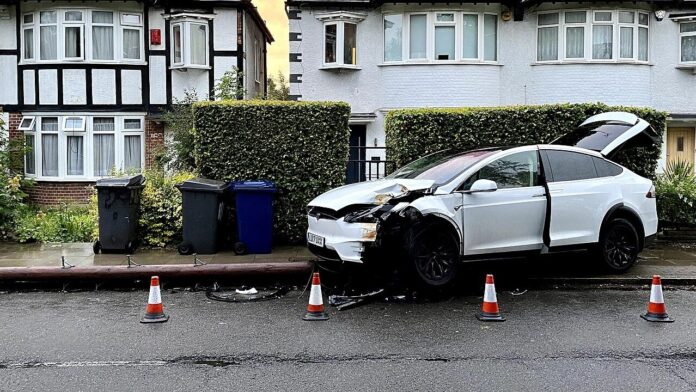
Featured image: A crashed Tesla Model X in Finchley, London, July 2021. Photo: No Swan So Fine / Wikimedia Commons, CC BY-SA 4.0 (cropped).