
Neuralink has put its first hard numbers on speech. The company says one participant with ALS in its VOICE trial reached 75 words per minute with a 5.8% word error rate on a 125,000-word vocabulary, and did it in the first week of using the implant to turn attempted speech into text and voice.
Neuralink posted the figures on X on Wednesday, Oct. 28 at 4:02 PM ET / 1:02 PM PT (Thursday, Oct. 29 at 5:02 AM JST). In follow-up posts it said Dr. Nader Pouratian, the study’s principal investigator, presented the data that day at the 2026 Annual NEALS Meeting, the yearly conference of the Northeast ALS Consortium.
“We are enabling speech to text and voice at conversational rates in participants with ALS,” the company wrote. Until now Neuralink had shown speech demos without publishing speed or accuracy figures, as TeslaNorth noted. This is the first time it has put a number on the board.
What 75 words a minute means
Natural conversation is often put at around 150 words per minute, so 75 isn’t fully natural speech yet. For someone who has lost the ability to talk, though, half of conversational speed in week one is a very different life from spelling out words one letter at a time.
The more useful comparison is with earlier brain-computer interface research. A 2023 Stanford study published in Nature, with a different implant, reported 62 words per minute and a 23.8% word error rate on the same 125,000-word vocabulary size. Neuralink’s single participant was faster, and the error rate is about a quarter of that. Word error rate is the share of words the system gets wrong, so 5.8% means roughly one slip in every 17 words.
The caveats matter. This is one participant, and the numbers come from the company and its investigator. Neuralink hasn’t said how many people are in the speech cohort or shared the full set of results, and a conference abstract isn’t a peer-reviewed paper. The abstract sits in the meeting proceedings published by the journal Muscle & Nerve. Neuralink’s devices are investigational and have not been approved by the FDA or any other regulator.
The VOICE trial and the robot that runs it
VOICE is registered on ClinicalTrials.gov as NCT07224256, an early feasibility study of “a precise robotically implanted brain-computer interface for communication restoration.” It started on Oct. 3, 2025, is still recruiting, and lists a primary completion date of October 2028.
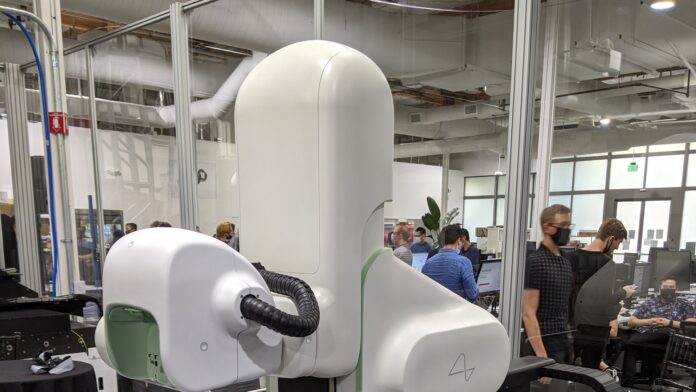
Two pieces of hardware are involved. The N1 implant is skull-mounted, wireless and rechargeable, and connects to ultra-thin electrode threads in the brain. Those threads are placed by the R1, Neuralink’s surgical robot, because they’re too fine for a human hand to insert reliably. The trial targets adults with severe speech loss from neurological conditions who also have impaired upper-limb function. When they try to speak, the motor cortex still fires even though the signal never reaches the mouth and vocal cords. N1 records that intent and the software decodes it into text or a synthesized voice.
The study’s preliminary efficacy measure is the monthly maximum of correct words per minute, tracked for up to 48 months after implant. So 75 in week one is a starting line, not a ceiling. Brain-computer interfaces usually improve as the decoder learns from more data, a pattern that echoes how AI models like DeepMind’s Genie 4 get better with scale.
Where it fits
Neuralink’s first trial, PRIME, focused on letting people with paralysis move a cursor and play games by thought. Speech is a harder and more personal problem. It’s also where much of the academic field has been heading, and outlets tracking the space picked the number up quickly. PANews reported the same figures, and NeuraBC called it high real-time performance for English, while stressing that the device is still research-stage.
There’s a robotics angle, too. The R1 is one of the more unusual robots in the Musk portfolio. Optimus gets the headlines in the humanoid race against rivals like Xpeng’s Iron, but the R1 doesn’t walk or fold laundry. It places threads in the brain with a precision a human hand can’t match, and every new VOICE participant depends on it.
The trial’s own scorecard runs for four years per participant. If week one is 75 words a minute, the interesting number is what month twelve looks like.
Sources: Neuralink on X (NEALS presentation, VOICE study), ClinicalTrials.gov NCT07224256, Muscle & Nerve (NEALS 2026 proceedings), TeslaNorth, PANews, NeuraBC, Nature (Willett et al., 2023).
— The EVX News team
Featured image: Neuralink’s surgical robot on display at the company’s August 2020 demo event. Photo: Leijurv / Wikimedia Commons, CC BY-SA 4.0 (cropped).

