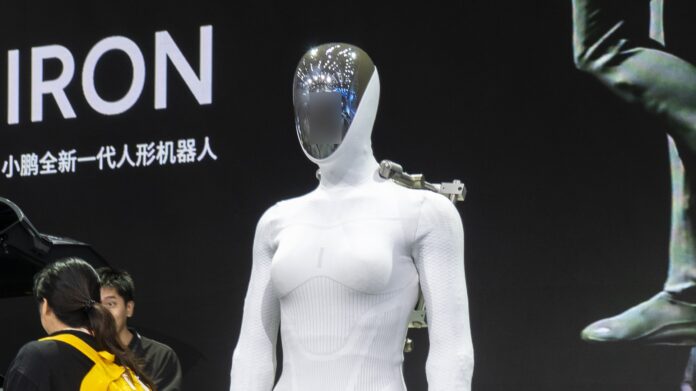

Xpeng’s Iron humanoid robot now has batteries rolling off a production line, even though the robot itself hasn’t started mass production yet. Xpeng vice president Gu Jie said on Wednesday, Oct. 28, that solid-state batteries built for Iron have entered small-batch production, while the robot remains in the stage before SOP (start of production).
Gu made the remarks at the annual congress of the China Society of Automotive Engineers (SAECCE), according to Yicai, which first reported them. IT Home, citing Yicai and Sina Auto, and CnEVPost reported the same details.
A battery designed around a body
A humanoid is a terrible place to put a battery. There’s no flat floor to fill like in a car, the torso is already packed with actuators and compute, and the whole thing is supposed to walk around people in a shopping mall. Gu said Xpeng’s robot-specific solid-state pack uses a high-energy-density design to fit the robot’s tight internal space, and that the company “redefined” its battery standards for robots. The pack is designed to stop thermal runaway from spreading, and it can survive impact and nail-penetration tests.
What Xpeng didn’t share: energy density, capacity, runtime, the supplier or how many packs it’s building. “Small batch” is all we get.
There’s also a wording question. When Xpeng unveiled the new-generation Iron at its 2025 Tech Day in November 2025, it said the robot would be the first in the industry to use all-solid-state batteries, as Yicai and CnEVPost both note. On Wednesday, Gu said “solid-state” without the “all.” That could be shorthand, or it could mean a semi-solid design. Xpeng hasn’t clarified, and we’d treat it as unconfirmed either way until the company says which chemistry is in the pack.
Where Iron stands
Xpeng commissioned an Iron production line on Sept. 8, when a robot completed automated final assembly and walked off the line, per IT Home and CnEVPost. The plan, repeated this week, is mass production by the end of 2026. Deployment starts in 2027, first in Xpeng stores and other commercial spaces, where Iron would greet shoppers and explain products. Industrial and home use come later.
That sequence (batteries first, robot SOP next, stores in 2027) looks a lot like how EV makers launch a new car. Not a surprise. Xpeng is a carmaker that also builds robotaxis, and it’s leaning on its auto supply chain, the same way it just won approval to run Level 4 robotaxi service across Guangzhou.
It’s also the playbook Tesla is running with Optimus, which leans on the same AI and hardware work as Tesla’s cars. Tesla’s most recent Optimus news is a practical one: the robot will soon plug Cybercabs in to charge at Tesla’s Robotaxi hubs. The difference is that Tesla is putting Optimus to work inside its own operations first, while Xpeng wants Iron facing customers in stores.
China’s humanoid supply chain keeps moving fast around both of them. Just this week, Schaeffler opened a factory in Taicang where humanoid robots help build humanoid robot joints. Batteries were one of the bigger open questions for walking robots. Xpeng now says it has an answer in production. The next proof is a robot that ships with it.
Sources: Yicai (第一财经), IT Home (IT之家), CnEVPost, 10jqka (同花顺).
— The EVX News team
Featured image: Xpeng’s Iron humanoid on display at Auto Guangzhou 2025. Photo: Tim Wu / Wikimedia Commons, CC BY-SA 4.0 (cropped).

