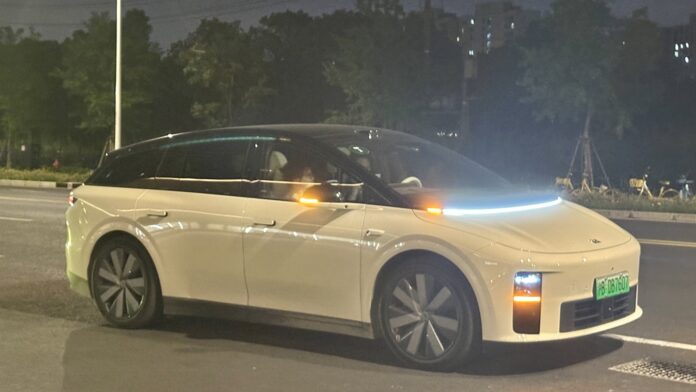

Li Auto has refreshed its i6 electric SUV without touching the price. The 2026 Li i6 launched in China on Wednesday at 249,800 yuan (about $37,400 USD), the same as last year’s car, but it now comes with Li Auto’s own Mach M100 driver-assistance chip, a bigger 96 kWh battery and up to 780 km of CLTC range.
Buyers who order by Nov. 30 get an introductory price of 239,800 yuan (about $35,900), Li Auto said in its launch release. Deliveries start right away, with some cars reaching owners in as little as one to two weeks, according to CnEVPost and Chinese tech site Qudong.
Goodbye Nvidia, hello M100
The headline change sits behind the windshield. The 2025 i6 used Nvidia’s Drive Thor-U chip, rated at 700 TOPS. The 2026 car swaps it for Li Auto’s in-house Mach M100 at 1,280 TOPS, standard on every car, Autohome reports. A dual-M100 package doubles that to 2,560 TOPS and adds three solid-state lidar sensors (two side-facing, one rear) to the roof unit, plus power front doors. It’s a 20,000-yuan option (about $2,990), cut from a list price of 30,000 yuan for the launch period.
Li Auto is pushing its Mach VLA 2.5 driver-assistance model to cars on the Mach platform through the OTA 9.2 update alongside the launch, Sina Tech reports. The company says the new 3D vision setup reads things like a bus slowing ahead or a car reversing toward you earlier, and handles tighter parking spots. Those are Li Auto’s claims; no independent testing yet.
China’s automakers are racing to bring the chip in-house. Xpeng already did it with its Turing chip, which Volkswagen is now using in the ID. UNYX 09. Tesla, of course, has designed its own FSD computers for years. Owning the silicon means owning the roadmap, and the margin.
Bigger battery, built in-house too
The battery is also Li Auto’s own now. The 96 kWh Lianshan 5C lithium iron phosphate pack replaces last year’s 87.3 kWh pack, which used CATL or Sunwoda cells. Li Auto assembles the new pack itself, with cells from Sunwoda and CALB, according to Autohome.
CLTC range climbs from 720 km to 780 km for the rear-wheel-drive car and from 660 km to 710 km with all-wheel drive. Li Auto says a 10-minute charge adds about 500 km. In a pre-launch drive around Lake Tai, the RWD car went 811.4 km before the battery hit zero, Qudong reports, or 104% of its CLTC figure. (CLTC is China’s own test cycle and is generous next to EPA numbers, so don’t expect 780 km on a U.S. highway.)
Li Auto is also offering a battery guarantee: if a self-developed pack catches fire because of its own defect and the car is written off, the company replaces it with a new car of the same spec, Qudong reports. The same applies to fires after a crash or an underbody scrape.
Inside, two 15.7-inch screens give way to a single 29-inch 6K panoramic display run by Qualcomm’s new Snapdragon 8797. Both front seats are full-size “zero-gravity” recliners with 16-way power adjustment and 18-point massage, and the frunk is now powered. Dual-motor AWD is a 20,000-yuan option (about $2,990) that brings 400 kW and 0-100 km/h in 4.8 seconds, state news agency Xinhua reports.
Why Li Auto needed this
The i6 was a hit at launch. Sina says it sold close to 190,000 units in its first year. But monthly deliveries have slid. CnEVPost’s tally shows 7,379 in September 2026, down 56.5% from August, still about 23% of Li Auto’s deliveries. The whole market is soft, too: China’s NEV retail sales fell 13% in the first 25 days of October.
Keeping the price flat while adding hardware is the classic Chinese answer. Li Auto CEO Li Xiang said he wants the i6 to become the company’s best-selling car worldwide. Europe is next: badged the Li 6, it’s scheduled to launch in Norway and the Netherlands in the first quarter of 2027.
Sources: Li Auto, Autohome, Sina Tech, Qudong, Xinhua, CnEVPost.
— The EVX News team
Featured image: Li Auto i6 in China. Photo: JustAnotherCarDesigner / Wikimedia Commons, CC0 (cropped).

