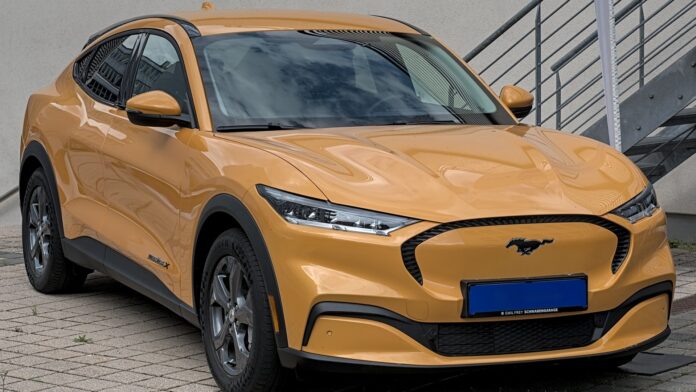

Ford’s electric-vehicle unit lost another $1.1 billion in the third quarter. Ford Model e posted an EBIT loss of $1.058 billion on just $1.2 billion of revenue, an operating margin of minus 86.5%, as the company wound down the F-150 Lightning and cut Mustang Mach-E output to match demand.
Ford reported results after the closing bell on Wednesday, Oct. 28 (Thursday morning, Oct. 29 JST). The Model e numbers, straight from Ford’s earnings release:
- Wholesales: 34,000, down 31% from 50,000
- Revenue: $1.2 billion, down 31% from $1.8 billion
- EBIT: minus $1.058 billion, versus minus $1.41 billion a year ago
- EBIT margin: minus 86.5%, versus minus 79.1%
- First nine months: $3.5 billion revenue (down 35%), minus $2.75 billion EBIT
Ford’s slide deck put the cause bluntly: “Volume and revenue down, driven by discontinuation of F-150 Lightning and right-sizing of Mustang Mach-E production to customer demand.” Sawyer Merritt flagged that line on X within minutes of the release.
Smaller loss, worse margin
There’s a real improvement buried in there. The dollar loss shrank by $352 million, or 25%, from last year. Ford says it’s squeezing its first-generation EVs for profitability while spending on two new things: affordable EVs on its Universal Electric Vehicle (UEV) platform and Ford Energy, its new battery storage business.
But revenue fell faster than costs, so the margin got worse. Every dollar of EV revenue now comes with about 86 cents of operating loss attached. Ford still expects Model e to lose about $4 billion for the full year, unchanged, as Drive Tesla noted.
The Lightning is the big hole. Production ended after Ford’s late-2025 EV reset, which also canceled several planned EVs, TeslaNorth reports. That leaves the Mach-E carrying the brand until the UEV cars arrive, starting with the Fathom pickup. Ford has already produced more than 5,000 large aluminum unicastings for that truck, due in 2027, using Tesla-style giant castings, Drive Tesla reports.
The rest of Ford is fine
The company overall made money. Revenue was $49.5 billion, down 2%. Net income was $2 billion and adjusted EBIT $2.7 billion, a 5.4% margin. Adjusted earnings per share came in at 49 cents against the 40 cents analysts expected, while automotive revenue of $46.08 billion slightly missed estimates, CNBC reports. Ford narrowed full-year adjusted EBIT guidance to $10.5 billion to $11 billion, raising the low end.
Ford Blue, the gas and hybrid business, earned $1.4 billion in EBIT. Ford Pro, the fleet and commercial unit, earned $1.7 billion. In plain terms, trucks and vans are still paying for the EV transition. CEO Jim Farley called 2027 a “foundational year” on the road to an 8% adjusted EBIT margin by 2029.
The Tesla comparison
A week earlier, Tesla reported its own third quarter with about $28 billion in revenue and a profit (our Q3 earnings coverage is here). Ford’s EV unit, by contrast, delivered 34,000 vehicles in a quarter. Tesla’s EV business is the company. Ford’s is a division that its truck business subsidizes, and the gap between those two models shows up in every line of this report.
It’s also why legacy automakers keep studying how Tesla builds cars. Ford’s UEV plan borrows Tesla’s big-casting playbook, and Tesla is already moving on. Its Cybercab uses a battery pack Tesla itself grades far above the Model Y’s, built for a car with no steering wheel at all. The pressure on the Fathom just went up another billion dollars.
Sources: Ford Q3 2026 earnings release (SEC), CNBC, Drive Tesla, TeslaNorth, Sawyer Merritt on X.
— The EVX News team
Featured image: Ford Mustang Mach-E. Photo: Alexander Migl / Wikimedia Commons, CC BY-SA 4.0 (cropped).

