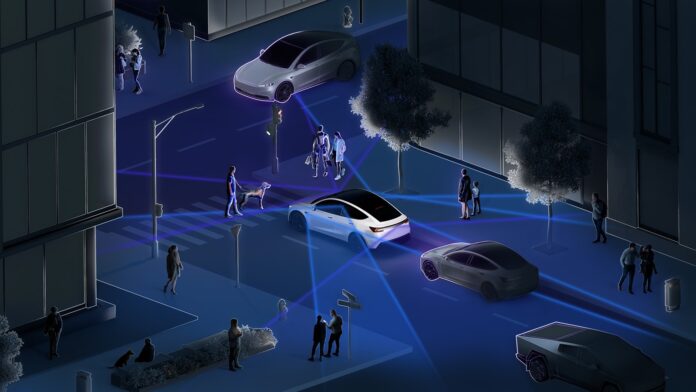

Tesla’s latest Full Self-Driving (Supervised) safety report puts cars with FSD engaged at about 6 million miles between major collisions, roughly nine times the U.S. average and about three times a manually driven Tesla with active safety features turned on.
The numbers landed on Tesla’s FSD Vehicle Safety Report page and were picked up overnight by Sawyer Merritt, who posted the table that Tesla watchers have been refreshing for months. Fleet FSD mileage on the same page now sits at 16.7 billion miles.
Miles per major collision, North America, all road classes, rolling twelve months:
- Teslas with FSD (Supervised) engaged: 6,006,200
- Teslas driven manually with active safety features: 2,031,221
- Teslas driven manually with no active safety features: 845,915
- U.S. average: 660,164
That first number is the one that matters for anyone who still treats FSD as a novelty. Against the U.S. average it’s about 9.1×. Against a modern Tesla driven by hand with Autopilot’s active safety stack still on, it’s about 3×. The gap to a pre-2014 Tesla without those systems is wider still.
What Tesla means by “major”
Tesla defines a major collision the way federal crash-recording rules do: an event that deploys a non-reversible restraint (airbags and similar) or hits a Delta-V threshold of 8 km/h (about 5 mph) inside 150 milliseconds. If FSD was on at any point in the five seconds before impact, the collision counts as FSD-engaged. Tesla does not assign fault in the report; every hit that meets the threshold goes in the bucket.
Sawyer’s longer post also listed the raw counts behind the rates: 1,579 major collisions over 9.48 billion FSD miles in the window, versus 17,775 major collisions over 36.1 billion manual-with-active-safety miles. The U.S. average denominator is built from FHWA vehicle-miles traveled and NHTSA’s Crash Investigation Sampling System, which Tesla argues lines up closest with its “major” definition because CISS focuses on tow-away crashes.
The same report page now shows the fleet logging FSD miles at a blistering pace. Sawyer separately noted the on-site tracker moved from about 16 billion to 16.7 billion miles, which works out to roughly 50 million FSD miles a day, or about 1,000 miles every 1.8 seconds.
Still supervised, still not Japan
None of this makes FSD a robotaxi. Tesla’s own wording is unchanged: FSD (Supervised) is an advanced driver-assistance system that needs a fully attentive driver ready to take over. The safety page lists markets where it’s already approved, including the U.S., Canada, Mexico, Australia, New Zealand, South Korea and a growing EU list that now includes Latvia as the tenth. Japan is not on that list.
The timing still helps the Robotaxi story. A day after Tesla drew a Starship-shaped 254-square-mile unsupervised zone across Houston, the company put fresh supervised safety math under the same software stack. Regulators reading the SGO crash counts without the miles underneath them will keep getting the wrong picture; Tesla says as much in the methodology section. The miles-per-collision table is the cleaner comparison.
Sources: Tesla FSD Vehicle Safety Report, Sawyer Merritt on X (fleet miles update), Learn My EV, BaseNor. Not a Tesla App and Drive Tesla Canada had not published dedicated pieces on this refresh at press time; Tesla’s own report is the primary source.
— The EVX News team
Featured image: Tesla Full Self-Driving (Supervised) Vehicle Safety Report social graphic. Image: Tesla.

 safety report shows 6,006,200 miles per major collision, about 9x the U.S. average, as fleet FSD miles reach 16.7 billion.)