
The FCC just voted to put a lot more airwaves on the table for satellite-to-phone service. At its October open meeting on Thursday, Oct. 29 in Washington, the commission adopted a proposal that would open an additional 482 MHz of licensed spectrum to direct-to-device service, the kind SpaceX sells as Starlink Mobile.
The FCC posted the result on X at 11:18 AM ET / 8:18 AM PT on Thursday (12:18 AM JST Friday, Oct. 30). It’s a proposal, not a final rule. Nobody got spectrum on Thursday. But it’s the biggest rewrite yet of the framework the FCC calls Supplemental Coverage from Space, and the timing lines up nicely with SpaceX’s own shopping spree.
What the FCC actually voted on
The Notice of Proposed Rulemaking would grow the number of bands eligible for satellite-to-phone coverage from five to 13, according to the FCC’s meeting summary and Teslarati. The FCC says it would also “eliminate burdensome” requirements and line up the satellite-to-phone rules with its older Mobile Satellite Service rules. Chairman Brendan Carr and Commissioners Anna Gomez and Olivia Trusty voted to adopt it, Drive Tesla reports.
The structural change may matter more than the megahertz. Today a satellite operator has to lease spectrum from every carrier holding the same airwaves across an entire region, which can mean the whole continental US. Under the proposal, an operator could instead certify that it has coexistence agreements with those carriers, or that it holds the ground license itself, and pick a license area covering only the places it actually serves, TeslaNorth explains.
A companion item proposes auctioning 25 MHz in the 1675–1695 MHz and 2020–2025 MHz bands, which could be used for land-based service, direct-to-device or both.
The carriers’ objection
AT&T, Verizon and T-Mobile didn’t love this one. Through their trade group CTIA, they asked the FCC in an Oct. 22 filing to drop the 2.5 GHz and 3.45 GHz bands, which make up 290 MHz of the 482 MHz in play, and argued that satellite signals could interfere with 5G service. CTIA also opposed swapping lease requirements for coexistence agreements. SpaceX pushed the other way and asked to add the 902–928 MHz band, per Teslarati.
The FCC hadn’t published the adopted text as of Friday morning in Japan, so it isn’t clear yet whether those two bands survived. Comments would be due 60 days after the notice appears in the Federal Register, and then the commission has to vote again on final rules. No date for that yet.
SpaceX has been building its own path
SpaceX hasn’t waited around for leases. This year it agreed to buy EchoStar’s AWS-4 and H-block licenses in a deal worth roughly $17 billion, and earlier this month agreed to acquire Grain Management’s nationwide 800 MHz portfolio, Teslarati notes. The FCC cleared its plan for up to 15,000 next-generation direct-to-cell satellites on Oct. 6 and approved its purchase of unused AWS-3 licenses from Tristar on Oct. 21. SpaceX President Gwynne Shotwell has said service on SpaceX’s own airwaves is targeted for early 2028. That’s the second path in the new rules, more or less.
Japan is already living in the future the FCC is writing rules for. Here, docomo Starlink Direct passed 10 million users in a little over five months, free on every Docomo plan. In the US the carriers are fighting over the same satellites they also partner with. T-Mobile is still Starlink Mobile’s US launch partner, even while leading the push to keep satellites out of 2.5 GHz. Awkward dinner table.
Sources: FCC October 2026 Open Meeting, Federal Register meeting notice, FCC on X, Drive Tesla, Teslarati, TeslaNorth, SatNews, Sawyer Merritt on X.
— The EVX News team
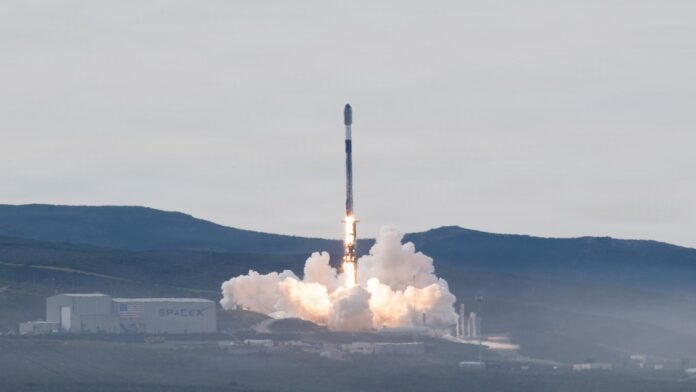
Featured image: A Falcon 9 rocket launches the Starlink 17-20 mission from Vandenberg Space Force Base, California, Jan. 25, 2026. Photo: U.S. Space Force / 2nd Lt. Andrew Taller via Wikimedia Commons (public domain, cropped).

