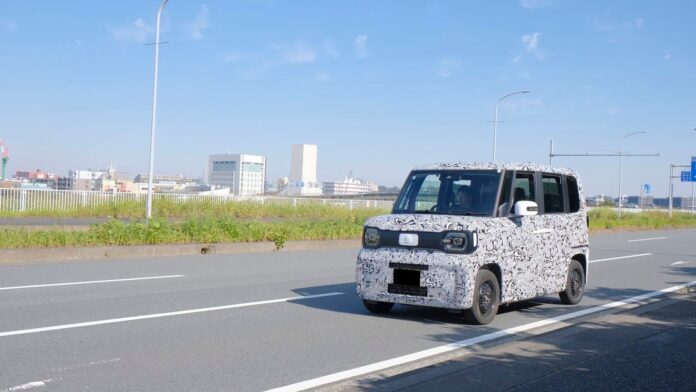

A new kei EV brand is already driving around Japan in camouflage. EMT, the Yokohama company behind the EMTA brand, said on Friday, Nov. 20, that a prototype of its first model, a kei-class electric minicar due in 2027, has been running on Japanese public roads since October. The car makes its world debut at the Tokyo Auto Salon at Makuhari Messe, which runs Jan. 15 to 17, 2027.
The interesting part is what EMT says it’s testing. Not range, not top speed, not crash structure. According to the company’s release, the road program is a “usability evaluation”: how easy the car is to operate while driving (controls, accessibility and connectivity) and how easy the information on its screens is to see and understand. Development staff drive the prototype through everyday routines in real traffic, the school run and grocery trip kind of driving, and feed what they find back into the design. Car Watch reports the testing is run out of the EMT R&D Center, which opened in Yokohama’s Kohoku Ward in July.
The press photo shows a tall, boxy kei in swirly black-and-white wrap, the shape Japanese buyers know from the Suzuki Spacia and Honda N-BOX school of minicar design. EMT hasn’t released a name, specs or a price. Those come at the Auto Salon press conference, the Nikkei reported earlier this month.
Who is EMT, exactly?
EMT was set up on Jan. 30, 2025, and is headquartered in Yokohama’s Minato Mirai district. Its parent is a Singapore-registered joint venture of five companies, three Chinese and two Japanese: automaker Chery, Jiangsu Yueda Automobile Group, battery maker Gotion High-Tech, car-accessory chain Autobacs Seven and painting-equipment maker Anest Iwata. Caixin and Autohome both named the same five when the brand launched in May. Autohome put the stakes at 27.27% each for Chery and Yueda, 18.18% each for Autobacs and Gotion, and 9.09% for Anest Iwata, and Autocar Japan reported the same split.
The first car will be built in China and imported, according to Caixin and the Nikkei. Autocar Japan reported that it uses Chery’s electric-drive technology and a Gotion battery. Chery, for its part, describes itself as one shareholder among several that isn’t involved in running EMT day to day, Autohome reported. The engineering leadership is notably Japanese. Chief technology officer Koji Yamamoto spent about 30 years at Nissan and was program director on the first Leaf, Autocar Japan reported after a briefing in August. At that session EMT said the kei EV sits on a new platform with an e-axle and a large underfloor battery, gets full over-the-air updates with its cloud servers based in Japan, and will sync settings like seat position, mirrors and climate with the owner’s phone. An end-to-end Level 2 driver-assist system is in development, but EMT called that a future plan.
The kei is the first of four models planned by 2029. Autocar Japan says the other three look like a compact hatchback, a small crossover and a minivan, and that EMT hasn’t ruled out building those in Japan later.
A crowded little segment
Kei cars make up about a third of Japan’s new-car sales, and the electric end of that market got busy fast this year. BYD launched its Racco kei EV in July, and Suzuki put its first kei EV, the e SKY, on sale this week from ¥2.12 million (about $13,300) with 310 km of WLTC range. They join the Nissan Sakura, Mitsubishi eK X EV and Honda N-ONE e:. EMTA will be the second Chinese-linked entry, arriving with a Japanese badge, a Japanese R&D team and, maybe most important, a Japanese retail partner. Autobacs runs one of the country’s biggest car-accessory and service chains.
The EVX Take
Testing usability before anything else is a smart read of who buys kei EVs in Japan: older drivers, parents doing short daily loops, rural households using it as the second car. They’ll forgive 180 km of range. They won’t forgive a confusing touchscreen. The bigger question is money. In the national CEV subsidy list, BYD’s Racco gets ¥150,000 (about $940) while Japanese kei EVs get ¥568,000 to ¥580,000, which is why the Racco’s price advantage disappears after the grant, as we found when we compared the five kei EVs. The subsidy is also set to shrink from January. How an EMTA kei scores on that list, and whether an Autobacs service network helps it, may matter more than anything on the spec sheet when the price finally shows up.
Sources: EMT press release (Nov. 20, 2026, Japanese), Car Watch (Japanese), Nikkei (Japanese), Autocar Japan and Autocar Japan R&D briefing (Japanese), Caixin (Chinese), Autohome (Chinese), EMTA. Featured image: a camouflaged EMTA kei EV prototype on a public road in Japan. Image: EMT Co., Ltd. press release (cropped).

