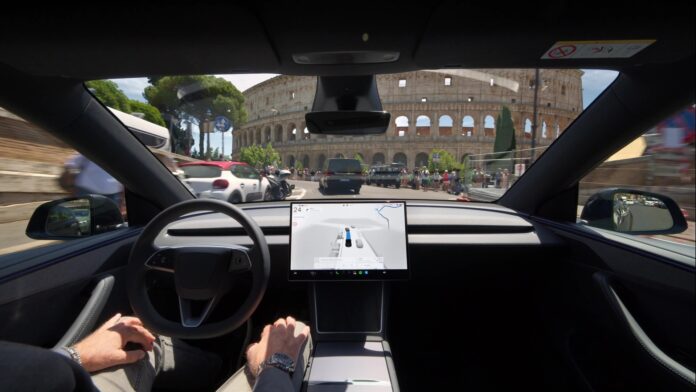

Italy has approved Tesla Assisted Driving, the supervised system the rest of the world knows as FSD (Supervised), and it’s the first of the European Union’s big four countries to do it. Tesla Europe announced the news at 5:21 a.m. ET / 2:21 a.m. PT on Friday, Nov. 20 (7:21 p.m. JST Friday) with a 31-second video shot around Rome and a caption that needs no data plan to understand: “Mamma, butta la pasta. Now approved in Italy. Rollout begins soon.”
“Mom, put the pasta on” is what Italians shout when they’re about to walk through the door. It’s a good line for a driver-assistance launch, and the video backs it up: a Model 3 rolling past the Colosseum with the driver’s hands resting in his lap and the car’s screen showing the planned route.
Italy makes it 12 EU countries. The Netherlands went first on April 10, when the Dutch vehicle authority RDW granted a provisional type approval. Lithuania, Estonia, Denmark, Belgium, Slovenia, Czechia, Croatia, Slovakia and Latvia recognized it over the following months, and Finland made it 11 just nine days ago. Italy took the same route, recognizing the Dutch approval instead of starting its own from scratch, Europa Press reported.
What Italian owners get, and what it costs
Not a date, yet. Tesla says the rollout begins “soon” through an over-the-air update and hasn’t said which cars get it first. Quattroruote notes that Tesla hasn’t officially listed the eligible models or hardware versions for Italy. In the markets that already have it, the European build runs on Hardware 4 cars.
The price is €99 a month (about $109), according to Quattroruote and Il Mattino. That works out to €1,188 a year (about $1,300) for anyone who keeps it switched on. Il Mattino says it’ll be offered as a subscription or as an option package on new Model 3 and Model Y orders.
The system itself is the same supervised Level 2 setup Europe has been getting since spring. It steers, brakes, changes lanes and handles intersections, roundabouts and traffic lights on city streets and highways while the driver watches the road and stays legally responsible the whole time. Europe’s version is a little stricter than North America’s. The RDW capped the speed offset at 10% over the limit earlier this month, down from 50%, and on Nov. 16 it approved an update for Hardware 4 cars that adds earlier attention warnings and requires hands on the wheel above 130 km/h (about 81 mph), as TeslaNorth and Not a Tesla App have reported.
Tesla told Italian media it spent more than two years on the approval, with thousands of pages of documentation and road testing. According to figures in Il Mattino, the European fleet has logged more than 200 million km (about 124 million miles) on the system since the Dutch debut, and more than 22,000 people have tried it from the passenger seat in demo rides across the EU. Italy got some of those too, with ride-alongs at Tesla’s Milan Linate location, TeslaNorth reports.
The math that actually matters
Country-by-country approvals are nice for the people who live there. The real prize is an EU-wide approval, which needs a qualified majority in the European Commission’s Technical Committee on Motor Vehicles: at least 15 of the 27 member states, representing at least 65% of the EU’s population.
That second number is why Italy matters more than the last 11 put together, almost. With 58.9 million people, Italy is about 13% of the EU’s 452 million on its own, per Eurostat’s latest count. Before Friday, the 11 approving countries added up to about 70 million, or 15%. Now the 12 come to just under 30%. Add Germany, whose transport ministry has signaled support, and the group reaches about 47%. Even France on top of that wouldn’t quite clear 65%. It would take France plus Spain, or Spain plus Poland.
The committee vote has slipped before. It was originally expected on Oct. 6, and Drive Tesla Canada has reported December at the earliest. Finland’s regulator Traficom has said it expects a final EU decision during the coming winter, with “further changes” to keep drivers alert before then.
The EVX Take
Italy is the first approval in Europe that changes the vote count in a real way, and it lands on the back of a stricter, hands-on-at-highway-speed version of the software, which is the version Brussels will actually be voting on. For Japan the lesson is about process, not geography. There’s no Dutch approval to borrow here; the transport ministry (MLIT) has to sign off on its own, and Tesla Japan president Richi Hashimoto has said he’s pushing to get FSD (Supervised) to Japanese owners in 2026, with about six weeks left on that clock. Europe’s concessions (a new name, a 10% speed cap, hands on the wheel above 130 km/h) look like a ready-made template for that conversation. Japan’s Model 3 and Model Y come from Giga Shanghai, and current builds already carry Hardware 4, so the car isn’t the holdup. The paperwork is.
Sources: Tesla Europe on X, Quattroruote (Italian), Il Mattino (Italian), Europa Press (Spanish), TeslaNorth, Not a Tesla App, Drive Tesla Canada, Traficom, Eurostat population data. Featured image: a Tesla Model 3 on Tesla Assisted Driving passing the Colosseum in Rome, still from Tesla Europe’s Nov. 20 video. Image: Tesla Europe (@teslaeurope) on X.

 on Nov. 20, the 12th EU country and the first of the big four. Rollout soon at €99 a month.)