
China put a record 99.4 GWh of batteries into new vehicles in October, and almost nine in ten of those gigawatt-hours were lithium iron phosphate. Data from the China Automotive Battery Innovation Alliance (CABIA), released Thursday, shows installations up 18.2% from a year earlier and 14.0% from September, beating the previous monthly high of 98.1 GWh set in December 2025.
The chemistry split is the headline inside the headline. LFP installations hit 86.3 GWh, up 27.8% year on year, for an 86.9% share, a record. Ternary (nickel-based) batteries came to 12.8 GWh, down 22.8% from a year earlier, and their 12.9% share is the lowest on record, according to CnEVPost’s tally of the CABIA figures. The same monthly numbers appear in reports from National Business Daily (每日经济新闻), Jiemian (界面新闻) and Sina Finance.
For the first ten months, China installed 675.6 GWh, up 16.9%. LFP accounted for 563.5 GWh of that, or 83.4%. Ternary cells grew just 2.7% to 110.6 GWh.
Storage is growing even faster
Car batteries are only part of the picture. China’s combined output of power and energy-storage batteries reached 245.1 GWh in October, up 43.6%. Sales of the two together were 230.4 GWh, up 38.8%: 159.3 GWh of power batteries and 71.1 GWh of storage batteries. That storage figure is up 70.5% from a year earlier, so grid batteries now make up almost a third of what China’s cell makers sell in a month.
Exports set a record too. China shipped 46.1 GWh of power and storage batteries abroad in October, up 63.4%, or 20% of the month’s sales. Power batteries made up 29.0 GWh of that and storage batteries 17.1 GWh, the latter nearly doubling (up 94.4%). Year to date, exports total 349.0 GWh, up 53.0%.
Those exports also show up in cars sold outside China. As we reported earlier this month, Chinese makers now supply more than half of the EV batteries installed outside China, with CATL and BYD alone at 44.5%.
Who made them
CnEVPost’s breakdown of the same CABIA release puts CATL first at 39.60 GWh, or 40.00% of October installations, down 0.93 points from September, with BYD second at 21.14 GWh (21.36%) and CALB third at 8.55 GWh (8.64%). By that count the CATL-BYD gap narrowed for a fifth straight month. We haven’t yet seen the company ranking confirmed by three separate Chinese outlets, so treat those maker shares as preliminary. The overall totals above are confirmed.
CATL has also been busy outside the cell business. This week BAIC said it would sell its 112 battery-swap stations and move to CATL’s Choco-Swap network, another sign the biggest cell maker wants a hand in how batteries get used, not just made.
The EVX Take
An 86.9% LFP share is a problem for Japan’s battery strategy, which was built around nickel-rich chemistries. Panasonic’s cells, the ones Tesla made famous, are ternary (NCA and NCM), and ternary is the shrinking slice in the world’s biggest EV market. Toyota saw this coming. Its battery roadmap includes a lower-cost “popularization” LFP battery with a bipolar structure, aimed at practical use in 2026–2027, but China is already installing more than 86 GWh of LFP a month. The storage numbers matter here too. Japan needs grid batteries to absorb more solar, and a 70% jump in Chinese storage-battery sales, with exports nearly doubling, means Japanese utilities and installers will keep weighing cheap Chinese LFP against domestic supply. Our read: Japan’s makers won’t win a price war on LFP, so their best bets are the next technologies, solid-state and better-performing LFP, delivered on time.
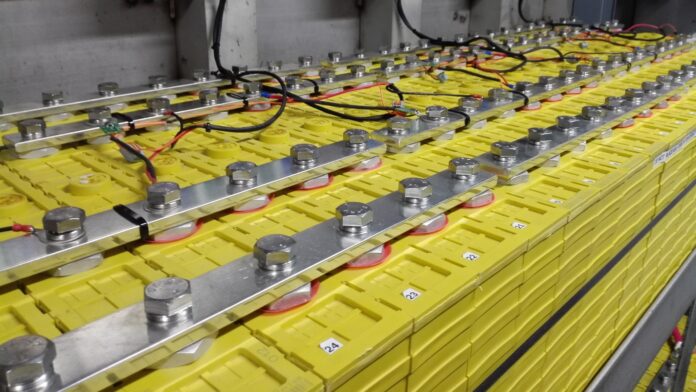
Sources: China Automotive Battery Innovation Alliance (CABIA) October 2026 data as reported by CnEVPost, National Business Daily, Jiemian and Sina Finance; company shares from CnEVPost; Toyota battery technology roadmap. Featured image: LiFePO4 battery cells wired in series and parallel with busbars, photo by Yo-Co-Man / Wikimedia Commons (CC BY-SA 4.0), cropped.

