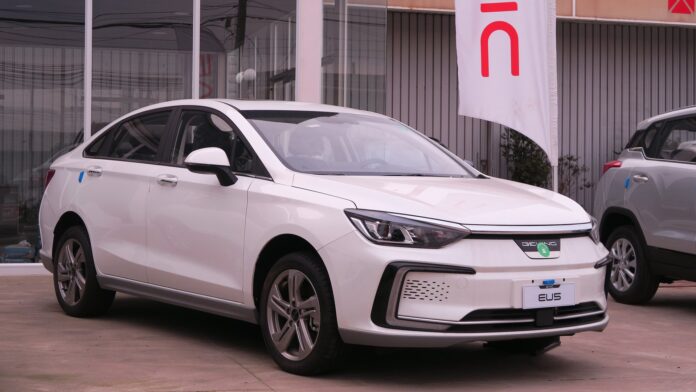

BAIC, one of the first Chinese automakers to bet on battery swapping, is selling its swap stations. BAIC Motor said in a Hong Kong stock exchange filing on Tuesday, Nov. 17 that its wholly owned unit BAIC Powertrain plans to auction the assets tied to 112 battery-swap stations through the China Beijing Equity Exchange, with a floor price of about 277.9 million yuan (about $41 million).
The package covers everything that keeps the stations running: inventory, fixed assets, construction in progress and intangible assets. The price is based on a Sept. 30 appraisal using the cost method, about 1.54% above the assets’ unaudited book value of 273.69 million yuan (about $40.8 million). BAIC Powertrain plans to file the listing notice with the exchange by the end of November. As a state-controlled company, BAIC Motor has to sell through a public equity exchange, so the final price will be whatever the winning bid is. No buyer has been identified and no agreement has been signed, the filing says.
Don’t expect the money to move BAIC’s results. If the sale closes at the appraised value this year, BAIC Motor expects it to add about 3.52 million yuan (about $525,000) to 2026 profit after costs. The stated reason is to focus on the core business and free up capital tied up in “non-core assets.” There’s a small irony in the paperwork, too. BAIC Powertrain’s main business, per the filing, is engines and transmissions.
From 3,000 stations to 112
What makes this interesting is who’s selling. BAIC started researching battery swapping in 2011, according to BAIC Group chairman Zhang Jianyong, and from 2016 used taxis as its first commercial market, running swap operations in 19 cities. Beijing now has about 57,000 BAIC electric taxis on the road, the group says.
In November 2017, BAIC’s EV unit announced a plan to invest 10 billion yuan (about $1.5 billion) to build 3,000 solar-and-storage swap stations and put 500,000 swap-capable vehicles on the road by 2022, as China News Service and 21st Century Business Herald reported at the time. It never got close. The 112 stations now up for sale are most of what BAIC actually built, and they were designed around BAIC’s own battery standard, mostly for taxis and ride-hailing cars.
Handing the keys to CATL
The sale isn’t BAIC giving up on swapping. It’s BAIC giving the hard part to a battery maker. On Oct. 22, BAIC Group signed a deeper battery-swap agreement with CATL, under which compatible models from several BAIC brands will plug into CATL’s Choco-Swap network and BAIC will open its dealer sites for new stations. The two say they want to build China’s first swap ecosystem serving about 1 million vehicles, though they haven’t put a date on that.
The first cars are already here. On Nov. 13, BAIC’s Arcfox brand launched a swap version of the Beta T1 and a lidar-equipped swap version of the Beta S3, both using CATL’s Choco batteries. BAIC says the Beta T1 swap version starts at 52,000 yuan (about $7,760), swaps its battery in 99 seconds and has 530 km of range, and that 7 in 10 Beta S3 buyers have picked the swap version.
Zhang was blunt about the logic. For an automaker, swap stations are a heavy-asset, high-maintenance business, he said at the launch, while a big battery company gets natural economies of scale from building and running them. CATL also wants the stations. It plans to reach more than 3,000 Choco-Swap stations by the end of this year and 6,000 in 2027, covering 297 Chinese cities with 5,000 urban stations and 1,000 along highways, as Yicai and The Paper reported. Nio, the best-known swap operator, had 4,254 stations in China as of Nov. 13, including 1,081 on highways, according to Nio Power’s live data cited by CnEVPost. At CATL’s pace, the battery maker could pass the automaker that made swapping famous.
BAIC has been busy elsewhere, too. Last week it launched the boxy Xingtan 5X with Huawei driver assistance. And CATL’s reach keeps growing well beyond swapping: together with BYD, it now makes 44.5% of the EV batteries installed outside China in the first nine months of the year.
The EVX Take
BAIC is admitting what Tesla figured out years ago when it dropped its own swap station in 2015 and went all in on Superchargers: refueling infrastructure is a business of its own, and an automaker that half-builds it ends up with stranded assets. The difference in China is that a battery giant is willing to carry the network for everyone. Japan has seen a smaller version of the same idea. Gachaco, the motorcycle battery-swap company backed by ENEOS, Honda, Kawasaki, Suzuki and Yamaha, shares one battery standard across rival brands, and most of Japan’s public fast chargers are run by e-Mobility Power rather than by individual carmakers. But nobody in Japan is building a cross-brand swap network for cars, and Japanese automakers don’t have a CATL-sized partner at home willing to fund one. If Choco-Swap reaches 6,000 stations, it becomes a feature that Chinese EVs sold in China have and Japanese cars there don’t, and that’s another gap Toyota, Honda and Nissan will have to answer for in the world’s largest EV market.
Sources: BAIC Motor filing to the Hong Kong stock exchange (Nov. 17, 2026); BAIC Group announcements (Oct. 22 and Nov. 2026); CnEVPost; Yicai; The Paper; China News Service; 21st Century Business Herald. Featured image: a white BAIC EU5 Plus electric sedan. Photo: RL GNZLZ / Wikimedia Commons (CC BY-SA 4.0), cropped.

 as its parent moves cars onto CATL's Choco-Swap network.)