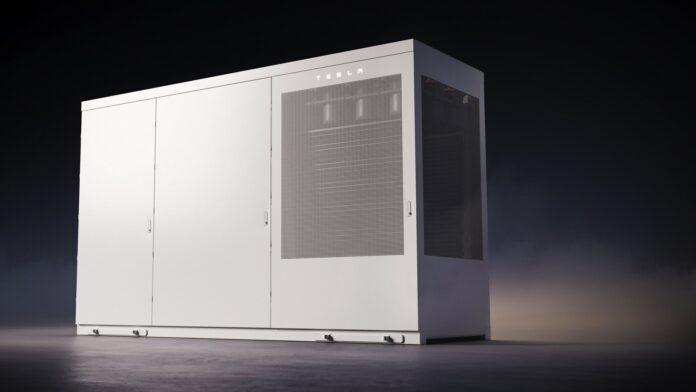


Tesla has built its own transformer. The company unveiled Powercore on Tuesday, a solid-state medium-voltage unit that rolls a transformer, an inverter and a circuit breaker into one enclosure, rated at 7.4 MW (9 MVA) continuously at 34.5 kV AC with grid-forming support for 10 MVA of peak power. It will be made in the US, and Tesla says the first units will be operating in 2027.
The announcement dropped from the Tesla Megapack account at 11:00 a.m. ET / 8:00 a.m. PT (1:00 a.m. JST Wednesday, Nov. 18), timed for the RE+ energy show in Las Vegas, where Tesla’s energy team has a booth this week. Elon Musk quoted it about 45 minutes later with a one-liner: “Advanced solid state transformers at scale from Tesla.”
What’s inside the white box
About an hour after the teaser, Tesla posted a full spec sheet and explainer, and it is not shy. Tesla calls the conventional medium-voltage transformer “100-year old” and “made-to-order,” and calls Powercore “the world’s most advanced medium-voltage power electronics platform.” The numbers behind the brag:
- Up to 9 MVA (7.4 MW) continuous at 34.5 kV AC, 10 MVA peak for grid-forming
- Nominal AC from 10 kV to 34.5 kV, nominal DC from 800 V to 2,000 V
- Peak efficiency of 98.86%
- Warranty of up to 25 years, system availability guarantees of 99.9% and up
- Operating range from −40°C to 55°C
There’s no flammable oil, which anyone who has seen a substation transformer fire on the evening news will appreciate. The built-in solid-state breaker clears faults up to 1,000 times faster than a conventional breaker, and the unit is modular, so a technician can swap parts in the field instead of hauling the whole thing away. AJ Booth, Tesla’s head of energy and charging, told pv magazine USA that the breaker can interrupt a fault in 100 microseconds. “We’ve done 3 terawatts of power converters at Tesla,” he said. “We build all of our power converters in-house.”
Pricing, customers and a factory location? Not yet.
One box, three jobs
For Megapack sites, Powercore cuts out a step. Today the inverters inside a Megapack turn battery DC into 480 V AC, then a separate transformer lifts it to medium voltage. Powercore goes straight from battery DC to medium-voltage AC, close-coupled to the batteries, and Tesla says the old two-stage setup had twice the losses. Paired with Tesla’s Powerhub software, the whole battery site becomes Tesla gear with no third-party equipment. This has been coming for a while. As Not a Tesla App points out, Tesla said it would make its own transformers back when it introduced Megapack 3 and Megablock in September 2025.
For data centers, the pitch is a single conversion from the medium-voltage feeder straight to 800 V DC for the racks, the architecture the AI crowd is moving to. Tesla says it’s working with Nvidia on 800 V DC designs, and Megapack is already qualified under Nvidia’s DSX Ready program. Tesla also says it has 10 GWh of Megapack running at data centers today. Booth’s line to pv magazine was the boldest of the day. He said a data center with Powercore and Megapack can make the local grid more stable than if the data center weren’t there at all.
For solar farms, it works as a central inverter for today’s 1,500 V DC arrays and the 2,000 V DC systems coming next. Tesla even did the off-grid math for us. In many parts of the world, it says, a 100 MW data center can run on 500 MW of solar and 1.7 GWh of batteries, all on 800 V DC. Add the company’s pledge to build 100 GW a year of US solar manufacturing, and the shopping list comes into focus. Panels, batteries, and now the box in the middle.
The EVX Take
The transformer is the most boring bottleneck in tech, which is exactly why this matters. In Japan the wait is already measured in years. Hitachi’s energy chief Andreas Schierenbeck told Nikkei in July that lead times on some new orders have stretched to three to four years, while grid operator OCCTO’s January demand outlook adds 6.61 GW of new data-center peak load by fiscal 2035. Powercore’s 10 to 34.5 kV range spans the 22 kV and 33 kV lines that Japanese utilities use to feed big customers, but Tesla hasn’t said anything about Japan, local certification or pricing, so treat it as a 2027-and-beyond option at best. Still, Tesla Energy is already selling into Asia’s AI power crunch (see Taiwan’s 1 GWh Megapack order), and a mass-produced transformer from a carmaker is a direct challenge to the made-to-order business that Hitachi, Mitsubishi Electric and Toshiba know so well.
Lester’s take
When I heard “Tesla Transformer,” I’ll admit I pictured a Cybertruck folding into a robot. Instead we got a big white box with no oil and a breaker that reacts in 100 microseconds, which is about 100,000 times faster than I react to an FSD release note. Honestly, I’m thrilled. Tesla is going after the most boring part of the grid with the same make-it-in-huge-volumes playbook it used on Model Y and Megapack, and Japan’s grid is waiting years for transformers right now. My only request: if Powercore ever ships to Japan before FSD does, I want it parked next to my Model Y so I can at least feel like something Tesla made is running at full power here.
Sources: Tesla Megapack on X and Tesla’s Powercore article on X, Elon Musk on X, Not a Tesla App, Drive Tesla Canada, pv magazine USA, Nikkei, OCCTO. Featured image: Powercore, image by Tesla (cropped).