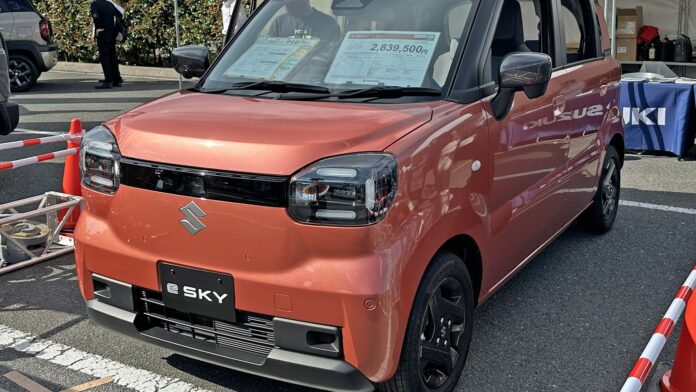

Japan’s biggest kei car maker finally sells a kei EV of its own. Suzuki’s e SKY went on sale on Monday, Nov. 16, priced from ¥2,120,000 (about $13,300) with 310 km (193 miles) of WLTC range, which beats every kei EV from the Japanese brands on paper. After the national CEV subsidy of ¥568,000 (about $3,560), the cheapest version works out to about ¥1,552,000 (about $9,740), the lowest of any kei EV now on the subsidy list.
The catch is the calendar. That ¥568,000 applies to cars registered by Dec. 31, and the subsidy money itself may run out before then.
What you get for the money
Every e SKY uses the same front-wheel-drive powertrain and a 26 kWh lithium iron phosphate (LFP) battery, so the three trims differ only in equipment. According to Suzuki’s release, prices including 10% consumption tax are:
- A (built to order): ¥2,120,000 (about $13,300)
- G: ¥2,390,000 (about $15,000)
- X: ¥2,790,000 (about $17,500)
Suzuki rates the car at 97 Wh/km on the WLTC cycle, which it calls the best efficiency in the kei EV class, and gives it a 4.4-meter turning circle, tight even by kei standards. The battery sits flat under the floor on a dedicated EV platform Suzuki calls HEARTECT-e, and the motor, inverter and reduction gear are packed into one oil-cooled eAxle. It’s also Suzuki’s first car in Japan with a 10.1-inch display audio screen and connected navigation that suggests charging stops based on the battery level.
One trap for bargain hunters. The ¥2.12 million A grade can’t use DC fast charging, according to a comparison by the charging-app maker EV Smart. The G and X take up to 50 kW and need about 25 minutes to reach 80%. On a 6 kW home charger a full charge takes about 4.5 hours. So the cheapest e SKY is really a car for people who can plug in at home every night.
The styling borrows from the 1955 Suzulight, Suzuki’s first kei car, and the LED lamps use a digital-number-style graphic front and rear. Suzuki first showed the design as the Vision e-Sky concept at the Japan Mobility Show in 2025. Its monthly sales target is 1,000 cars, Response reported when prices were announced on Oct. 6.
How it stacks up
The kei EV field had split into two groups: cheap city cars with 180 km of range, and newer models closer to 300 km. The e SKY lands at the top of the second group. Here is how the national subsidy and WLTC range compare across the five kei EVs that qualify, using the Next Generation Vehicle Promotion Center’s figures as compiled by EV Smart:
- Nissan Sakura: 180 km, from ¥2,448,600 (about $15,360), subsidy ¥580,000 (about $3,640)
- Mitsubishi eK X EV: 180 km, subsidy ¥574,000 (about $3,600)
- Honda N-ONE e:: 295 km, from ¥2,699,400 (about $16,930), subsidy ¥580,000
- BYD Racco: up to 320 km (300 Premium), from ¥2,145,000 (about $13,460), subsidy ¥150,000 (about $940)
- Suzuki e SKY: 310 km, from ¥2,120,000, subsidy ¥568,000
BYD’s Racco still claims the longest range, but its much smaller grant flips the math. After subsidy, the e SKY A is roughly ¥440,000 (about $2,760) cheaper than the base Racco. Against the Sakura, which defined this segment, the Suzuki offers 130 km more range for less money up front.
Timing matters just as much. Japan’s trade ministry has said CEV applications should close sometime between early and late December, first come, first served. For kei cars registered from Jan. 1, 2027, the grant also shrinks. The revised table puts the e SKY at ¥450,000 (about $2,820), down ¥118,000 (about $740). As we explained in our Japan EV sales report, the subsidy follows the registration date, not the order date. With the car launching in mid-November and dealers already warning of long waits, plenty of December orders won’t make it.
Kei EVs could use the help. Japan sold 16,262 of them from January through October, about one in seven of the country’s 111,876 EVs. In October they dipped 2.0% from a year earlier, as the launch bump from Honda’s N-ONE e: faded, while larger registered EVs more than tripled.
The EVX Take
Suzuki is the name that matters in this segment. It sells more kei cars than almost anyone, through dealers in towns where nobody has ever seen a Tesla store, and its buyers care about price per kilometer more than 0-100 times. A Suzuki-badged EV that costs about ¥1.55 million after subsidy and goes 310 km is exactly the kind of car that could move EVs beyond early adopters in rural Japan, where kei cars are the family’s second car and a 6 kW home charger is easy to fit. The weak spot is timing. Launching six weeks before the subsidy shrinks, with the budget likely to run out first, means the e SKY’s real test comes in early 2027, at ¥450,000 instead of ¥568,000. If it holds near its 1,000-a-month target then, kei EVs have turned a corner. For Tesla Japan, which sells nothing near this price, it’s a reminder that the biggest EV fight in Japan is happening at the cheap end of the market.
Sources: Suzuki release and e SKY product page; Next Generation Vehicle Promotion Center subsidy notice; EV Smart; Response. Featured image: a Suzuki e SKY X on display in Japan. Photo: Tokumeigakarinoaoshima via Wikimedia Commons, CC0 (cropped).

 with 310 km of range. How it compares with the Sakura, N-ONE e: and Racco.)