
Finland just became the 11th EU country to let Tesla owners use the company’s supervised driver-assistance system, the one the rest of the world still knows as FSD (Supervised) and Europe now calls Tesla Assisted Driving. Finland’s transport agency, Traficom, said on Wednesday that it had recognized the Dutch provisional type approval on Tuesday, Nov. 10, and that Tesla “can immediately start offering the system to its customers in Finland.” Tesla Europe followed with a short post on X at 1:18 a.m. ET on Wednesday, Nov. 11 / 10:18 p.m. PT on Tuesday, Nov. 10 (3:18 p.m. JST Wednesday): “Rollout begins soon.”
Elon Musk reposted the news at 12:11 p.m. ET / 9:11 a.m. PT on Wednesday (2:11 a.m. JST Thursday, Nov. 12) with a simpler line: “Tesla self-driving now approved in Finland.” Regulators would pick different words. That’s sort of the whole story.
Why Finland didn’t wait for Brussels
According to Traficom’s release, two things pushed it to move ahead of the EU-wide decision. The first is the set of changes Tesla has already made, which the Dutch regulator RDW signed off on earlier this month. Drivers can no longer set the system to keep running at up to 50% over the speed limit, any speeding offset resets to zero every time the car restarts, and the on-screen information about speed settings is clearer. The name change counts too. “The name change helps users and the market understand the true nature of the system,” Traficom senior specialist Jukka Juhola said, adding that genuinely self-driving cars, where responsibility shifts away from the driver, will eventually exist alongside systems like this one. The new name is already in Tesla’s Finnish- and Swedish-language marketing and owner guidance.
The second reason is weather. Traficom wants Finnish owners to learn the system before the hardest part of winter arrives. Juhola said winter conditions were part of the assessment, but warned the system “may be subject to various limitations if the cameras become covered in snow, slush or other dirt.” He was blunt about who’s in charge, too: “It is always the driver who receives the fine for speeding.”
Most owners won’t need a trip to an inspection station. Traficom says a modification inspection is only needed if the car has been altered in ways that affect the system, with unusual tire sizes and lowered suspension as its examples. Not a Tesla App expects Finland to get Tesla’s European build of FSD v14 on Hardware 4 cars, like the other approved markets.
Eleven down, and the math that matters
Finland joins the Netherlands, Lithuania, Estonia, Denmark, Belgium, Slovenia, Czechia, Croatia, Slovakia and Latvia, which made it 10 late last month. Every one of them got there the same way, by recognizing the approval the RDW first granted on April 10. Finland had been weighing it since at least June, when Traficom said it was still assessing the system in Finnish conditions.
The bigger prize is an EU-wide approval, which needs a qualified-majority vote in the European Commission’s Technical Committee on Motor Vehicles (TCMV). Drive Tesla Canada reports the vote is expected in December at the earliest, after slipping from its original Oct. 6 date. Traficom says the approval would take effect across the bloc about three weeks after a successful vote, and that recognizing it at home doesn’t commit Finland to a yes. It also expects “further changes” before then, aimed at keeping drivers alert.
Here’s where the headcount can mislead. A qualified majority means at least 15 of the 27 member states, and those states also have to represent at least 65% of the EU’s population. By our count, the 11 countries that have said yes add up to about 70 million people, roughly 15% of the EU. Add Germany, whose transport ministry agreed a 10% speed cap with Tesla and has signaled support, and Italy, which said in October it backs fast approval, and you’re at 13 countries but still only about 47% of the population. Getting to 65% takes another big one. France alone wouldn’t quite do it. France plus Spain, or Spain plus Poland, would.
The EVX Take
Finland’s shortcut doesn’t exist in Japan. EU countries can borrow the Dutch approval; Japan’s transport ministry (MLIT) has to sign off on its own, and Tesla Japan president Richi Hashimoto said in October that he’s doing everything he can to get FSD (Supervised) to Japanese owners in 2026, a goal with about seven weeks left. Two details from Helsinki are worth watching in Tokyo, though. Japan’s own framework already files Level 2 systems under “driving support” (MLIT’s Nov. 4 study-group materials spell this out), and the same Nov. 4 meeting discussed a working group for a new “Level 2++” certification for hands-off-capable cars, according to the Nikkei. A Europe-style rename and a hard speed cap are exactly the kind of concessions that would make that conversation easier. The other detail is snow. Finland approved the system with an open warning about cameras caked in slush, which is useful real-world evidence for owners in Hokkaido and Tohoku. And South Korea is a reminder that approvals can stall on paperwork: its transport ministry says Tesla’s exemption filing for China-built cars is missing key technical documents, as reported this week. Japan’s Model 3 and Model Y come from Shanghai too.
Sources: Traficom (Nov. 11, 2026), Traficom (June 23, 2026), Tesla Europe on X, Elon Musk on X, Not a Tesla App, Drive Tesla Canada, MLIT (Nov. 4, 2026, Japanese), Nikkei (Japanese).
— The EVX News team
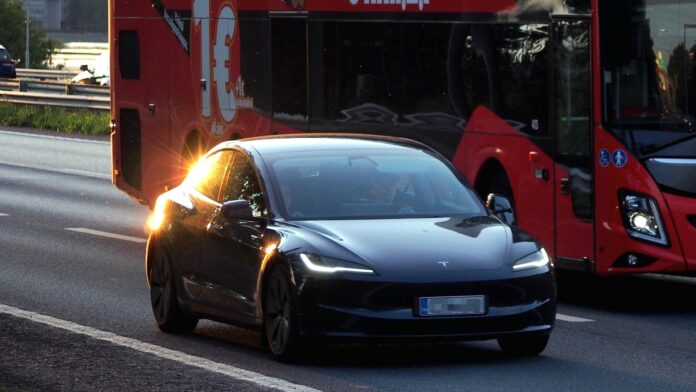
Featured image: A Tesla Model 3 on the Länsiväylä highway in Koivusaari, Helsinki, passing an Onnibus double-decker (August 2026). Photo: VynedJ via Wikimedia Commons, CC BY 4.0 (cropped).

, making it the 11th EU country. What it means for the EU vote and for Japan.)