
Japan’s EV subsidy is running out of money because people bought too many EVs, and two new arrivals landed right in the rush: Suzuki’s first kei EV and the first electric Renault ever sold here. In China, Toyota’s bZ4X started carrying riders with nobody behind the wheel, and the country put a record 99.4 GWh of batteries into new cars in a single month. Here’s the week on EVX News, in eight stories and one number.
Missed a few days? This is the catch-up. Every item links to our full story, sources and all.
1. Japan’s CEV subsidy is nearly gone, weeks ahead of plan
The Next Generation Vehicle Promotion Center (NeV), which runs the CEV grant for the trade ministry, said on Nov. 18 that the money would probably run out on Nov. 20, 24 or 25, with only about ¥10.7 billion (about $67 million) left as of Nov. 17. Applications close as of the business day before the money runs out, and anything that arrives later is rejected. At stake: ¥1,270,000 (about $7,970) on a Tesla Model 3 or Model Y, ¥1,300,000 (about $8,160) on a Toyota bZ4X and ¥580,000 (about $3,640) on a Nissan Sakura. Next year’s program is still “under consideration.” Tesla Japan, meanwhile, delivered its 60,000th car in Japan. The deadlines, the trade-in trap and what to do if your car isn’t registered yet.
2. Suzuki finally sells a kei EV, and it’s the cheapest one on the list
The e SKY starts at ¥2,120,000 (about $13,300) with 310 km of WLTC range from a 26 kWh LFP battery, more than any kei EV from a Japanese brand on paper. With the ¥568,000 (about $3,560) subsidy, the base car worked out to about ¥1,552,000 (about $9,740), the lowest of any kei EV on the subsidy list. One trap for bargain hunters: that base A grade can’t use DC fast charging. Suzuki is aiming for 1,000 sales a month. Trims, charging times and how it stacks up against the Sakura and BYD Racco.
3. Renault brings its first EV to Japan, in very loud yellow
Renault Japon put the Renault 5 E-Tech on sale on Nov. 19 as a 200-car Première Edition at ¥5.75 million (about $36,100). It’s the first electric Renault officially sold here and the first Renault 5 on Japanese roads in roughly 30 years. It gets 405 km of WLTC range and, importantly for Japan, CHAdeMO fast charging at up to 100 kW. Alpine launched its A290 the same day, 100 cars at ¥6.49 million (about $40,700). The regular Renault 5 follows in fiscal 2027. Specs, the charging-card offer and the Nissan connection.
4. A Chery-backed kei EV is already driving around Japan in disguise
EMT, the Yokohama company behind the EMTA brand, said on Nov. 20 that a camouflaged prototype of its first kei EV has been on Japanese public roads since October. Its world debut is at the Tokyo Auto Salon at Makuhari Messe, Jan. 15 to 17, 2027. The owners are three Chinese companies (Chery, Yueda and battery maker Gotion) and two Japanese ones (Autobacs Seven and Anest Iwata), and the chief technology officer was program director on Nissan’s first Leaf. The car will be built in China and imported. Who’s behind EMTA and what it’s testing first.
5. Toyota’s bZ4X goes driverless in Guangzhou
Pony.ai and Toyota put their Gen-7 bZ4X robotaxi into Pony.ai’s fully driverless fleet in Guangzhou on Nov. 16, starting in the Nansha district, with rides bookable 24 hours a day. The partners are working toward about 1,000 of them across major Chinese cities. The same car is the base for the driverless bZ4Xs Toyota will build for Waymo at its Takaoka plant, due to start testing in Japan in 2027. What launched, and why Guangzhou is a preview for Tokyo.
6. Xpeng posts a record quarter and promises a much bigger one
Xpeng’s third-quarter revenue hit a record 24.28 billion yuan (about $3.6 billion), up 19.1%, on a record 118,390 deliveries, and vehicle margin rose to 13.1%. It still lost 870 million yuan (about $130 million). For the fourth quarter it guides 169,000 to 174,000 deliveries, up 45% to 50%. For scale, Xpeng’s October alone (50,237 cars) was more than three times Japan’s entire October EV market. The numbers, the Q4 math and the “physical AI” pitch.
7. China installs a record 99.4 GWh of car batteries, and 86.9% is LFP
China put a record 99.4 GWh of batteries into new vehicles in October, up 18.2% from a year earlier. Lithium iron phosphate took a record 86.9% share, while nickel-based ternary cells, the kind Panasonic is known for, fell to their lowest share on record. Sales of energy-storage batteries jumped 70.5%, and battery exports hit a record 46.1 GWh. The full breakdown and what it means for Japan’s battery bet.
8. A Huawei-powered minivan tests Level 3 at 120 km/h between Chinese cities
Stelato, the brand BAIC builds with Huawei, started what it calls China’s first cross-city Level 3 expressway test at 120 km/h with its V8 MPV. It’s a company road test, not a feature owners can switch on yet. The V8 launched on Nov. 20, with presale prices from 329,800 yuan (about $48,900). Japan got there first in 2021 with Honda’s Legend, but that system only worked in expressway traffic jams, and Honda built just 100 cars. How the system works and where China’s L3 rules stand.
Number of the week: ¥10.7 billion
That’s about $67 million, all that was left in Japan’s CEV subsidy pot as of Nov. 17, out of roughly ¥110 billion (about $690 million). It had been expected to last into December. About ¥1.4 billion went in a single day. Our subsidy story.
The EVX Take
Japan’s EV market had its busiest week in a while, and the subsidy is the thread running through all of it. Suzuki and Renault launched into a grant that’s about to vanish, which is awkward for a ¥2 million kei car and less so for a ¥5.75 million collector’s item. The more important story is at the cheap end. Suzuki, EMTA and BYD’s Racco are all chasing kei buyers, and kei cars make up about a third of Japan’s new-car sales. China, meanwhile, keeps showing Japanese automakers what scale looks like: Xpeng ships more cars in a month than Japan’s whole EV market, and LFP now fills almost nine in ten Chinese EV batteries. Toyota’s answer, for now, is partnerships. Its bZ4X drives itself in Guangzhou with Pony.ai’s software and will do the same in Japan with Waymo’s.
Next week we’ll be watching for the final CEV cutoff date and any word on what replaces the grant, plus Tesla Japan’s two new stores in Fukushima and Kitakyushu, which open on Nov. 27.
This digest summarizes Japan- and China-relevant stories EVX News published between November 15 and November 22, 2026. Sources for each item are listed in the linked articles.
— The EVX News team
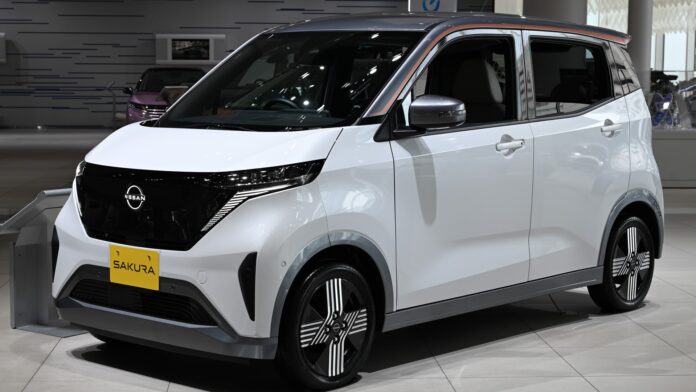
Featured image: Nissan Sakura kei EV on display, June 2024. Photo: TTTNIS via Wikimedia Commons, CC0 (cropped).
Follow @teslaloha on X for more

