
BYD’s profit is growing again, and the growth is coming from outside China. The company reported third-quarter net profit attributable to shareholders of 10.02 billion yuan (about $1.50 billion USD), up 28.08% from a year earlier, on revenue of 221.49 billion yuan (about $33.2 billion), up 13.59%.
BYD put out the report on Thursday, Oct. 29. TMTPost had it at 5:54 PM Beijing time, which is 6:54 PM JST, or 5:54 AM ET / 2:54 AM PT. Chinese outlets including The Beijing News, 21st Century Business Herald and TMTPost carried the same numbers. 21st Century Business Herald pointed out that quarterly profit is back above the 10-billion-yuan mark.
Better quarter, flat year
Zoom out and the picture is less festive. For the first nine months, revenue was 566.30 billion yuan (about $84.8 billion), basically unchanged, and net profit fell 4.24% to 22.35 billion yuan (about $3.34 billion). Operating cash flow was a bright spot, up 33.36% to 54.47 billion yuan (about $8.15 billion). Basic earnings per share for the quarter rose 29.41% to 1.10 yuan (about $0.16), and Reuters said the quarter still came in below analyst expectations, according to Drive Tesla.
Volume tells the same story. BYD sold 3,131,576 vehicles from January through September, down 3.94% from last year, even though September alone came in at 463,561, up 16.98% from a year earlier, per Gasgoo and Nanfang Plus.
The overseas engine
Exports are doing the heavy lifting. BYD’s overseas sales of passenger cars and pickups hit 179,877 in September, up 153.9% year over year, and reached 1,337,831 for the first nine months, up 92.66%, according to Gasgoo and Nanfang Plus. That nine-month total is already more than BYD sold overseas in all of 2025, The Beijing News notes, and overseas made up about 43% of BYD’s nine-month sales. BYD’s NEV business now reaches more than 120 countries and regions.
Meanwhile, at home, China’s NEV market is cooling. Retail sales in the first 25 days of October fell 13%, as we reported this week. That’s why the export numbers matter so much right now.
What it means for Japan
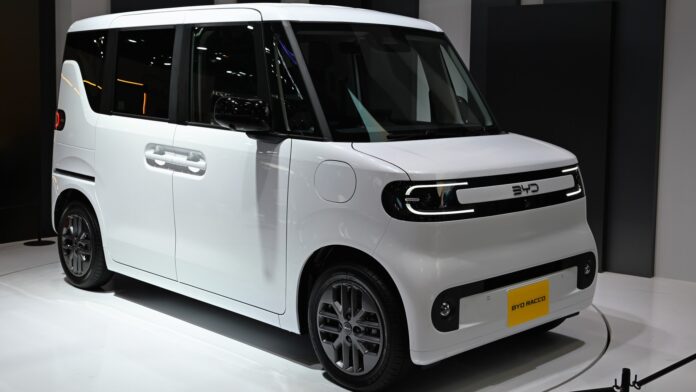
Japan is one of those export markets, and a tough one. BYD launched its first kei car, the RACCO, here on July 28, starting at ¥2,145,000 (about $13,580) including tax, with a ¥150,000 (about $950) CEV subsidy on every grade. It’s the first kei EV that a foreign automaker has designed specifically for Japan’s rules. That’s a lot of engineering for one country’s tiny-car class, and the overseas numbers above are the reason BYD can afford it. Whether Japanese kei buyers, a famously loyal bunch, start trading their Nissan Sakuras is the next number to watch.
Sources: The Beijing News (新京报), 21st Century Business Herald (21经济网), TMTPost (钛媒体), Gasgoo (盖世汽车), Nanfang Plus (南方+), Drive Tesla, BYD Auto Japan.
— The EVX News team
Featured image: The BYD RACCO kei EV prototype on display in Japan, 2025. Photo: TTTNIS / Wikimedia Commons (CC0, cropped).

 on 13.59% revenue growth, as overseas sales jumped 92.66% in nine months.)