
Xiaomi’s car business lost money again in the July-September quarter, and the company says China’s weak car market is the main reason. In its third-quarter results, filed with the Hong Kong exchange on Tuesday, Nov. 24, the segment that holds Xiaomi’s EVs, AI and other new ventures posted an operating loss of 3.4 billion yuan (about $510 million at 6.66 yuan per dollar). EV revenue fell 19.9% to 22.7 billion yuan (about $3.4 billion), and Xiaomi delivered 100,975 vehicles in the quarter.
The numbers, in plain English
Xiaomi says the “NEV, AI and other new initiatives” segment (NEV means new-energy vehicle, China’s umbrella term for EVs and plug-in hybrids) brought in 23.9 billion yuan, of which 22.7 billion came from cars. Its gross margin, the share of revenue left after the direct cost of making the product, fell to 19.2% from 25.5% a year earlier. The filing blames fewer deliveries and a changing mix, including fewer sales of the high-priced SU7 Ultra.
The market is the other half of the story. Xiaomi’s own filing says retail sales of passenger vehicles in mainland China fell 24% year over year in the third quarter. Company-wide, revenue was 107.2 billion yuan (about $16.1 billion), down 5.2%. Adjusted net profit was 4.88 billion yuan, down 56.8%. Reuters, using LSEG data, said that missed the 5.2 billion yuan analyst average, and Xiaomi shares closed down 3.7% in Hong Kong at HK$26.5. Sina’s Hong Kong market desk quoted a lower consensus of 4.75 billion yuan, which would make it a beat. Whether it’s a miss or a beat depends on whose estimate you use, but the year-over-year drop is not in dispute. Xiaomi also pointed to rising memory-chip costs and heavier AI spending.
The bright spots
October was better. The Securities Times, via Sina Finance, reports that October deliveries topped 50,000, a 2026 high, as the new SkyNomad series ramped up. SkyNomad is a family of four extended-range SUVs (a battery plus a small gasoline engine that charges it) launched in September at 209,900 to 299,900 yuan, or about $31,500 to $45,000. Xiaomi says it took more than 10,000 locked orders in the first four minutes and more than 70,000 in the first month, and that more than 10,000 were delivered in Q3. In the filing, Xiaomi also says all four of its models ranked in the top ten among NEVs priced above 200,000 yuan in China in October, citing Dongchedi data. Those are the company’s claims, and we haven’t independently verified them. We covered October’s delivery numbers when they came out.
Europe is next
On the earnings call, Xiaomi president Lu Weibing said the company plans to enter Europe in 2027, according to IT Home and Cailian Press via Sina Tech. The first four markets are Sweden, Germany, Spain and Italy. Xiaomi has set up a research-and-design center in Germany, has signed with eight leading German dealer groups (the filing calls them memorandums of understanding, meaning non-binding agreements), and says it has run high-speed and function tests at seven proving grounds. Lu also said launching extended-range cars didn’t cannibalize the company’s pure-electric sales.
The EVX Take
Xiaomi is the latest Chinese carmaker showing the same pattern: a domestic market that’s shrinking and price-sensitive, and a growing push abroad. We saw the flip side earlier this week, when Nikkei data showed Chinese brands now outsell Japanese ones in 39 countries. Xiaomi’s target list is Europe first, and Japan isn’t on it in any of the sources we reviewed.
For Japan, there are two things to watch. First, Xiaomi sells phones here but has announced no EV plans for Japan, so for now there’s no Xiaomi car you can buy in Japan, and none is promised. Second, a 24% market drop is the kind of pressure that pushes Chinese makers to lengthen their export lists, and Japan is already a small stop for BYD. If Xiaomi’s European launch goes well, a right-hand-drive version for Japan is a plausible later step, but that’s our speculation, not anything the company has said.
Sources: Xiaomi’s HKEX results announcement (primary), Reuters via CNBC-TV18, Securities Times via Sina Finance, IT Home via Sina Tech, Sina Hong Kong Stocks, Lianhe Zaobao.
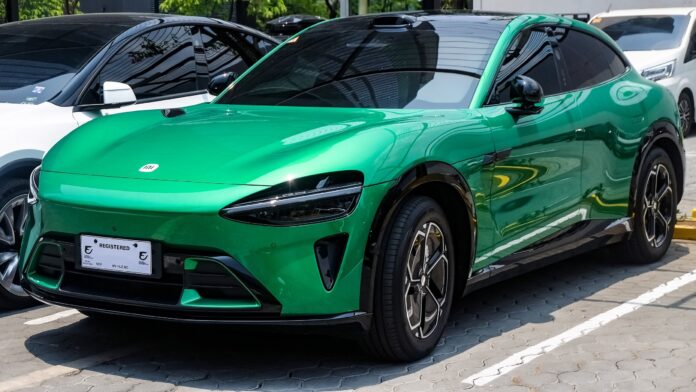
Photo: A Xiaomi YU7. Photo by Ethan Llamas, CC BY-SA 4.0, via Wikimedia Commons.Follow @teslaloha on X for more

