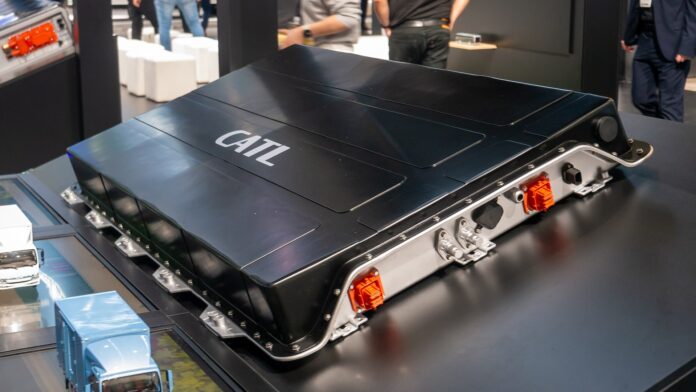

CATL has unveiled a bigger battery for its swapping network: the 30# Chocolate pack, a 100 kWh unit that the company says gives more than 700 km of range on China’s CLTC cycle and can be exchanged at a station in 99 seconds. It was shown on the evening of Nov. 26 at Huawei’s Qiankun ecosystem conference, the same stage where Huawei’s car unit talked up its own tie-up with CATL’s swap system.
The numbers come from CATL’s presentation, as reported by Sina Finance (via Kuai Technology), Auto China, China EV Industry Net and CarNewsChina. Auto China says it was presented by Yang Jun, CATL’s co-president for markets.
What CATL promised
- Capacity and range: the first version is 100 kWh, good for more than 700 km CLTC.
- Power: peak discharge of 600 kW, enough for a 0 to 100 km/h time in the three-second range.
- Refill two ways: a 99-second swap at CATL’s new stations, or a fast charge that adds 400 km in 10 minutes.
- Durability: CATL says the locking mechanism is rated for a swap every day for 27 years, vibration tests run at 1.5 times China’s national standard, and batteries in the network get a lifetime warranty with round-the-clock monitoring.
- Flexible sizing: drivers will be able to choose different capacity tiers as their needs change.
What it means, in plain English. “Chocolate” is CATL’s brand for its standardized swap packs, flat blocks shaped a bit like slabs of chocolate. In a swap system you don’t own the battery; you drive into a station, a machine pulls out the depleted pack and drops in a charged one. The catch has always been that the packs are standard sizes, and the earlier 20# and 25# packs that CATL launched in December 2024 are smaller. CarNewsChina notes the 25# LFP version, the one used most at CATL’s stations, is 56 kWh. At 100 kWh, the 30# can go into larger, pricier cars that would never have accepted a 56 kWh pack.
The network behind it
CATL’s swap business had built more than 2,520 Chocolate stations across 31 provinces as of late September, according to Guandian, Sina Finance and Auto China. Much of that started with ride-hailing fleets. Earlier this month BAIC said it would stop running its own network and hand its 112 swap stations to CATL.
The more interesting question is who will build cars around the new pack. CATL didn’t name a model or a production date. Two reports point the way, though neither is confirmed by the companies. 36Kr reported this week that AITO, the premium brand Seres builds with Huawei, has started a project for a battery-swap version of its M6 SUV and is negotiating with CATL; IT Home, D1EV and Sina Finance carried the same report. 36Kr says it would be the first premium brand to sign up with CATL’s swap unit. Separately, CarNewsChina spotted a swap version of BAIC’s boxy Xingtan 5X in the latest government vehicle filings and expects it to use the 30#.
Huawei’s role is bigger than hosting the event. According to Auto China’s account, Huawei car-unit CEO Jin Yuzhi announced a formal partnership between Qiankun driver assistance and CATL’s swap network, and the Yijing brand said it will launch what it calls the first “smart swap” car. That builds on the self-driving swap demo the two showed in October, where the car drives itself into the station.
The EVX Take
Battery swapping for cars barely exists in Japan, and the 30# won’t change that soon. Japan’s swap effort is on two wheels, through Gachaco, the shared scooter-battery service that ENEOS set up in 2022 with Honda, Kawasaki, Suzuki and Yamaha, and which Honda made a consolidated subsidiary in April. What the 30# does matter for is Japanese brands in China. CATL already supplies the battery in Dongfeng Nissan’s new NX7 and is co-developing the pack for Toyota’s Highlander 9X, both shown at this week’s Guangzhou show, so a swap standard that now reaches 100 kWh gives Toyota, Honda and Nissan one more Chinese system they’ll be expected to support. Tesla tried swapping once, with a 2013 demo and a short-lived pilot station, then bet on Superchargers instead. In China, CATL is betting there’s room for both, and a 10-minute, 400 km fast charge on the same pack suggests it’s hedging that bet too.
Image: A CATL battery pack on display at IAA Transportation 2024 in Hanover (not the 30# pack). Photo: Matti Blume, via Wikimedia Commons (CC BY-SA 4.0), cropped.Follow @teslaloha on X for more

