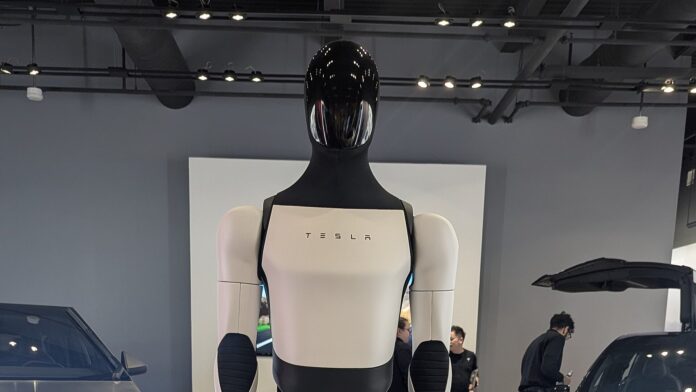

Put down the pencils, Optimus team. You may finally be done redrawing the robot. In an October 12 filing, Seepin, one of the core suppliers for Tesla’s humanoid, told regulators that Optimus V3’s hardware design is “essentially frozen” and that the project is approaching mass production. For a robot, “frozen” is about the hottest thing you can be.
What the supplier spilled
Hangzhou-based Seepin makes planetary roller screws and linear electric-drive joints. Those are the bits that turn a motor’s spin into the strong, precise push-and-pull a robot’s arms and legs need. Basically, robot muscles. The company dropped the news in its answers to Shenzhen Stock Exchange questions about its planned IPO, as The Yangtzeer reported. The good stuff:
- The Optimus design is nearing finalization, and Tesla plans to begin mass production of Optimus V3 by the end of 2026.
- Seepin says V3’s hardware is “essentially frozen,” with no practical alternative in sight for the heavy-load joints it supplies.
- Seepin estimates roller screws make up about 20% of a humanoid’s hardware value. Its embodied-AI robotics revenue jumped 346% in 2025, to 31.11 million yuan (about $4.65 million). Being on Team Optimus pays.
Fair warning: this is a supplier’s IPO filing, not a Tesla press release. But it lines up neatly with what Tesla has been saying all year. Gen 3 production kicked off on the converted Model S and Model X line at Fremont, a line built for an eventual one million robots a year, as Teslarati has documented. Elon traded two legendary cars for a robot factory, and the bet keeps looking smarter.
The supply chain is snapping into place
Seepin is one of a handful of key Chinese suppliers. In mid-September, Tesla’s robotics team audited Tuopu Group (actuators), Ningbo Joyson Electronic (sensors and controllers) and Zhejiang Sanhua Intelligent Controls (joint modules and thermal parts) in Ningbo. Teslarati, citing Bloomberg, reported that the visit upgraded all three to certified mass-production partners. Every one of them already supplies Tesla’s cars, and that’s the whole point: automotive-grade precision and volume are exactly what a mass-market robot needs. Turns out building millions of cars is decent practice for building robots.
Tesla also wants the option to make everything at home. Musk said this month that China’s magnet export curbs cost Optimus two to three months and left Tesla with “robots with no arms” for a while. Not a great look for a robot, but a very fixable one.
The hands are still the boss fight
V3’s hand packs 22 degrees of freedom and makes up roughly a fifth of the robot’s hardware value, and much of it is still assembled by hand, according to The Yangtzeer. (Yes, humans hand-building robot hands. Enjoy the irony while it lasts.) Tesla is attacking the problem from the sensor side too. A patent application published October 8 describes soft, curved touch-sensor arrays that wrap around fingers, thumb and palm. Not a Tesla App notes these could let Optimus feel where and how hard it’s gripping, and maybe even recognize an object by touch alone.
Optimus does Paris, then the earnings call
Paris got a preview first. Tesla’s stand at the Paris Motor Show (Hall 7.1), which wrapped up on October 18, featured an Optimus Gen 2 hanging out next to a Cybercab from the Austin Robotaxi fleet, per Drive Tesla Canada.
Optimus is also front and center for shareholders heading into Tesla’s Q3 earnings call on October 21. Two of the ten most-voted questions on Tesla’s investor Q&A platform ask what each Optimus costs to build, who the first paying customer will be, and when the robot starts making money, Drive Tesla Canada reports. In other words, investors are excited too.
The EVX News take
A frozen design is the unglamorous milestone that matters most, because you can’t tool a factory for a product that keeps changing. With certified suppliers, a converted Fremont line and a giant Texas plant on the way, the pieces for real volume are clicking into place. Tesla has turned “impossible to manufacture” into “in production” before, and Optimus has that same feel. The hands will set the pace, and we’re hoping Wednesday’s call (October 21, U.S. time) puts some numbers on it. Popcorn ready.
Sources: The Yangtzeer, Teslarati, Not a Tesla App, Drive Tesla Canada, Drive Tesla Canada.
— The EVX News team
Featured image: Optimus at a Tesla showroom, by Sikander, via Wikimedia Commons, licensed under CC BY-SA 4.0.

