
Tesla’s lawyers in Shanghai have told one of China’s oldest EV news sites to take down its livestreamed test of FSD V14, hand over the VINs of the car it used and promise never to hack a Tesla again. The site’s founder says no. “We will not take down the story,” D1EV (第一电动网) CEO Pang Yicheng said in a video posted on Nov. 10, after publishing the letter on his Weibo account.
The car in question is a Model Y that drove in D1EV’s “Intelligent Driving Competition” in Changsha, Hunan province, which the site streamed on Nov. 8. According to the letter, which Jiemian reproduced in full, the Model Y was running FSD V14 that had been “cracked and activated without authorization,” switching on a driver-assistance function that isn’t supposed to run on that vehicle in China. The other headline entrant was a GAC Aion car running a WeRide driving system. The Tesla was on V14.2.2.
What Tesla is demanding
The notice comes from Tesla (Shanghai) Co., Ltd., and it isn’t subtle. National Business Daily, which also published its contents, lists four demands:
- Stop all cracking, activation, testing, reviewing and sharing of Tesla’s driver-assistance software, and don’t help anyone else do it.
- Delete every livestream replay, video, article and comment thread about the cracked test on D1EV’s own channels (its site, WeChat, Weibo, Douyin, Bilibili, Xiaohongshu and more), and ask other platforms that reposted it to delete their copies.
- Within 48 hours, provide in writing the VINs of every car used, and let Tesla’s technicians restore the software to factory state.
- Sign a company letter promising no more cracking, reverse engineering or unauthorized access to Tesla vehicles or systems.
Tesla argues the stunt breaks the law and also violates the online product-review rules that China’s Cyberspace Administration and its market regulator (SAMR) jointly issued in June 2026, which cover reviewer qualifications, test standards, test samples and the authenticity of content. If D1EV doesn’t comply, the letter says, Tesla will report the matter to the police and pursue the people responsible, including through civil action.
“Bring it on”
Pang, who founded D1EV in 2010, has been anything but quiet. On Weibo he joked that if he gets locked up, his team has promised to bring him meals, then wrote: “Come on, bring it on, I’m waiting for you.” In the video he gave three reasons for refusing. D1EV has asked Tesla many times for access to an official internal test build and never got one. He has been lobbying regulators to approve V14 quickly. And the Changsha run came from owners who wanted to see how V14 copes with difficult Chinese roads.
His review of the software is more interesting than the legal sparring. Pang said V14’s “fundamentals are the best in the world, better than WeRide and Huawei,” and singled out its understanding of complex scenes and its causal reasoning. He also said the build showed it hasn’t been trained on enough local road data. NBD reports the testing covered more than 800 km (about 500 miles) of highways, city streets, night driving and heavy rain, and Pang warned that the slick short clips circulating online suffer from survivorship bias.
Tesla China had not commented publicly as of Wednesday, Nov. 11. D1EV’s own news flash on the dispute says nothing further has happened yet.
Why Tesla is drawing a line now
The awkward part for Tesla is that a lot of Chinese owners have already paid for FSD. The package costs 64,000 yuan (about $9,600) in China, but V14 hasn’t completed regulatory approval there, so buyers get a cut-down feature set rather than the North American software. That gap has created a gray market. NBD found dozens of listings on Chinese e-commerce sites promising “full-blooded FSD” (满血FSD) modules, some for only a few hundred yuan (well under $100). Viral clips have helped too. In June a V14 car filmed on one of China’s cliffside mountain roads racked up tens of millions of views after Tesla and Musk reposted it, according to NBD, and some of the vehicles in other clips were suspected of being unlocked with third-party tools.
There’s also a regional precedent. On Oct. 27, Seoul police said they had referred 80 people to prosecutors for activating FSD with unauthorized devices and had seized 21 of the gadgets. Under South Korea’s Motor Vehicle Management Act, the offense carries up to two years in prison. Korean police said unauthorized activation can leave a car misreading the road or acting against the driver’s intent.
Seen from Tesla’s side, a media outlet livestreaming an unapproved build to a national audience is the worst version of that problem. It happens while Tesla is still trying to win approval for V14 in China, a market where Giga Shanghai just shipped a record 87% of its October output abroad as domestic sales slid (our October Shanghai numbers). A good FSD launch is one of the few levers Tesla has left there, and regulators are the ones holding it.
The EVX Take
Japan is in the same waiting room. Tesla Japan started FSD (Supervised) testing in August 2025 and was still aiming for a 2026 introduction in October (Lester’s column this week walks through why Japan matters), and plenty of Japanese owners have paid for FSD they can’t use yet. The China letter shows how Tesla is likely to handle anyone who jumps the queue: it won’t wink at unlock devices, because its relationship with regulators like Japan’s transport ministry is worth more than a few viral clips. If you’re a Japanese owner eyeing a cheap “FSD unlock” online, look at Seoul first. The pressure Pang is trying to create cuts both ways, though. A respected outlet saying V14 beats WeRide and Huawei on fundamentals is the kind of free review Tesla could never buy, and it lands just as Chinese and Japanese regulators are deciding how fast to move.
Sources: Tesla (Shanghai) legal notice as published by Pang Yicheng on Weibo and reproduced by Jiemian and National Business Daily (Nov. 10); NBD follow-up on gray-market FSD modules and the Korean case; IT Home (Nov. 11); D1EV; Sina Finance.
— The EVX News team
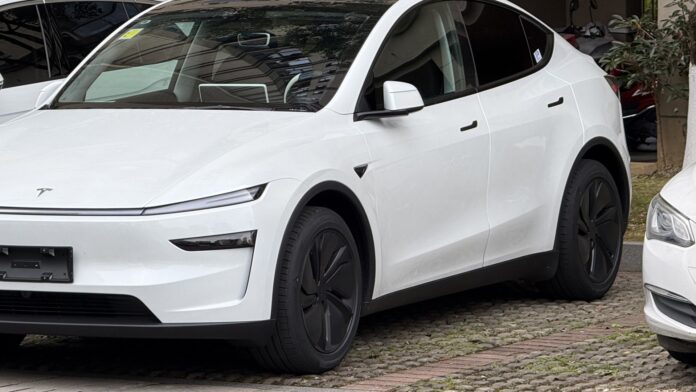
Featured image: A facelifted Tesla Model Y in Sanming, Fujian province, China. Image: Randall Ferry via Wikimedia Commons, CC BY-SA 4.0 (cropped).

