
SpaceX is going to make its own solar cells. German equipment maker SINGULUS TECHNOLOGIES said on Tuesday, Nov. 10 that it has signed a contract to supply SpaceX with a turnkey production line for heterojunction (HJT) solar cells, the first of several lines planned under a wider partnership. The cells are for Starmind, SpaceX’s solar-powered computing satellites, and they’ll be made at its factory in Bastrop, Texas.
Elon Musk put it his own way a few hours later. “SpaceX has ordered 100 GW/year of HJT solar manufacturing equipment from Singulus in Germany,” he wrote on X. “This is for Starmind to create a sentient sun.”
What was actually signed
The SINGULUS announcement is more measured than the tweet. The first line will be delivered in the first half of 2027, and production “will scale to support more than 100 GW of production equipment as SpaceX accelerates satellite manufacturing in Bastrop.” SpaceX’s own post used the same “more than 100 GW” figure. The company’s mandatory market disclosure put the value of the first firm order at more than €60 million (about $67 million), as several German financial outlets reported.
That 100 GW is a target for the whole buildout, not what one line can do. On its third-quarter earnings call, SINGULUS management said the first line will have a capacity in the three-digit megawatt range, below 1 GW, according to Investing.com’s call transcript. Decisions on scaling up are more of a 2028 story. So the gap between “a few hundred megawatts in 2027” and “100 GW a year” is where most of the work lives.
“Partnering with SINGULUS gives us a high-performance manufacturing path for solar cells for our Starmind satellites at our production facility in Texas,” said Mike Nicolls, SpaceX’s senior vice president of Starlink. Lars Lieberwirth of the SINGULUS executive board said the deal lets the company industrialize its process platform, which combines wet chemistry, vacuum coating and thermal processing, “at a meaningful scale.”
SpaceX was already in the room
This didn’t come out of nowhere. SINGULUS says it entered a strategic partnership with SpaceX in March 2026, and that SpaceX provided significant funding then and again in October through a subordinated secured loan. SINGULUS had announced a loan of about €22.8 million (about $25 million) in October to pay off its debts to its former Chinese shareholder, Triumph Science and Technology Group, whose roughly 16.75% stake moved to a German investor. A €3.56 million (about $4 million) convertible bond issued in March to a then-unnamed partner, now known to be SpaceX, can convert into up to 1.8 million new shares, roughly 20% of the share capital, finanzen.net calculated.
For SINGULUS, the order is enormous. The company, which has about 325 employees, expects 2026 revenue of around €83 million (about $92 million) and had an order backlog of €47.1 million (about $52 million) at the end of September. One SpaceX line is worth more than that entire backlog. Investors noticed. The shares jumped as much as 85% to €23.50 (about $26) on Xetra on Wednesday, after starting the year at €1.41.
Why a rocket company wants its own solar fab
Starmind is the reason. SpaceX’s published specs for its AI1 satellite describe a 75-meter solar wingspan and a computing payload that draws up to 250 kilowatts at peak (175 kW on average), flying in sun-synchronous orbit and sending results down through laser links to Starlink. That is a lot of solar per satellite, multiplied by a lot of satellites. Buying cells on the open market, which China dominates, would leave SpaceX’s AI-in-orbit plans hostage to someone else’s capacity and trade policy.
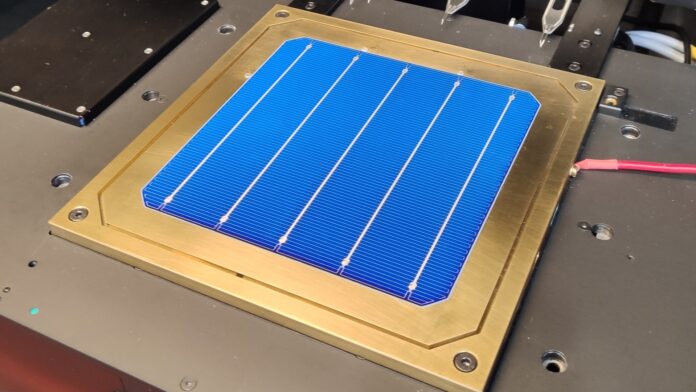
HJT makes sense for a factory starting from scratch. The cells sandwich a crystalline silicon wafer between ultra-thin layers of amorphous silicon, which cuts losses at the surface and gives high efficiency with relatively few process steps. SINGULUS is also developing perovskite processes, which could matter later.
It also fits a pattern across Musk’s companies. Tesla just started site work on its $10.1 billion “Project Crystal Sun” solar factory in Texas (our report), and the Tesla–SpaceX Terafab chip project is buying tools in Japan on very short deadlines partly to feed SpaceX’s space-based data centers (here’s that story). Chips, power and satellites, all made in-house in Texas. The new Starlink Mini 2 is a tiny consumer cousin of the same idea (our Mini 2 story).
The EVX Take
There’s a Japanese irony buried in this order. Heterojunction cells were commercialized by Sanyo Electric, whose “HIT” cells went into mass production in 1997, and Kaneka set a world efficiency record for a silicon cell with a heterojunction back-contact design in 2017. Panasonic, which absorbed Sanyo, then quit making its own solar cells in 2021. Now the technology Japan pioneered is being scaled for orbit with German tools in Texas. Tokyo’s current solar bet is flexible perovskite film, led by companies like Sekisui Chemical, and that is a different market from satellites. But if SpaceX really builds toward 100 GW of cell capacity, it becomes one of the largest buyers of the specialty materials HJT lines consume, such as low-temperature silver paste and ITO sputtering targets, two areas where Japanese suppliers are strong. That’s where the Japan opportunity is, more than in panels.
Sources: SINGULUS TECHNOLOGIES (Nov. 10); SpaceX on X; Elon Musk on X; SINGULUS Q3 2026 call transcript; finanzen.net; Börse Express; Interesting Engineering (Starmind AI1 specs).
— The EVX News team
Featured image: A silicon heterojunction solar cell under test at the University of New South Wales’ Solar Industrial Research Facility. Image: Radiotrefoil via Wikimedia Commons, CC BY-SA 4.0 (cropped).

