
The cable is gone. SpaceX unveiled Starlink Mini 2 on Tuesday, a second-generation portable dish with a removable 71 Wh battery that Starlink says keeps it online for up to 4.5 hours, plus Wi-Fi 6 and USB-C charging built in. Starlink announced it on X at 12:28 p.m. ET / 9:28 a.m. PT on Tuesday, Nov. 10 (2:28 a.m. JST Wednesday, Nov. 11). For now, preorders are open only by invitation for select U.S. customers. Starlink says the dish is “coming soon to more customers and countries.”
The first Mini was already small enough for a backpack, but it couldn’t run without outside power. It shipped with a DC barrel cable, so owners ended up hauling power stations, 12-volt car taps or a USB-C adapter paired with a 100 W charger. Mini 2 puts the power inside. Starlink says you can get online in about 60 seconds with a clear view of the sky. The battery clips onto the back with a quick-release mechanism, so a charged spare can go in when the first one runs down. You can also run the dish straight from a 60 W USB-C source, and the battery doubles as a power bank with up to 60 W of USB-C output.
The spec sheet shared by Sawyer Merritt and listed on Starlink’s Mini 2 page puts the dish at 263 × 314 × 23.1 mm, down from 38.5 mm thick on the original. It weighs 1.6 kg (3.53 lb) with the battery and kickstand. The battery alone is 490 g, so minus the pack the dish and stand come in at about the old Mini’s 1.16 kg. Wi-Fi coverage goes up to 167 square meters (1,800 sq ft), and the dish keeps an IP67 rating. The box includes a 60 W USB-C wall charger, a 3-meter USB-C cable and a standard 1/4″-20 tripod thread. Drive Tesla Canada notes that spare batteries will be sold separately.
Then there’s the price. Invitation emails quoted by PCMag put the preorder at $999, which includes 12 months of Roam Unlimited. SpaceX values that service at $2,100. Buyers put down a refundable $100 deposit and pay the remaining $899 plus tax when the dish ships, and shipments are estimated to start in mid-December. Starlink says that price and the bundled year of service apply only to this preorder invite. One day before launch, Starlink tracker DISHYtech found a $249 “Mini 2 Beta Kit” and a $50 battery listed in Starlink’s site code, so a cheaper standalone price may come later. Starlink hasn’t confirmed either figure. The first Mini also launched through invitations in 2024, at $599. It now sells for as little as $149 in the U.S.
Mini 2 isn’t the only SpaceX hardware news from Tuesday. The company also signed a supply deal with Germany’s SINGULUS for heterojunction solar-cell lines at its Bastrop, Texas, satellite plant. The connectivity push keeps moving on other fronts as well, from Starlink Mobile’s 5G network with Qualcomm to airline deals like ZIPAIR’s Starlink-equipped fleet.
The EVX Take
Japan is the market where a battery-powered dish makes the most sense. After the January 2024 Noto Peninsula earthquake, KDDI and Starlink Japan delivered 350 Starlink units free to evacuation shelters at the request of Ishikawa Prefecture and the Ministry of Internal Affairs and Communications. Every one of those dishes needed a power source. A dish that runs off its own battery is a much better fit for disaster kits than one that needs a power station. Starlink hasn’t given a Japan date, and there’s a reason to expect some wait. The original Mini reached Japan on Jan. 23, 2025, at ¥34,800 (about $220), about seven months after its U.S. invite launch. Any new terminal also has to clear Japan’s radio certification (giteki) before it can legally transmit here. Japanese buyers should also know that Starlink’s own guidance bars using the service while moving on land in Japan, so the in-motion use advertised in the U.S. doesn’t apply here. One number deserves a real-world test. The original Mini’s spec sheet lists an average draw of 25–40 W, but a 71 Wh pack lasting 4.5 hours works out to about 16 W. Either the new dish is much more efficient, or 4.5 hours is a best-case figure. The 71 Wh pack is under the 100 Wh limit airlines generally use for carry-on lithium batteries, so a spare can fly in your cabin bag.
Sources: Starlink on X, Starlink Mini 2 product page, Sawyer Merritt on X (spec sheet), Drive Tesla Canada, PCMag, SINGULUS, KDDI (Jan. 7, 2024), ITmedia Mobile (Japan Mini launch, Jan. 23, 2025).
— The EVX News team
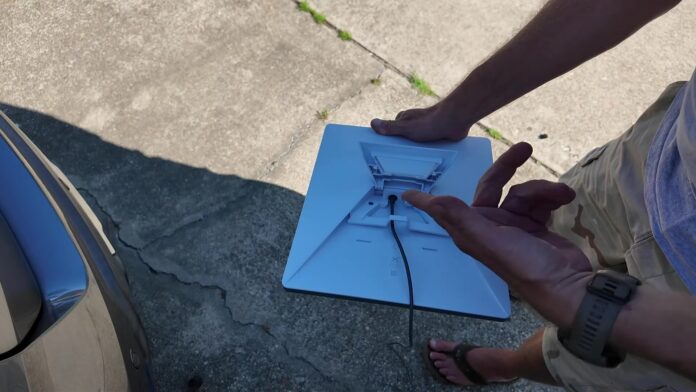
Featured image: A first-generation Starlink Mini being set up on pavement, its DC power cable plugged into the back. Image: still from “Starlink Mini Overland and Camping Power Testing” by Overland Calling via Wikimedia Commons, CC BY 3.0 (frame extracted).

