
For Tesla drivers in Japan, the most annoying sight on a road trip is a row of fast chargers they can’t use. That may finally change. Tesla plans to launch a new CHAdeMO adapter in Japan in January 2027, Nikkei reported on October 16. It would increase the number of fast-charging ports Tesla owners can use in Japan about 12-fold.
What we know
Here’s what Nikkei reported, as summarized by Touch Lab:
- Launch: January 2027.
- Power: up to 130 kW, 2.6 times the 50 kW limit of Tesla’s old CHAdeMO adapter.
- Price: just under ¥100,000.
- Testing: Tesla says it has finished compatibility testing with Japan’s major charger models.
Japanese Teslas use Tesla’s own NACS connector. The original CHAdeMO adapter went off sale around 2024, and since then owners have been hunting for used ones on flea-market apps. Owners also say the old adapter gets flaky on hot summer days, which is exactly when you need a charge most.
Why “12 times” isn’t hype
According to the charging-map service GoGoEV, Japan has roughly 1,400 fast-charging ports that support Tesla’s NACS connector, and about 14,800 CHAdeMO ports. CHAdeMO is the fast-charging standard Japan invented, and it still dominates the country’s public charging.
The biggest difference will be on the expressways. Fast chargers at highway service and parking areas are almost all CHAdeMO. Today, a Tesla driver on a long trip often has to leave the expressway to find a Supercharger. Tesla’s network keeps growing, with its 157th Japanese site opening in Sumida, Tokyo, at the end of September, but it’s still concentrated around big cities. With the adapter, every service area charger becomes an option.
There’s movement from the other direction as well. On October 9, Ten Fields Factory announced that it won a NEXCO East and West tender to install 36 FLASH MARK.7 chargers at 18 expressway parking areas. These are up to 400 kW, with both NACS and CHAdeMO plugs, so Teslas can charge there without any adapter. The target is to have them running by the end of December 2027. Between native NACS plugs and a 130 kW adapter, Japan’s highways are about to get a lot friendlier to Tesla owners.
Third time’s the charm?
This adapter has been a long time coming. Tesla Japan president Hashimoto first revealed it at the Tesla Owners Club Japan national meeting in June 2025, when it was expected before the end of 2025. In March 2026 the target slipped to April–June, with Tesla citing time needed for safety testing. Now it’s January 2027, more than a year after the original goal.
Touch Lab is cautiously optimistic, noting that this is the first time a specific launch month has been named. A January launch would also arrive well before next summer, when the old adapter’s heat problems are worst.
Why it matters beyond Tesla
Japan is one of the few major markets where Tesla’s plug isn’t becoming the default. In North America, almost every automaker has adopted NACS. In Japan, CHAdeMO is national infrastructure, and that won’t change soon.
A fast, affordable adapter is the practical answer. It removes one of the most common reasons Japanese buyers give for hesitating on a Tesla: “What if I can’t charge in the countryside?” With the Model Y already Japan’s best-selling foreign-brand model, a solid answer to that question could matter more than any new trim level.
The EVX News take
A ¥100,000 adapter that opens up 14,800 chargers is about as good a value as an EV accessory gets. Tesla still needs to ship on time, and we’ll believe the 130 kW figure when owners report real charging speeds at a service area in August. If it delivers, January 2027 could be the month the Japanese road trip stops being a Supercharger scavenger hunt.
Sources: Nikkei (Japanese), Touch Lab (Japanese), Touch Lab, March 2026 (Japanese), EVsmart Blog (Japanese), Touch Lab on FLASH (Japanese).
— The EVX News team
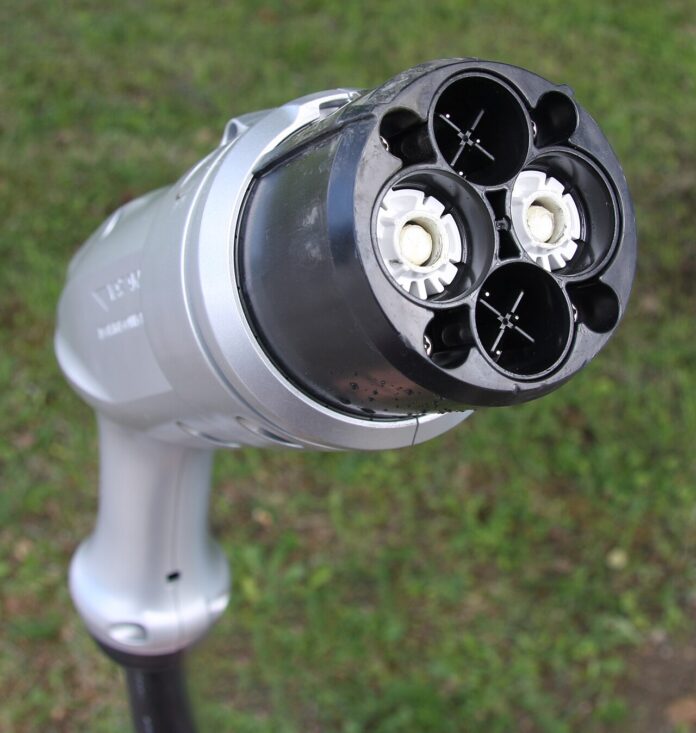
Featured image: CHAdeMO connector, by D-Kuru, via Wikimedia Commons, licensed under CC BY-SA 4.0.

