

The Federal Communications Commission has authorized SpaceX to put up to 1 million satellites in orbit as data centers, the first license of its kind in the U.S. The constellation is called Starmind, and the FCC’s Space Bureau granted it on Wednesday, Nov. 25. FCC Chairman Brendan Carr announced it on X at 11:09 a.m. ET / 8:09 a.m. PT (1:09 a.m. JST Thursday, Nov. 26), and Elon Musk replied half an hour later: “Much appreciated. This will be a great asset to America and the world.”
A million is a big number. The deadline for the first one is not exactly a sprint. Under the FCC order, SpaceX has until Nov. 25, 2033 to get its first Starmind satellite working in orbit. Then the pace picks up fast.
Post embedded from FCC Chairman Brendan Carr’s official X account (@BrendanCarrFCC).DATA CENTERS IN SPACE🇺🇸
— Brendan Carr (@BrendanCarrFCC) November 25, 2026
Today, in a historic first, the FCC approved SpaceX’s request for 1 million satellites (orbital compute modules) to create data centers in space
The Starmind & competitor constellations will use solar power to extend America’s lead in Super Intelligence
What the FCC actually signed
The order, signed by Space Bureau chief Courtney Reinhard, grants the application in part and defers one piece of it. In plain terms:
- Size: up to 1,000,000 satellites in shells between 500 and 1,002 km up, at 30-degree and sun-synchronous inclinations. (A sun-synchronous orbit keeps a satellite passing over the same lighting conditions every day, which means near-constant sunshine for solar panels.)
- Deadlines: 1 satellite by Nov. 25, 2033; 10% of the total (100,000) by Nov. 25, 2035; 50% by Nov. 25, 2038; the full constellation by Nov. 25, 2040. The order says the authorization becomes “null and void” if SpaceX misses them.
- Radio: Starmind’s main data path is laser links to SpaceX’s own Starlink satellites. The FCC license covers only backup and emergency “TT&C” (telemetry, tracking and command, the housekeeping signals that let operators steer a satellite and check its health) in Ka-band, on a non-interference basis.
- Term: 15 years, and the clock only starts once SpaceX certifies that its first Starmind satellite is working in orbit. The FCC also waived the usual surety bond (a cash guarantee operators post to prove they’ll actually build).
- Deferred: SpaceX asked for flexibility in how satellites above 600 km are disposed of at the end of their lives. The FCC held that request back. SpaceX has to file a complete orbital debris plan before it deploys anything above 600 km.
Petitions to deny from Amazon’s Kuiper Systems (now Amazon Leo), Viasat and the American Astronomical Society were all denied. The FCC also dismissed environmental and optical-astronomy objections as outside its authority, a line that will keep astronomers unhappy. SpaceX filed the application on Jan. 30, and the FCC accepted it for filing on Feb. 4, as Teslarati covered at the time. That filing described altitudes as high as 2,000 km; the grant tops out at 1,002 km.
Amazon said “centuries.” The FCC said yes.
Amazon called Starmind a “lofty ambition rather than a real plan” in its March petition and argued it would take SpaceX centuries to build, CNBC reported. Carr fired back at the time that Amazon “should focus on getting Amazon’s house in order with their own launches and their own satellite constellation,” according to Reuters via NBC News. Amazon declined to comment on Wednesday.
For scale, Reuters puts the number of satellites in orbit today at about 17,000, all operators combined. Operators often ask for more than they plan to fly to keep their design options open, so read 1 million as a ceiling, not a launch manifest.
What a Starmind satellite is
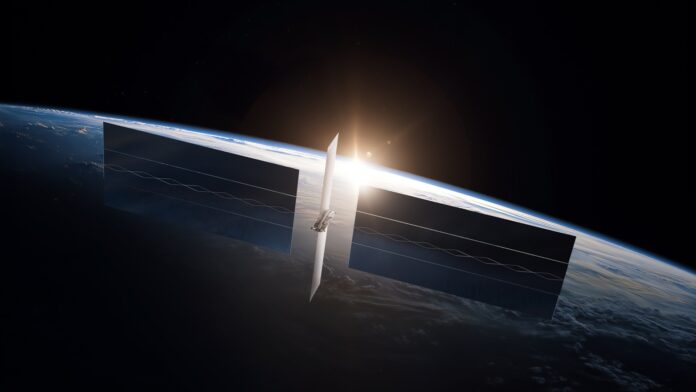
SpaceX’s Starmind page describes the first model, AI1, as a 30-meter-tall satellite with a 75-meter wingspan of solar arrays and a compute payload of up to 250 kW peak (175 kW average). For a sense of size, 250 kW is roughly what 20 Tesla Wall Connectors draw running flat out, per satellite. The pitch is simple. Power on Earth is getting hard to find for AI, and in orbit the sun rarely sets and heat radiates straight into space, so you skip the chillers and cooling towers.
The pieces have been lining up all year. In August SpaceX said it is working with Nvidia on the AI1 compute payload, with Rubin GPUs and Vera CPUs. In October, SpaceX executive Michael Nicolls said the satellites would fly in clusters of “10-ish satellites” linked by about 10 terabits of bandwidth, Teslarati reported. This month SpaceX ordered a solar cell production line from Germany’s SINGULUS for Starmind. SpaceX says its Gigasat Factory in Bastrop, Texas, could start turning out thousands of AI satellites as soon as late 2027, with Starship doing the heavy lifting to orbit.
SpaceX isn’t giving up on the ground, either. About an hour after the FCC news, it posted that its planned Cochise County, Arizona compute site will use no gas plant and a closed-loop dry cooling system, that SpaceX will pay $3.6 billion to upgrade the local grid, and that it wants a public meeting on Dec. 9 to go ahead. That’s the roughly $50 billion campus we covered on Nov. 13.
Japan’s bet looks different
Japan has its own space-computing project, and it’s a lot smaller on purpose. Space Compass, the joint venture of NTT and SKY Perfect JSAT, is building an optical data relay in geostationary orbit as the first step toward what it calls a “space integrated computing network.” It was selected in April for JAXA’s Space Strategy Fund, with support of up to ¥23.5 billion (about $150 million) through March 2031, according to Space Compass. Its first relay satellite is on order from Switzerland’s SWISSto12.
The EVX Take
The real news here is the paperwork, not the satellites. A U.S. regulator has now written deadlines for orbital data centers into a license, so Starmind stops being a slide and becomes a schedule. The 2033 date for one satellite is generous; the 2035 jump to 100,000 is the hard part, and it only works if Starship hits airline-like launch rates. For Japan, this widens a gap. NTT and SKY Perfect JSAT are betting on laser relays, which is smart and buildable, but Japan has no launch system that can lift at Starship scale, so any Japanese AI company that wants compute in orbit will likely be renting it from an American operator. Watch the debris plan for orbits above 600 km. That filing will decide how much of the 1 million SpaceX can actually use.
Lester’s take
The FCC just gave SpaceX until 2033 to launch the first of a million flying data centers. I bought FSD four times and still can’t use it here in Japan, so I’ll make a call: Starmind satellite number one reaches orbit before FSD gets approved in Japan. At least SpaceX’s deadline is in writing. Mine is “soon,” which Tesla owners know is its own unit of time.
Sources: FCC Space Bureau order (Nov. 25, 2026), Brendan Carr on X, Elon Musk on X, SpaceX Starmind, SpaceX on X (Arizona), CNBC, Reuters via NBC News, Teslarati, Sawyer Merritt on X, Space Compass.
Image: Rendering of a Starmind AI1 satellite in orbit. SpaceX, from its official X account (@SpaceX).Follow @teslaloha on X for more