
Nvidia sells the shovels of the AI gold rush, and now it’s giving away some very good maps too. The company has expanded its open Nemotron model family with Nemotron 3.5 Super VL, a 120-billion-parameter model that can see as well as read, and Nemotron 3.5 Bolt, a squeezed-down model built to run AI agents on your own desk instead of someone else’s cloud.
Super VL: big brain, small appetite
According to Nvidia’s announcement, written by Nvidia VP Kari Briski, Super VL is an open 120B model aimed at “specialized always-on agents,” meaning software that grinds through business workflows lasting days or weeks. The numbers that matter are below.
- Mixture-of-experts design: 120 billion parameters in total, but only about 12 billion active for any given step, per Nvidia’s developer blog. That’s how it stays fast.
- Speed: Nvidia says it’s the fastest open agentic model in its class, with up to 5x the throughput of the next best on the Artificial Analysis leaderboard.
- Accuracy: comparable to Nvidia’s own largest reasoning model at roughly one-fifth of the parameter count, on instruction following, tool use, multistep workflows and visual understanding.
- Eyes: the “VL” means vision-language. It reads text from images, tables, charts, web pages and PDFs, so an agent doesn’t have to hand documents to a separate vision model.
- Training: about 26 trillion tokens of pretraining, then roughly 3.8 million post-training samples and reinforcement learning across dozens of environments.
And “open” here means more than downloadable weights. Nvidia is shipping open datasets and training recipes, plus its reinforcement learning environments in NeMo Gym. Super VL is available on Hugging Face, OpenRouter, ModelScope and as an Nvidia NIM microservice.
Who’s already using it
The customer list is the most interesting part. Nvidia says dozens of organizations are post-training Super VL on their own data. A few examples from the announcement:
- Scale AI tuned it for Skydance‘s vendor credit finance agent and for EY‘s M&A due diligence agent.
- Ramp uses it for financial document intelligence.
- CrowdStrike is customizing it for “agentic blue teaming” in enterprise security.
- Perplexity uses it for search and agentic tasks, and Atlassian for agentic search across Jira and Confluence.
- Salesforce is customizing it to automate government workflows in secure environments.
The pitch to all of them is control. “Unlike closed frontier models, organizations can post-train Super VL on their own data, deploy it on their own infrastructure and oversee what they build,” Nvidia says. For a bank checking credit files or an insurer hunting fraud, keeping the model and the data on-premises is a big deal.
Bolt: an agent that fits in 24 GB
The other half of the launch is for people with an Nvidia box under the desk. Nemotron 3.5 Bolt 74B-A9B 24GB uses native 2-bit quantization to squeeze a 74B-parameter model (9B active) into 24 GB of memory, small enough to run local agents on RTX Spark laptops and DGX Spark while other apps keep running. Nvidia says it’s the No. 1 open model in its class on PinchBench and No. 2 on BrowseComp, and it works with llama.cpp, Ollama, LM Studio, Unsloth and vLLM. A smaller sibling, Bolt E4B 4GB, aimed at voice assistants and robots on Jetson and GeForce RTX hardware, is due Oct. 23.
As TechCrunch notes, the lineup covers everything from enterprise servers to PCs, which is exactly where Nvidia sells hardware.
The EVX News take
Nvidia doesn’t need to win the chatbot war. It needs everyone to keep building, and open models that run best on Nvidia chips are a smart way to make sure they do. In a post on X, Nvidia summed up Jensen Huang’s view: “Entire industries will be built on open models.” For the rest of the AI world, from SpaceXSI’s Grok to OpenAI and Meta, Super VL raises the bar for what a free model can do. And local agents that never touch the cloud are good news for anyone who’d rather keep their files on their own machine.
Sources: Nvidia Blog, Nvidia Technical Blog, Nvidia Research, TechCrunch.
— The EVX News team
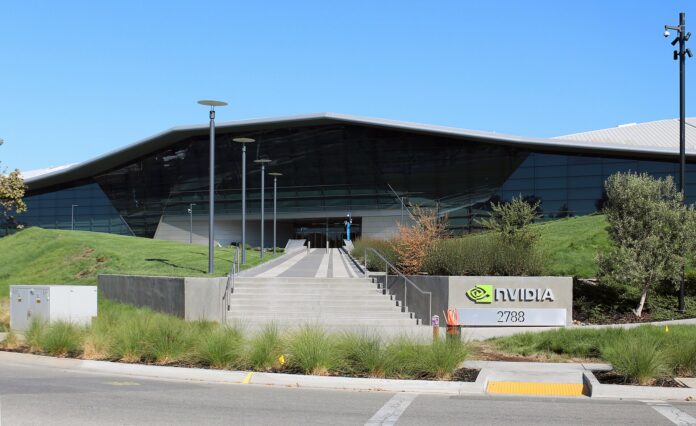
Featured image: “NVIDIA Headquarters” by Coolcaesar, via Wikimedia Commons, licensed CC BY-SA 4.0.

