
Japan’s national EV subsidy has run out. The Next Generation Vehicle Promotion Center (NeV), which runs the CEV grant for the trade ministry (METI), stopped taking applications with whatever arrived on Friday, Nov. 20, with online applications cut off at 5:15 PM JST (3:15 AM ET / 12:15 AM PT Friday). After counting Friday’s paperwork, about ¥930 million (about $5.9 million) was left in a ¥110 billion (about $693 million) pot, and NeV judged that applications through Tuesday, Nov. 24 would very likely blow past it. So it closed the door a few days early.
Last week we laid out the likely dates: Nov. 20, 24 or 25. It was the first one. If you’re shopping for an EV in Japan today, the ¥1.27 million (about $8,000) that used to come off a Tesla Model 3 or Model Y is gone, along with ¥1.3 million (about $8,190) on a Toyota bZ4X and ¥580,000 (about $3,650) on a Nissan Sakura. METI says what comes next is “under consideration,” TBS News Dig reported.
The last day was a stampede
The money didn’t fade out slowly. METI’s own update log shows the remaining balance at about ¥12.1 billion as of Nov. 16, ¥10.7 billion on Nov. 17, ¥9 billion on Nov. 18 and about ¥6.6 billion on Nov. 19. Then came Friday, and the balance dropped to ¥930 million. By our math that’s roughly ¥5.7 billion (about $36 million) in applications landing on the final day, as dealers rushed paperwork in before the weekend. Back in September and October, the official forecast was that the money would last until sometime in December.
The reason is simple. Japanese drivers bought more EVs than the budget planned for. Japan passed 100,000 EVs in a single calendar year for the first time, with 111,876 sold from January through October, and the regional business daily Chubu Keizai Shimbun summed up the closing as sales running ahead of what the ministry expected. Nikkei, NHK and Nikkan Jidosha Shimbun all reported the Friday shutdown.
What it means, in plain English
- CEV subsidy: the government’s grant for buying a “clean energy vehicle,” meaning a battery EV, plug-in hybrid or fuel cell car. The amount is set car by car, and the buyer gets it after the car is registered.
- Registration vs. application: two separate steps. The car gets plates (registration), then you or the dealer mail or upload the application. Only the application date counted at the end. A car registered on time whose paperwork arrived after Friday gets nothing from this round.
- Supplementary budget: extra spending approved partway through the fiscal year. This grant came from the fiscal 2025 one, and applications opened on March 31, 2026.
- Rejection letter: late applications get a “notice of non-acceptance” from NeV. On NeV’s status page, anything that arrived by Nov. 20 shows as “under review,” and anything from Nov. 24 on shows “no record.”
What happens next
Nobody knows yet, and NeV says so plainly. In its closing notice it points to the one time this happened before. In 2018 the grant ran out with applications that arrived on Dec. 17. The next year’s program covered cars registered from Jan. 1 onward, after the cabinet approved the budget. Cars registered between Dec. 18 and Dec. 31, and cars that missed the deadline, got nothing. NeV stresses that this is only a past example and nothing has been decided this time.
If history repeats, December is the dead zone. A car registered in late 2026 might fall between two programs, while one registered in January could qualify for whatever comes next. That’s a “might.” The amounts were also already set to shrink for cars registered from Jan. 1, 2027 (to ¥762,000, about $4,800, for a Model Y), and any new program could use different numbers again.
Automakers’ own deals keep running. Tesla Japan’s “charging support program” still takes ¥264,000 (about $1,660) off a new Model 3 for the first 1,500 buyers and ¥88,000 (about $550) off a new Model Y for the first 3,500, through Dec. 31, according to its Oct. 23 press release. That leaves a Model 3 from ¥5,049,000 (about $31,800) and a Model Y from ¥5,499,000 (about $34,700), now with no national grant underneath. The same release reminds buyers that many prefectures and cities run their own EV subsidies on separate budgets, so those are worth checking before you sign.
The EVX Take
The subsidy ran dry because it worked, and that’s the awkward part. Japan’s EV market finally got moving this year, helped by cheaper kei EVs like Suzuki’s new e SKY, BYD’s Racco and a refreshed Model 3 and Model Y, and now December buyers face a gap of up to ¥1.3 million with no date for what replaces it. The grant also leaned toward Japanese brands. The kei EVs from Nissan and Suzuki got ¥568,000 to ¥580,000 while BYD’s Racco got ¥150,000 (about $950), so the pause takes away a bigger price edge from the home team than from the imports. Expect December EV registrations to slump and January to bounce if a new program covers January cars. The thing to watch is the government’s next supplementary budget, because that’s where any new money would show up first. Until then, Tesla’s price, and every other EV price in Japan, just went up by the size of the grant.
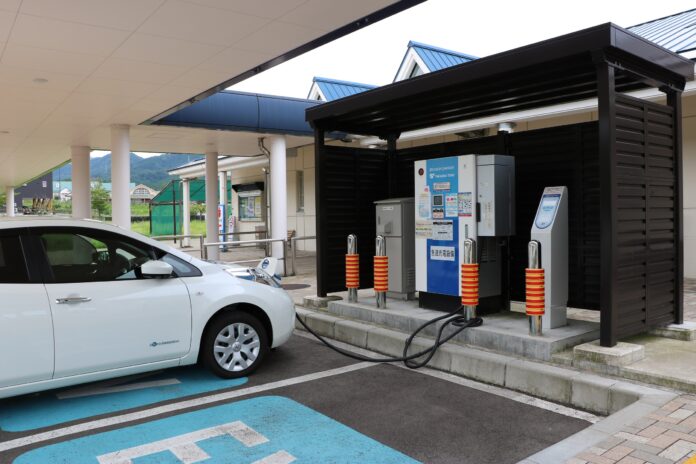
Sources: NeV closing notice (Nov. 20, 2026, Japanese), NeV CEV subsidy page (Japanese), METI (Japanese), Nikkei (Japanese), NHK (Japanese), Nikkan Jidosha Shimbun (Japanese), TBS News Dig (Japanese), Chubu Keizai Shimbun (Japanese), Tesla Japan press release (Oct. 23, 2026, Japanese). Featured image: a Nissan Leaf at an EV quick-charging station at the Johana service area on the Tokai-Hokuriku Expressway in Nanto, Toyama. Photo by さかおり via Wikimedia Commons, CC BY-SA 4.0.
Follow @teslaloha on X for more

 off a Tesla Model 3 or Y. Here's the last-day rush and what to do now.)