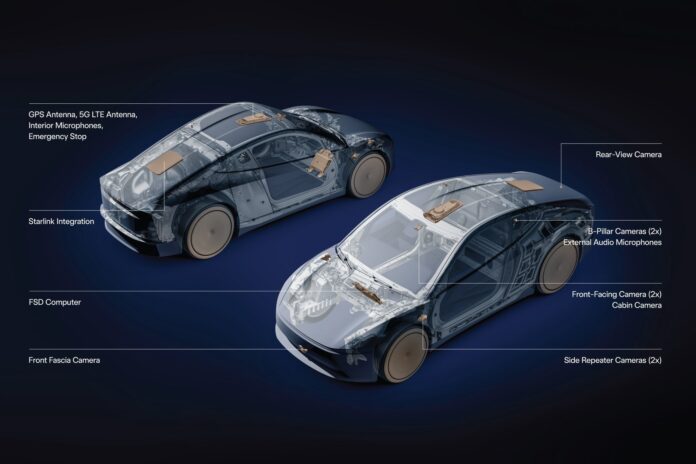

Elon Musk says built-in Starlink could reach every Tesla model, not just the Cybercab, “towards the end of next year,” meaning late 2027. He made the comment on X on Sunday, Nov. 22 at 8:15 PM ET / 5:15 PM PT (Monday, Nov. 23 at 10:15 AM JST), and he tied it straight to Tesla’s self-driving plans: “This will be important for unsupervised FSD, so passengers have high bandwidth everywhere for work and entertainment.”
Hopefully available towards the end of next year.
— Elon Musk (@elonmusk) November 23, 2026
This will be important for unsupervised FSD, so passengers have high bandwidth everywhere for work and entertainment.
Post embedded from Elon Musk’s official X account (@elonmusk).
He was answering David Marcus, the former PayPal president, who wrote that he couldn’t wait for Tesla “to offer an embedded Starlink option in all models (beyond the Cybercab).” About 20 minutes later, after Sawyer Merritt summed it up as all Tesla models getting Starlink by the end of 2027, Musk added one carve-out: “Except in China, as Starlink is illegal there.” Starlink doesn’t have a license to operate in mainland China, so that one was expected.
Note the word “hopefully.” This is a target in a reply, not a product announcement. Musk didn’t name models, a price, or whether cars already on the road could get the hardware added later, as TeslaNorth pointed out. Teslarati and Benzinga also reported the exchange.
The Cybercab already has one
There’s real hardware behind the idea. Tesla showed a Cybercab with a Starlink dish built into the body back in July.
Starlink V5 directly integrated in Cybercab pic.twitter.com/FxzTtzjB6I
— Tesla (@Tesla) July 20, 2026
Post embedded from Tesla’s official X account (@Tesla).
In September Tesla said the Cybercab would “soon” carry “V5 Starlink hardware, too, for complete connectivity,” next to its 22-inch screen with theater, music and gaming apps. Last week that became real: the Cybercabs that started public rides in Dallas on Nov. 19 have the dish built flush into the rear, Not a Tesla App reported, and Drive Tesla Canada described them as having factory-installed Starlink. Riders don’t appear to be able to connect to it yet.
For now the dish is a backup. Tesla AI chief Ashok Elluswamy has said it’s used mainly as redundant connectivity for navigation, customer service and fleet management, and that it “is still not required for safe operation of the vehicle,” according to Not a Tesla App. The driving itself happens on the car’s own computer. Sunday’s comment points at the next step, where the same link also serves the people in the back seat.
Meanwhile, AI4.5 lost some memory
Musk also changed the spec of Tesla’s next car computer on Sunday. “RAM is super expensive, so we reduced AI4.5 from 32GB to 24GB,” he wrote at 5:31 PM ET / 2:31 PM PT (7:31 AM JST Monday), replying to Whole Mars Catalog. “That will be fine. It’s hard to use 32GB anyway, given memory bandwidth constraints.” On the first-quarter earnings call, Tesla had talked about doubling memory per chip from 16 GB to 32 GB, Teslarati noted. Earlier the same day Musk said AI4 costs twice as much as before because of memory and storage prices, and that the bigger AI5 chip goes to Optimus while cars stay on AI4.
What it means, in plain English
- Starlink: SpaceX’s internet service, beamed from thousands of satellites in low Earth orbit, about 550 km up. Because they’re close, the delay is short enough for video calls and streaming. A dish only needs a clear view of the sky.
- Built-in vs. add-on: today people bolt a Starlink dish to a roof rack. Built-in means a flat antenna inside the car’s body, like the one in the Cybercab’s rear.
- How Teslas connect now: through cellular (LTE) networks and Wi-Fi. Where there’s no cell signal, you lose streaming and live traffic. A satellite link fills those gaps.
- Unsupervised FSD: self-driving where nobody has to watch the road. Then the driver becomes a passenger, and passengers want internet. That’s Musk’s point.
- RAM and memory bandwidth: RAM is the computer’s short-term workspace. Bandwidth is how fast data moves in and out of it. Musk is saying a bigger workspace doesn’t help much if the road to it is the bottleneck.
The EVX Take
Japan is one of the easiest markets on paper. Starlink launched here on Oct. 11, 2022, its first country in Asia, and KDDI’s au Starlink Direct has connected ordinary smartphones to the satellites since April 2025, so the license question that blocks China doesn’t apply. There’s a wrinkle, though. The Model 3 and Model Y sold in Japan come from Giga Shanghai, and Musk’s only named exception is China. Nobody has said whether Shanghai-built export cars would get the dish, so that’s the question for Tesla Japan. The case for it is easy to make here: mountain roads where the bars drop to zero, and earthquakes, where KDDI and Starlink Japan sent 350 dishes to Noto shelters in January 2024. A car that keeps its connection when the towers go down is a real selling point in this country. Just don’t expect a signal in the tunnels. And with FSD (Supervised) still not approved in Japan, “work and entertainment” from the back seat is a perk Japanese owners will get to enjoy later than most. Here, the dish may matter more for maps and safety than for movies.
For cars outside China, the target is the end of 2027. Starlink has already been squeezed into a laptop-sized Mini, and Tesla has already fit one flush into the Cybercab’s rear hatch. Spreading it across the lineup is now a cost and packaging problem.
Sources: Elon Musk on X (late-2027 target, China exception, AI4.5 at 24 GB), Sawyer Merritt on X, Tesla on X (July 20, Sept. 3), Not a Tesla App, Drive Tesla Canada, Teslarati, TeslaNorth, Benzinga, Nikkei Asia (Starlink Japan launch), KDDI (au Starlink Direct). Featured image: Tesla’s cutaway graphic of the Cybercab showing its built-in Starlink, cameras and FSD computer. Image: Tesla via X (official, July 20, 2026).
Follow @teslaloha on X for more

