
CEATEC 2026 wrapped up at Makuhari Messe on October 16, and the robots stole the show. A University of Tokyo startup brought a homegrown humanoid that’s heading for mass production at a Mitsubishi Motors plant. Honda showed an avatar robot with an AI co-pilot that steadies a human operator’s hands. And on the sidelines, Kawasaki Heavy Industries and the Matsuo Institute revealed how they taught a humanoid to lift 22.7 kg in six weeks. Here’s Japan’s physical-AI week, translated and explained.
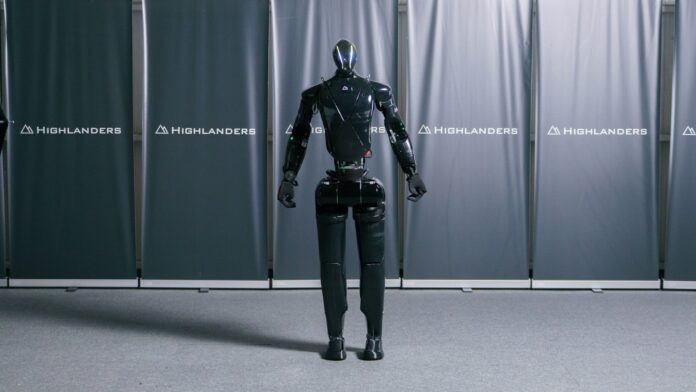
Highlanders’ “N”: a made-in-Japan humanoid built to be mass-produced
Tokyo startup Highlanders showed a mass-production prototype of its humanoid robot “N” on October 13 and 14 in the AWS booth in Hall 4, with live demos run by its engineers. According to the company’s CEATEC announcement:
- Fully vertically integrated: mechanics, electronics, embedded software and AI are all developed in-house. Sound familiar, Tesla fans?
- Payload: 8 kg with one arm, 12 kg with both.
- Shipments targeted for 2027. The pitch is a robot that can work in factories and facilities built for people, without rebuilding them, aimed squarely at Japan’s labor shortage.
The industrial muscle comes from Mitsubishi Motors. In a memorandum of understanding signed in July, the two companies agreed to discuss co-developing humanoids for Mitsubishi’s own plants. Mitsubishi also said it would consider building Highlanders’ robots in an idle building at its Kyoto plant, starting as early as 2027, according to Mitsubishi’s release. Mitsubishi called it the first tie-up of its kind between an automaker and a humanoid developer for mass production. It has already invested in Highlanders and plans to invest more. Trade paper Nikkan Jidosha Shimbun reported a planned capacity of around 1,000 units a month. Highlanders was also selected in September for GENIAC, the national robot foundation-model project run by Japan’s Ministry of Economy, Trade and Industry (METI) and the New Energy and Industrial Technology Development Organization (NEDO).
Honda’s Avatar Robot gets an AI co-pilot
Honda went a different way. Rather than replacing people, its Honda Avatar Robot is built to send a person’s skills somewhere else. An operator wears goggles and gloves and works through the robot from far away. At CEATEC, a remote engineer used it to tighten screws on an engine case. Honda ran the demo twice, once with its new AI support system and once without, as Response reported:
- Without AI help, the multi-fingered hand could pick up a screw but struggled to shift its grip for installation. With AI on, the robot balanced its finger forces and made the swap.
- A nut driver wouldn’t turn without assistance but turned fine with it.
- With a torque wrench, the AI corrected the tool’s wobbly path (the operator waves their arm in mid-air, after all) so the screw could be tightened.
Yamaguchi, a researcher in Honda R&D’s frontier robotics domain, told Response the project started around the time Honda decided to end ASIMO, about five to six years ago. The lesson from ASIMO was that dexterous hands and full autonomy were the bottlenecks, so Honda combines human judgment with robotic precision instead. Network lag is the other enemy: even Japan-to-US links can add about 200 milliseconds, and the AI handles fine control locally to cover the gap. The first real-world use would be remote troubleshooting in factories. Medical work, equipment maintenance, disaster response and space come later.
Kawasaki and the Matsuo Institute: 22.7 kg, six weeks
On October 13, the Matsuo Institute, an AI company spun out of the University of Tokyo’s Matsuo Lab, disclosed its work with Kawasaki Heavy Industries on a reinforcement-learning control policy for Kawasaki’s humanoid Kaleido9. Using an NVIDIA simulator, the team built the full sim-to-real pipeline, from training to running on the real robot, in six weeks. Kaleido9 then lifted a basket weighing about 50 lb (22.7 kg) with both hands and set it on a table. It performed the demo at the May 21 opening of the Kawasaki Physical AI Center in San Jose, after testing at Kawasaki’s KAWARUBA lab at Haneda. The release notes Japan’s growth strategy plans ¥10.5 trillion in public-private physical-AI investment by fiscal 2040.
The EVX News take
Notice the pattern? Japan’s answer to the humanoid race is to pair nimble startups and labs with old-school manufacturing muscle: Highlanders with Mitsubishi, the Matsuo Institute with Kawasaki. Tesla is doing everything in-house with Optimus, and Highlanders is copying that vertical-integration playbook at a smaller scale. Japan has one of the world’s most acute labor shortages and some of its best factories. If a Kyoto plant starts turning out humanoids in 2027, Optimus will have a real Japanese rival. We love that. Competition makes everyone’s robots better.
Sources: Highlanders (PR TIMES), Mitsubishi Motors, Nikkan Jidosha Shimbun, Response, Honda, Matsuo Institute.
— The EVX News team
Featured image: Highlanders, via PR TIMES.

