
The Tesla Model Y just set a record that most cars never get a shot at. Green NCAP, the European program that rates how green a car really is from mine to scrapyard, gave the Berlin-built Model Y Rear-Wheel Drive a full five-star Sustainability Rating and a 93% score. Its life-cycle greenhouse gas total came in at 95 grams of CO2-equivalent per kilometer, the lowest figure Green NCAP has ever published.
Green NCAP released the results on Thursday, Oct. 29, and Tesla’s European account was quick to brag about it. Fair enough.
Why 95 grams is a big deal
Life-cycle numbers usually get fuzzy fast. Most automakers don’t hand over factory data, so Green NCAP fills the gap with generic assumptions about how a car and its battery were built, and those assumptions tend to be conservative. Tesla did something different. It gave Green NCAP its own vehicle and battery manufacturing data for the Model Y, and Green NCAP’s experts checked it. The program calls that a first for Tesla and “OEM best-practice transparency.”
That checked data is what pushed the score to the top. To earn all 10 points in the Greenhouse Gases category, a car has to come in under 110 g CO2-eq/km. The Model Y beat that line by 15 grams, and that’s with a 1.9-tonne SUV, not a featherweight city car. Green NCAP says Tesla’s moves to cut emissions at the vehicle and battery plants “are effective.”
The comparison Green NCAP chose makes the point without any help from us. It rated a similarly sized Volkswagen Tayron 1.5 eTSI, a mild-hybrid gas SUV, at 2½ stars and 41%, with 263 g CO2-eq/km over its life. That’s almost three times the Model Y’s figure.
What the test drives showed
The lab and road results back it up. On a mixed road drive in 35°C (95°F) summer heat, the Model Y used 15.2 kWh per 100 km, and 12.7 kWh/100 km on a short urban trip. Cold weather costs it, as it does every EV. In the −7°C (19°F) winter cold-start test it drew 30.5 kWh/100 km, but the same cycle with a pre-warmed car took only 21.2. Green NCAP’s tip for owners is basically what every Tesla forum has said for years: precondition before you leave.
The cabin earned unusual praise. It reached a 16°C target in four to eight minutes on a cold start, and after the car sat locked at −7°C for 30 minutes, the cabin had lost just 5.2°C. Green NCAP says the Model Y is one of the few cars it has tested with “good” thermal insulation, and one of only two rated “good” for both consumption and range and for cold-winter performance. A 10% to 80% DC fast charge took 24 minutes.
There was one ding. The European Model Y has no bidirectional charging (V2L or V2G), and Green NCAP noted it. Owners in Japan may smile at that one: the new Japan-market Model 3 and Model Y just added V2L this month, with the adapter due in January.
The Japan angle
The rating covers the Berlin-built car sold in Europe, and the low score depends on Tesla’s own data from that plant. Japan’s Model Ys come from Giga Shanghai, so this exact 95-gram figure doesn’t carry over to cars here. The efficiency and cold-weather results are about the car itself, though, and they’re a nice data point for the country’s best-selling import model.
Green NCAP also rated the BYD Dolphin Surf (five stars, 96%, judged with generic production data), the Suzuki e Vitara (4½ stars, 87%) and a diesel Volkswagen Golf (3½ stars, 69%). Europe bought about 150,000 Model Ys last year, by Green NCAP’s count, and Giga Berlin just built 7,000 in one week. Now the next automaker has to decide whether to open its own books to the testers.
Sources: Green NCAP press release, Green NCAP Model Y assessment, Tesla Europe on X, Drive Tesla, TeslaNorth.
— The EVX News team
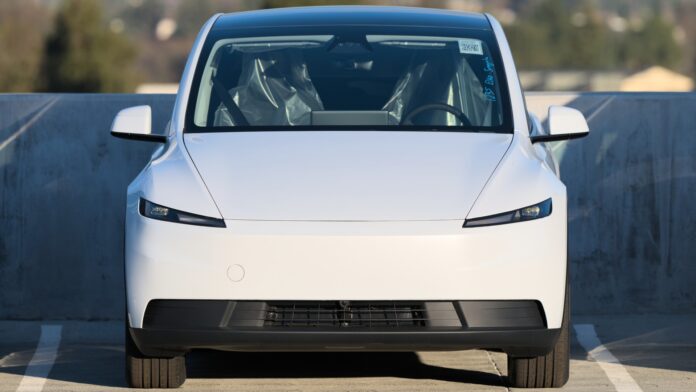
Featured image: A 2025 Tesla Model Y, front view. Photo: Dllu / Wikimedia Commons (CC BY-SA 4.0, cropped).

