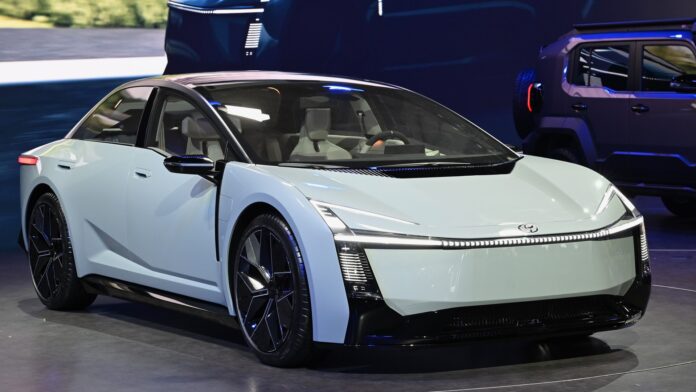

Toyota is building its next cars around one platform that can take a battery, a plug-in hybrid or a regular hybrid without changing the body. The key enabler is an all-new 1.5-liter four-cylinder hybrid system that Toyota says is small enough to fit under a low, EV-style hood and should cut fuel use by more than 15%.
Toyota Motor Europe laid out the plan in a release from Brussels on Wednesday, Oct. 28. It calls the new architecture a “multi-pathway platform,” a nod to the company’s long-standing argument that the world won’t go fully electric at one speed.
A BEV platform first, with room for an engine
The interesting part for EV watchers is the order of priorities. Toyota says the platform is being developed “to deliver uncompromised performance and product appeal as a battery-electric vehicle.” The hybrid hardware then has to shrink to fit that package, not the other way around.
That’s why the engine is new from the ground up. The 1.5-liter four comes in naturally aspirated and turbocharged versions. Going from three cylinders to four sounds backward, but more cylinders allow a shorter stroke, which lowers the engine’s height. Car Watch reported earlier this month, from a Toyota technical briefing in Europe, that the turbo version covers the power range of today’s 2.5-liter four with 20% less volume and 15% less height, and that the non-turbo version is 10% smaller and 10% lower. The goal is something close to the compactness of an EV’s e-axle.
The motors, power control unit and inverters are also lighter and smaller, and Toyota developed the whole thing as one powertrain instead of bolting a hybrid onto an existing engine. The naturally aspirated version is meant to cover the hybrid performance that Toyota’s 1.8-liter engine and its 1.5-liter three-cylinder handle today.
Where the 15% comes from
Toyota is targeting “more than 15% better fuel economy” through lower mechanical friction, better thermal management, smaller electrical losses and lower aerodynamic drag. The last one ties back to the platform: a lower hood means a sleeker nose. Toyota hasn’t given a specific fuel-economy figure, a launch date or the first model.
Japanese outlet Kuruma News points to the next Corolla as the likely first car, since Toyota’s Corolla Concept was shown with multiple powertrains. Car Watch noted the Corolla Concept also appeared on the panel at Toyota’s European briefing. InsideEVs and HT Auto also covered the announcement.
The business case
A shared architecture means development and factory spending gets spread across BEVs, PHEVs and hybrids combined. Toyota also says factories should be able to “seamlessly adjust the powertrain mix to closely match customer demand.” Translation: if EV demand jumps in one market, the same line can build more of them without a retool. If it stalls, the line shifts to hybrids.
Toyota plans to sell the new engine and hybrid tech to other companies in the coming years, and says the system is being designed to run on renewable and carbon-neutral fuels.
What it means for EVs, and for Japan
It’s easy to read this as Toyota doubling down on hybrids, and it partly is. Hybrids remain Toyota’s profit engine and the default choice for Japanese buyers. But it also shows Toyota designing cars where a BEV version is the baseline rather than an afterthought, which is how Tesla and the Chinese makers already think. It fits Toyota’s broader shift we covered earlier this month, from making every model software-defined by 2030 to Japan’s carmakers trying to build at China speed.
For buyers in Japan, the practical upshot is choice on one body: the same next-gen Corolla-sized car could come as a hybrid at the dealer down the street or as an EV for the commuter with a home charger. Rivals aren’t waiting. Mercedes just put the electric GLC on sale in Japan on a dedicated EV platform.
Sources: Toyota Motor Europe, Kuruma News, Car Watch, InsideEVs, HT Auto.
— The EVX News team
Featured image: Toyota Corolla Concept (2025). Photo: TTTNIS / Wikimedia Commons, CC0 (cropped).

