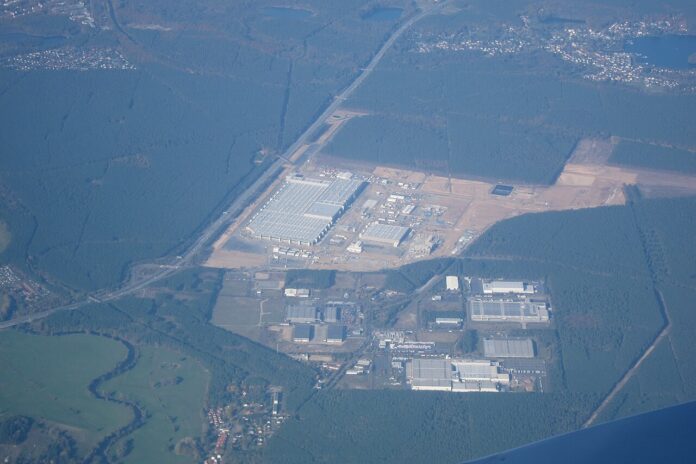

Giga Berlin is preparing for its next big expansion. Tesla plans to apply for permits in December for a second production hall more than twice the size of the current one, the first concrete step toward the factory’s long-discussed target of 1 million vehicles a year.
The plan
German broadcaster rbb24 first reported the plans, and Not a Tesla App and Drive Tesla Canada followed:
- A new production hall north of the existing plant in Grünheide.
- About 536,000 m² (5.76 million sq ft), versus 219,000 m² (2.35 million sq ft) for today’s main building.
- Permit applications in December 2026, with construction possibly starting in 2027.
- The full build-out is expected to take about ten years.
At 1 million vehicles a year, Giga Berlin would rival Giga Shanghai, Tesla’s largest manufacturing hub, in annual capacity.
Tesla’s statement
Tesla said the expansion is consistent with what it filed years ago: “As early as 2023, Tesla outlined the phased expansion of Gigafactory Berlin-Brandenburg in its application for a partial permit and set out the associated environmental impacts. With the approval notice of October 15, 2024, its fundamental approvability was established. The planned partial permit application for the northern production building builds on that.”
Where Berlin stands today
- Current output target: 7,500 Model Y per week, about 375,000 a year.
- Two ramps in 2026: a 20% production increase with 1,000 new hires in April, then another 1,000 jobs to reach 7,500 a week this month.
- More than 750,000 vehicles built in total, passed this spring.
- Berlin builds the Model Y for Europe and several export markets, including Canada.
Drive Tesla Canada notes there’s still room to grow inside the current permitted capacity of 500,000 before any new hall comes online. The original approved plans also allow battery cell capacity to double from 50 GWh to 100 GWh a year.
Built with the environment in mind
Giga Berlin has faced local opposition over forest clearing and water use, and Tesla has adjusted its plans accordingly. In May 2024, local officials approved revised plans that significantly reduced the amount of forest to be removed. The new expansion includes a dedicated electrical substation, another water-recycling system and Tesla’s own wastewater treatment. Drive Tesla Canada reports that while water consumption would rise, the expansion isn’t expected to generate additional sanitary wastewater.
What could go in there
Musk has said Cybercab is the “most likely next major product” for Giga Berlin, with Optimus possibly following, and he recently said he hopes to bring Cybercab to Europe soon. Not a Tesla App also notes that the expansion delivers on a promise Tesla leadership made to Berlin workers, after employees voted against a union majority in this year’s works council election.
Why it matters
Europe is in a strong EV moment. Tesla finished Q3 with the Model Y leading across the continent, and European EV sales recently hit record highs. Building more cars locally means shorter supply chains, fewer cars shipped across oceans, more European jobs, and products designed for European buyers. A 1-million-unit Berlin would be one of the most important clean-manufacturing sites in the EU.
The EVX News take
A decade-long timeline is a realistic one for a German permitting process. The plan is in motion, the permits are coming, and the hall is sized for the products Tesla expects to build next. Giga Berlin started out as Tesla’s riskiest factory, and it’s becoming one of its most important.
Sources: Not a Tesla App, Drive Tesla Canada, rbb24, Tesla statement, @alex_avoigt on X.
— The EVX News team
Featured image: Tesla Gigafactory Berlin-Brandenburg, by Olivier Cleynen, via Wikimedia Commons, licensed under CC BY 4.0.

