
Tesla has asked the Australian Senate to help pull the country’s national self-driving law forward by two years, from an expected 2029 to 2027, and to back a driverless trial on public roads in 2027 while that law is still being written. The requests are the last two of eight recommendations in a submission Tesla Motors Australia sent to the Senate Select Committee on Productivity in Australia.
The submission, numbered 258 and dated Oct. 16, was published on the committee’s website last week. Most of its eight pages are about chargers, trucks, fuel credits and road user charging. The autonomy section is short, and it’s blunt.
“Australia’s AV regulatory framework was first proposed by the National Transport Commission back in 2016,” Tesla wrote. “Today, progress on a national AV framework remains fragmented and continues to face uncertain timelines.”
The two asks
Recommendation 7 is the near-term one. Tesla wants the Commonwealth to “support an AV trial in 2027, working with industry to grant permits to unlock AV trials on public roads until such time that the national regulatory framework for AVs is in place.” In plain terms, give out permits so driverless cars can be tested on real roads before the full rulebook exists.
Recommendation 8 goes after the rulebook itself, the proposed Automated Vehicle Safety Law (AVSL). Tesla wants Canberra to work with the states and territories to “prioritise and accelerate” it, through faster federal-state coordination and work on technical standards. Pulling the law forward “by just two years,” Tesla argues, “would not just save hundreds of lives and prevent thousands of injuries, but also unlock more than $10 billion” (about $7.0 billion USD) in safety, productivity, environmental and economic benefits. That figure comes from modeling by the Autonomous Vehicle Association of Australia, not from Tesla. Tesla also cites the federal government’s own estimate that autonomous vehicles could save up to 800 lives a year at full adoption.
The pitch lands in a country where road deaths hit a 15-year high in 2025, a point Tesla makes in the first line of the section.
Tesla’s FSD numbers from down under
To make the case, Tesla points at the system it already sells there. FSD (Supervised) launched in Australia and New Zealand in September 2025, and Tesla says cars have since driven more than 160 million kilometers (about 99 million miles) with it switched on. Compared with Tesla vehicles driving without it, Tesla says drivers using FSD (Supervised) saw 40% fewer collisions, 90% fewer harsh-braking events and 86% fewer harsh-acceleration events.
Those are Tesla’s own figures, and the submission doesn’t spell out the method or time period, as techAU pointed out. Tesla is also careful about what the product is. The submission says FSD (Supervised) complies with Australian law “as an SAE Level 2 ADAS that requires drivers to maintain proper control of the vehicle at all times.” The safety data is about a supervised system. The trial Tesla wants would be about the next step, a car with nobody responsible behind the wheel. For a sense of how Tesla reports those numbers elsewhere, see its latest U.S. FSD safety report.
Where Australia’s rules actually stand
Tesla’s “2029” date is the heart of its argument, and it isn’t easy to find in public documents. techAU searched for it and came up empty. What the record shows is a target that keeps slipping. Transport ministers set a goal in 2017 of an end-to-end system by 2020. The National Transport Commission’s 2022 policy paper talked about implementing the framework by the end of 2026.
The latest firm decision came at the Infrastructure and Transport Ministers’ Meeting of Nov. 21, 2025. Ministers agreed to “conditional deployment of automated vehicles in select locations from 2027 as a first step,” with full national readiness “as soon as practical thereafter,” depending on each state’s and territory’s capabilities. So 2027 is already on the official calendar for limited deployment. What isn’t public is when the AVSL itself would start nationally. Tesla’s 2029 may come from its talks with officials, which the submission mentions.
Tesla isn’t facing pushback in the inquiry, at least not yet. techAU reviewed the other submissions it could open and found few that deal with road autonomy at all, and none opposing a 2027 start. The committee has public hearings listed for Nov. 30 and Dec. 4, according to EV Select.
Why Tesla cares about Australia
Australia is a real market for Tesla. The submission says Tesla has delivered more than 151,000 cars there since 2023 and runs the country’s largest public ultra-fast charging network, with more than 1,000 bays at 160 sites. Tesla has been touring the Cybercab through its Australian showrooms, Information Age reported, but the car can’t legally run on local roads, since it has no steering wheel or pedals and Australian law assumes a human driver. In Texas, Tesla’s registered robotaxi fleet just passed 1,200 vehicles. In Australian showrooms, the same car is a very expensive photo prop. Drive Tesla Canada and Autotalk also covered the submission.
The EVX Take
Japan already did the thing Tesla is asking Australia to do. Japan’s amended Road Traffic Act has allowed permitted Level 4 driverless operation since April 2023, and the government’s target is driverless mobility services in 100 or more locations by fiscal 2027, according to the transport ministry. Those permits mostly cover slow, fixed-route shuttles, though, and that’s why Waymo and Toyota’s driverless bZ4X plan for Japan in 2027 matters more than the law on paper. Tesla’s own Japan program is a step behind its Australian one. It has been testing FSD (Supervised) on Japanese roads since August 2025 but hasn’t released it to customers. If Canberra says yes to a 2027 trial, Tesla gets a right-hand-drive, left-side-of-the-road test bed that looks a lot like Japan’s roads, and that data would be directly useful for any Japanese launch.
The hearings come next. If senators take up recommendation 7, the first permits could be drafted in 2027, the same year Japan’s 100-location goal comes due.
Sources: Tesla Motors Australia, Submission 258, Senate Select Committee on Productivity in Australia, ITMM communique (Nov. 21, 2025), National Transport Commission, Drive Tesla Canada, techAU, Information Age (ACS), EV Select, Autotalk, MLIT, Tesla Japan (PR Times).
— The EVX News team
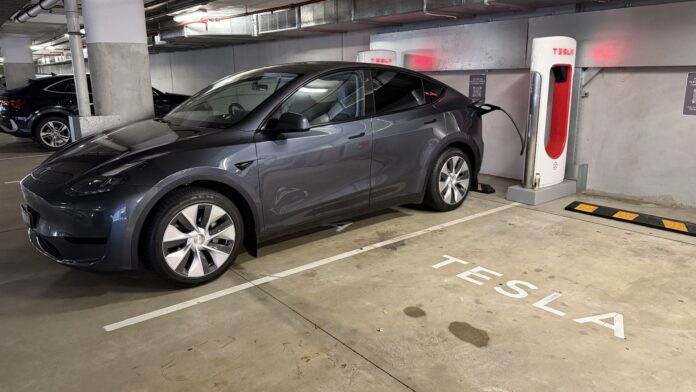
Featured image: A Tesla Model Y at a V3 Supercharger in North Coogee, Western Australia, August 2026. Photo: Leesieoh / Wikimedia Commons (CC BY-SA 4.0, cropped).

