
Tesla’s batteries are about to plug into one of Japan’s biggest grid storage sites, a few days after Japan’s EV subsidy ran out of money. Over in Guangzhou, Japan’s carmakers showed up with Chinese software, Chinese batteries and, in Nissan’s case, a plan to ship a China-built van home. Here’s the week on EVX News, in eight stories and one number.
Busy week? This is the catch-up. Every item links to our full story, sources and all.
1. 140 Tesla Megapacks switch on in Shiga, a year early
ORIX said on Nov. 24 that its Maibara Koto battery station in Maibara, Shiga Prefecture, starts commercial operation on Monday, Dec. 1. Inside: 140 battery containers rated at 134 MW and 548 MWh, and Tesla Japan confirmed back in February 2025 that they’re Megapacks. That same announcement said the site would open in 2027. It’s early. (Quick decoder: MW is how fast it can push power into the grid, MWh is how much it can store.) It’s also the second big Megapack project to start up in Japan this month, after a roughly 125 MWh system next to a solar farm in Oita on Nov. 15. The two numbers, the 20-year auction behind it and the biotope pond.
2. Japan’s EV subsidy ran dry on Friday
Last week we said the CEV grant would probably end on Nov. 20, 24 or 25. It was the 20th. NeV stopped taking applications with whatever arrived that Friday, leaving about ¥930 million (about $5.9 million) in a ¥110 billion (about $693 million) pot, after roughly ¥5.7 billion (about $36 million) in paperwork landed on the final day alone. So the ¥1.27 million (about $8,000) that used to come off a Tesla Model 3 or Model Y is gone for now, and what comes next is “under consideration.” The reason it ran out is a happy one, sort of: Japan sold 111,876 EVs from January through October, its first 100,000-plus year. What it means if you’re still shopping.
3. Japan’s carmakers bring Chinese brains to Guangzhou, and Nissan wants to ship them home
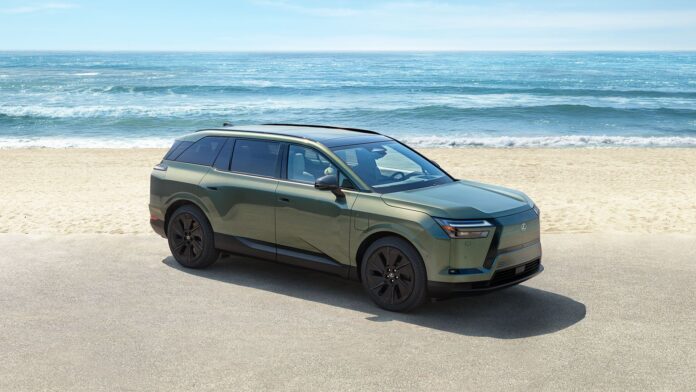
The Guangzhou Auto Show opened on Friday, Nov. 27, and Japan’s biggest carmakers leaned on local tech. Lexus gave the three-row TZ electric SUV its China debut (Japan gets it “around winter 2026”), and GAC Toyota named the Highlander 9X, Toyota’s first range-extender (an EV whose gas engine only charges the battery), with Huawei driver-assist software and a CATL battery. Dongfeng Nissan launched a plug-in hybrid SUV at 129,900 yuan (about $19,500). The day before, Nikkei reported that Nissan is preparing to import a China-built NV200 plug-in hybrid van to Japan from the second half of fiscal 2027. Nissan hasn’t announced it. Tesla skipped the show, as usual. Who brought what, and why Nissan is looking at Zhengzhou.
4. Chinese brands now outsell Japanese ones in 39 countries
A Nikkei analysis of January–September sales found Chinese carmakers ahead of Japanese ones in 39 countries, 14 of which flipped this year, including Germany, Italy and Brazil. In Germany it’s 6% to 5%. In Brazil, BYD’s new local factory helped push China’s share up 10 points to 19%. Japanese brands still lead in 54 of the 93 countries Nikkei could compare, so this isn’t a wipeout. But the flips came where EVs took off. The country-by-country numbers.
5. CATL’s new swap battery is a 100 kWh chocolate bar
CATL showed its 30# Chocolate pack at Huawei’s Qiankun conference on Nov. 26: 100 kWh, more than 700 km on China’s generous CLTC test cycle, and a 99-second swap at CATL’s stations. Battery swapping, in plain English, means you don’t wait for a charge; a machine pulls out the empty pack and drops in a full one. CATL’s earlier 25# pack, the one most used at its stations, is 56 kWh, so this one opens the door to bigger, pricier cars. CATL’s network passed 2,520 stations across 31 provinces by late September. The specs, the Huawei tie-up and the Japanese brands caught in the middle.
6. Suzuki’s kei EV hit the gym for Europe
Suzuki unveiled the all-new electric Ignis on Nov. 25, and it’s basically the e SKY kei car from last week’s digest, bulked up. It’s 175 mm longer and 90 mm wider, with the same 26 kWh LFP battery and a 67 kW (about 91 hp) motor, well past the 47 kW limit kei cars in Japan stick to. It goes on sale in Europe and other markets from around summer 2027. No price and no official range yet. The specs and the strategy.
7. A Tokyo startup mocked up Tesla’s Reality View in about seven hours
Tesla showed off Reality View, the live bird’s-eye screen in FSD v15, and Turing CEO Issei Yamamoto replied, “Let’s build one at Turing too!!” Just under seven hours later he posted a 26-second clip: “I built it and it worked!” His own caveat: it’s a rendering demo, not connected to the car’s controls, and running it live on the car’s computer would take more work. Tesla’s version, of course, already ships. What the clip shows, and what it doesn’t.
8. XPeng’s robot heads to production, and its CEO shrugs at Reality View
At its AI Day in Guangzhou on Nov. 25, XPeng said its IRON humanoid robot enters hardware mass production in January 2027 (that’s the factory building it, not you buying one) and that its robotaxis there have started invitation-style rides with nobody in the driver’s seat. Asked about Tesla’s Reality View, CEO He Xiaopeng said he’d only watched videos and that it “isn’t that difficult”; the real question, he said, is whether it’s worth the computing power. He also said robots won’t reach homes and factories at scale until 2029 or later. IRON, the empty driver’s seat and the YOYO-01 robotaxi.
Number of the week: 548 MWh
That’s how much energy the 140 Tesla Megapacks at ORIX’s Maibara Koto station can store. At 134 MW, it can run flat out for about four hours, and by ORIX’s math one full charge and discharge equals the daily electricity use of about 51,000 Japanese homes. It starts work on Monday, Dec. 1. Our Megapack story.
The EVX Take
The week split neatly in two. On the buying side, Japan’s EV market lost its subsidy just as sales passed 100,000 for the first time, so the next few months will show how much of that demand was the grant talking. On the building side, the news kept pointing at China. Japan’s carmakers are using Huawei software and CATL batteries for their China cars, Nissan may sell a China-built van at home, and Chinese brands keep passing Japanese ones abroad. Tesla is the outlier in both halves. It doesn’t need a Chinese software partner, the Model 3 and Model Y Japan buys already come from Giga Shanghai, and its Megapacks are now among the largest grid batteries in Japan, opening ahead of schedule. A rival CEO calling Reality View “not that difficult” while a Tokyo startup builds its own mock-up in under seven hours is, if anything, a compliment.
Next week we’ll be watching Maibara’s Dec. 1 start, China’s November delivery numbers in our monthly scoreboard, our Japan EV sales report for November, and any word on what replaces the CEV grant.
This digest summarizes Japan- and China-relevant stories EVX News published between November 22 and November 28, 2026. Sources for each item are listed in the linked articles.
— The EVX News team
Featured image: Lexus TZ, official press photo, May 2026. Image: Toyota Motor Corporation (Lexus Global Newsroom).
Follow @teslaloha on X for more

