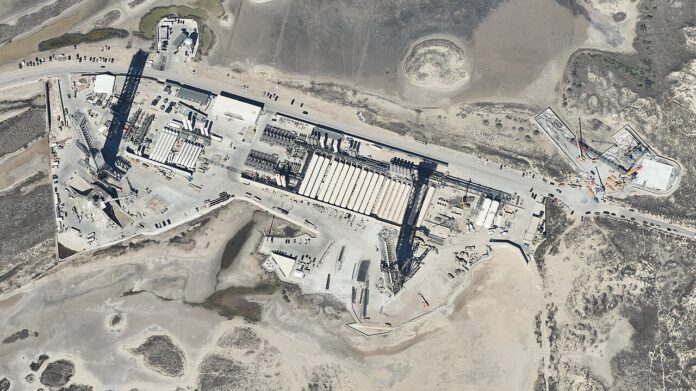

SpaceX wants to launch Starship from Texas nearly every weekday. The FAA has formally started an environmental review of a plan for up to 456 Starship launches and 912 landings a year from Starbase, about 18 times today’s limit.
What the FAA announced
The FAA said Tuesday it will prepare a Programmatic Environmental Impact Statement on SpaceX’s proposal. The notice of intent was set to publish in the Federal Register on Wednesday. Drive Tesla Canada and Teslarati lay out the plan:
- Today: 25 launches and 50 landings a year, under an FAA approval from May 2025.
- Phase 1: up to 100 launches and 200 landings a year, with no day-of-week or time-of-day limits.
- Phase 2: up to 456 launches and 912 landings a year, day or night but weekdays only, which works out to about 1.75 launches every weekday. The FAA says Phase 2 could follow “within several years.”
The 912-landing cap applies at Starbase regardless of where a mission launched, so vehicles flown from other sites and returned to Texas count toward it. Starship and Super Heavy could land at the launch site or in the Gulf and open ocean.
Have your say
The review will cover air quality, wildlife, coastal resources, water, noise and aviation. Public scoping meetings are scheduled for:
- November 17 – Brownsville (in person)
- November 18 – virtual session
- November 19 – Port Isabel (in person)
Written comments are due November 30 on regulations.gov under docket FAA-2026-12808. A draft statement will follow later, and any increase beyond this proposal would need its own review.
Ambitious, by design
For perspective, Starship has flown three times from Texas this year, including Flight 14 on September 28, the first orbital flight, which deployed 26 Starlink V3 satellites. Teslarati notes that Starbase has never hosted more than five launches in a calendar year. In February, the FAA separately approved up to 44 Starship launches a year from Launch Complex 39A in Florida.
So why ask for 456? Because the whole point of a fully reusable rocket is airline-style turnaround. Musk has said Starship could eventually fly more than once an hour within a decade. The near-term needs are already large: thousands of Starlink V3 satellites, NASA’s Artemis lunar lander, which depends on multiple tanker flights for orbital refueling, and SpaceX’s own space-based computing plans. You don’t get there with 25 launches a year.
What it means for Flight 15
Nothing changes in the short term. Flight 15, which Musk said on October 10 is hopefully four to six weeks away and will attempt to catch the ship with the tower, flies under the existing 25-launch limit. So will every Starbase launch until the review is finished.
The EVX News take
Asking for permission to fly more often than any rocket program in history only makes sense if the rocket comes home and flies again. SpaceX is betting it will, and the paperwork is now in motion. If the Flight 15 catch attempt succeeds, a 456-launch cap starts to look less like an ambition and more like a plan.
Sources: Drive Tesla Canada, Teslarati, FAA notice of intent (Federal Register, docket FAA-2026-12808). Not a Tesla App did not cover this story.
— The EVX News team
Featured image: SpaceX Starbase launch site, early 2026, by NOAA / NODD, via Wikimedia Commons, in the public domain.

