
BYD sold 490,168 new energy vehicles in October, its best month of 2026, and its battery-electric passenger car sales topped 300,000 for the first time. The rest of China’s EV field split hard on Sunday: Leapmotor set another record at 106,127, Xpeng and Xiaomi each passed 50,000 deliveries, and Nio and Li Auto both went backward.
BYD’s numbers come from its monthly production and sales filing with the Hong Kong exchange. Total sales rose 10.97% from October 2025 and 5.74% from September. It’s BYD’s sixth straight month of year-on-year growth, and its highest monthly total since December 2024, according to CnEVPost.
BYD’s mix keeps tilting electric
The headline is the battery-electric line. BYD sold 305,743 battery-electric passenger cars in October, up 37.38% from a year earlier and a record for the third month running. Plug-in hybrids went the other way, falling 17.23% to 177,382. Battery EVs were 63.28% of BYD’s passenger car sales, up from 50.95% a year ago, by CnEVPost’s math.
Exports did most of the lifting. BYD shipped 170,194 NEVs abroad in October, up 102.84%, though that’s 5.81% below September. In China, BYD sold 319,974 cars, 10.57% fewer than a year earlier. From January through October, BYD has sold 3,621,744 NEVs, still 2.16% behind last year’s pace, with exports at 1,513,154. Cailian Press, Eastmoney and Sina Finance (via MyDrivers) reported the same totals, and Sina’s breakdown has the Dynasty and Ocean lines at 423,843, Fang Cheng Bao at 43,872, Denza at 15,152 and Yangwang at 258.
That overseas surge is the same story that drove BYD’s 28% jump in third-quarter profit. Home is the harder market, and BYD’s new second-generation Seal 07 sedan arrives on Nov. 5 to help.
The startups: three up, two down
Leapmotor delivered 106,127 vehicles worldwide, its fourth straight month above 100,000 and up 51% from a year ago, according to the company figures reported by Jiemian. Growth from September was only 0.45%, though. Leapmotor is at 772,666 for the year, 77% of its 1 million target, so it needs about 113,700 a month in November and December. It also says its 2 millionth car rolls off the line this month.
Xpeng delivered 50,237, its first month above 50,000, up 20% from a year earlier and 22% from September. Overseas deliveries hit a record 13,326, up 166%, which Beijing Daily worked out as about 26.5% of the total. More than one in four new Xpengs now leaves China.
Xiaomi said it delivered “more than 50,000” cars without giving an exact count, its best month of the year and only the second time it has passed 50,000. October was the first full month of deliveries for its new Sky Nomad (澎程) range-extender series.
Nio delivered 34,246, down 15.23% and its first year-on-year drop since February 2024. The Nio brand did 18,125, Onvo 8,383 and Firefly a record 7,738. Li Auto delivered 29,025, down 8.63%, its lowest month since February, though it said more than 3,000 were the new Mega MPV. Huawei’s HIMA alliance fell 50.84% to 33,537, and Geely’s Zeekr slipped 12.72% from September to 32,483 while still rising 51.63% from a year ago.
China Securities Journal summed up the startups’ month as “significantly diverged” and quoted Chen Shihua, deputy secretary-general of the China Association of Automobile Manufacturers, saying NEVs have made up more than half of China’s vehicle exports for four straight months.
Context: a soft home market
All of this landed in a weak month for Chinese retail. Industry data showed China’s NEV retail sales down 13% in Oct. 1–25, and brands are reaching for financing deals to move cars. Tesla, which reports China numbers later through the China Passenger Car Association, just halved its down payment on the Model 3 and Model Y. The winners in October were mostly the brands with fresh models or a strong export pipeline.
The EVX Take
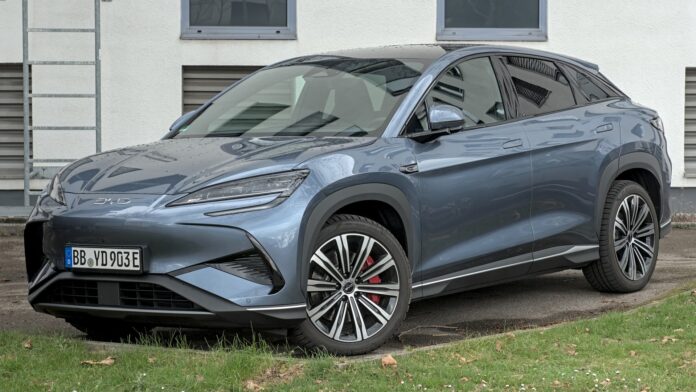
For Japanese automakers, the scariest number here isn’t 490,168. It’s 170,194, BYD’s exports in a single month. Those cars land in Southeast Asia, Europe, Latin America and Australia, which are exactly the markets where Toyota, Honda and Nissan earn the money that’s been shrinking in China. On CnEVPost’s October chart, GAC Toyota reported 53,022 sales and Dongfeng Honda 17,026, both counting every powertrain. Xpeng, a startup founded in 2014, came within about 2,800 cars of GAC Toyota. In Japan itself, BYD is still a small brand, with a lineup that includes the Atto 3, Dolphin, Seal and the Sealion 7 pictured above, but a company with this export machine doesn’t need Japan to be big to keep pressure on Japanese brands everywhere else.
Next up is the China Passenger Car Association’s preliminary October data, which should give Xiaomi’s exact number and Tesla China’s total later this week.
Sources: BYD HKEX filing (Oct. 2026 production and sales), CnEVPost (BYD), CnEVPost (roundup), Cailian Press, Eastmoney, Sina Finance, Jiemian, Beijing Daily, China Securities Journal (via Sina).
— The EVX News team
Featured image: A BYD Sealion 07 EV (sold in Japan as the Sealion 7) in Böblingen, Germany, March 2025. Photo: Alexander Migl / Wikimedia Commons (CC BY-SA 4.0, cropped).

