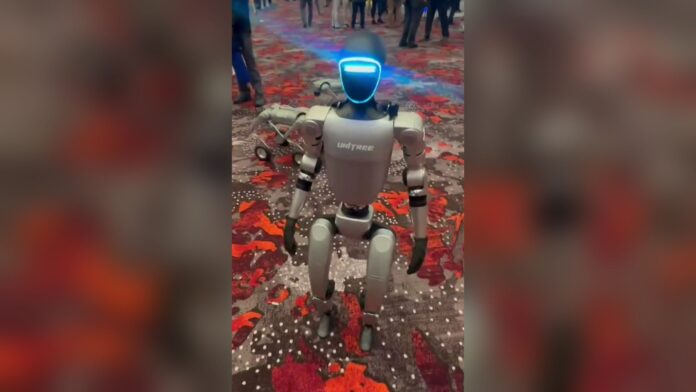

Alibaba’s mapping arm has built a humanoid robot brain without putting a robot in the room. Amap (高德, Gaode) and Alibaba’s Token Hub team have released λ0, or “lambda zero,” a whole-body control model trained mostly on 500 hours of people going about everyday tasks, and they say it runs on a Unitree G1 with no robot demonstrations for the target tasks.
The release went out on Oct. 23 with a project page, an arXiv technical report and open code. Chinese tech outlet 猎云网 (Lieyun), via Tencent News, described it as Amap’s first whole-body foundation model “based on open-world behavior,” and RobotJia summed up the pitch in a headline: wear the gear, walk through the task once, and the G1 learns to carry things while it walks.
Recording people instead of robots
Most humanoid training data comes from teleoperation: a person drives the robot through a task, again and again, and someone resets the scene every time. It’s slow and it needs a robot for every recording. λ0’s dataset, called HumanVerse-500, skips the robot entirely. Collectors wear a neck-mounted GoPro set at the height of the robot’s camera, PICO body trackers for posture and movement, and a hand-reconstruction pipeline fills in finger motion from the video.
The team says one demonstration takes about 29 seconds this way, against roughly 100 seconds on a real robot, which works out to about 3.4 times the collection throughput. The tasks are deliberately mundane: storing toys, moving boxes, throwing out bottles and takeout bags, pushing a cart, delivering fruit, wiping a table, watering plants. Chores, basically. Exactly what a home robot will be asked to do.
Training runs in three stages. First, the model learns object interaction and hand motion from seven existing first-person human datasets. Then it’s mid-trained on the robot-aligned HumanVerse data. Finally, 600 task-specific human demonstrations (150 per task) tune it for the jobs being tested. Alignment steps match the human camera view to the robot’s and convert human movement into motion a G1 can physically make.
The numbers, with an asterisk
On the team’s real-world tests with a Unitree G1, λ0 succeeded in 62.5% of trials (25 of 40), 22.5 points better than the strongest baseline they compared against, π0.5, according to the report and coverage in AI Affairs, citing Pandaily. The project page lists 76.2% average progress on long-range tasks, where the robot has to walk to a target and interact, and 51.7% on the harder whole-body tasks, such as closing a drawer. In simulation, on the SIMPLE benchmark, the team reports about 90%.
Now the asterisk. All of these are the team’s own numbers, and nobody outside has reproduced them yet. The arXiv paper hasn’t been peer-reviewed. The code is out under the Apache 2.0 license, a sample of HumanVerse is on Hugging Face, and a mid-training checkpoint built on Alibaba’s Qwen3.5-2B is public, TSN reports. But the full 500-hour dataset and the final deployment workflow are marked “not yet released,” and the model card warns it “is not a deployment-ready robot policy.” The name, by the way, is a small joke. The repository says the shape of λ echoes 人, the Chinese character for “human.”
Why a map company cares
Amap’s day job is maps and navigation, which is mostly about understanding where people go and how they move through space. Teaching a robot to walk across a break room with a tray isn’t that far off. It’s also one more sign of how crowded the “learn from human video” idea has become. Unitree’s founder is pitching robots that teach themselves, Nvidia filled a keynote stage with open-source robot ducks, and Tesla says Optimus is in early production at Fremont. Data is now the bottleneck for all of them. If 500 hours of people doing chores can stand in for thousands of hours of teleoperation, the cheapest training rig in robotics might turn out to be a GoPro and a person with a to-do list.
Sources: λ0 project page, arXiv 2610.18950, 猎云网 via Tencent News, RobotJia (机器人之家), AI Affairs / Pandaily, TSN.
— The EVX News team
Featured image: A Unitree G1 humanoid, the robot λ0 was tested on, at UAV Expo 2024. Photo: Sayanesy, via Wikimedia Commons, CC0 (background extended to 16:9).

