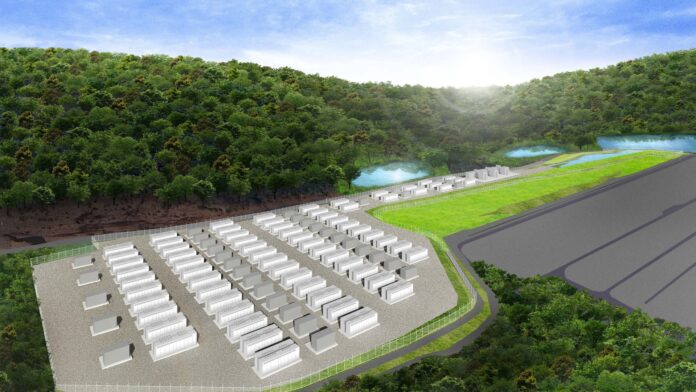

One of Japan’s biggest grid batteries is about to go to work, and it’s built from Tesla Megapacks. ORIX said on Nov. 24 that its Maibara Koto battery station (米原湖東蓄電所) in Maibara, Shiga Prefecture, starts commercial operation on Monday, Dec. 1. The site holds 140 lithium-ion battery containers rated at 134 megawatts and 548 megawatt-hours, which ORIX’s announcement calls one of the largest in Japan by its own count.
ORIX’s release doesn’t name the hardware. Tesla did that itself back on Feb. 4, 2025, when Tesla Japan announced that Megapack had been chosen for the exact same 134 MW / 548 MWh project, and the Kyoto Shimbun headlined this week’s story with the rows of “U.S. Tesla-made containers” now sitting on the site.
There’s a small detail in there worth noticing. In that 2025 announcement, Tesla Japan said the station was scheduled to start operating in 2027. It’s opening on Dec. 1, 2026.
What the two numbers mean
Battery plants are described with two figures, and they measure different things. Megawatts (MW) is how much power the plant can push into the grid at once, like the width of a pipe. Megawatt-hours (MWh) is how much energy it can store in total, like the size of the tank. Divide 548 by 134 and you get roughly four hours: Maibara can run flat out for about four hours before it’s empty.
ORIX puts that in household terms. One full charge and discharge equals the daily electricity use of about 51,000 Japanese homes, using a Ministry of the Environment figure of about 10.7 kWh per household per day. That’s a way to show the size, not a count of homes it supplies.
The job is simple to describe. The plant soaks up electricity when there’s more than the grid needs (a sunny spring afternoon, say) and sends it back when demand climbs or the sun goes down. According to Nikkei, it will mainly charge from the Kansai Electric Power service area and discharge back into it.
Why a 20-year auction matters more than the ribbon cutting
The Dec. 1 start is commercial operation. The bigger date is April 2027, when the station begins running under Japan’s long-term decarbonization power auction (長期脱炭素電源オークション). That program, run through the grid coordinator OCCTO, pays winning projects revenue that covers their fixed costs, in principle for 20 years. For a battery owner, that turns a bet on volatile power prices into something a bank can lend against.
Maibara wasn’t a small winner. Tesla Japan said in 2025 that it had the largest awarded capacity of any battery project in the auction’s first round, for fiscal 2023, and energy news site Enehub reported it was one of 30 battery projects awarded that year, with Toshiba Plant Systems handling engineering and construction.
The local paper filled in the rest. The Shiga Yukan reports that the roughly 25,000-square-meter site sits on city-owned land in Maibara’s Banba district, leased to ORIX until March 2047 for ¥6.48 million a year (about $40,700). It connects to the grid through Kansai Transmission and Distribution’s Koto substation next door, with 35 intermediate transformers and three extra-high-voltage transformers on site. There’s also a public plaza and a biotope pond, with signs for kids learning about renewable energy. (A grid battery with a nature walk is a very Japanese way to do infrastructure.)
Not the only Megapack switching on this month
Maibara is the second large Megapack project in Japan to start operating in November. On Nov. 15, a roughly 30 MW / 125 MWh Megapack system began commercial operation beside a 39 MW solar farm in Oita City, according to Toshiba, which built it, and Osaka Gas, which runs the trading. That one is owned with solar developer Sonnedix, and it exists to fix a very Kyushu problem: on bright spring and autumn days the island makes so much solar power that utilities order plants to throttle output (出力制御, “output curtailment”). The battery stores that midday surplus and sells it in the evening instead.
Put the two together and Tesla has added roughly 673 MWh of grid storage in Japan in a little over two weeks. For scale, Tesla deployed 13.7 GWh of storage worldwide in the third quarter, according to its Q3 production and deployment report. Maibara alone is about 4% of that quarter. In Japan, it’s a landmark. On Tesla’s global tally, it’s about half a week of deployments.
The EVX Take
Most Japanese drivers know Tesla as the company whose cars they see in Tokyo and whose FSD they still can’t use here. Megapack is the part of Tesla that is already fully licensed, plugged in and earning in Japan, and it’s growing quietly. The auction system is the reason: 20 years of predictable revenue makes grid batteries an infrastructure investment instead of a trading bet, and that pulls in owners like ORIX, Osaka Gas and Toshiba, the kind of names Japanese utilities trust. That’s also a market Japanese companies want, so every American container on a Shiga hillside is a data point in a real competition. The detail we like best is the calendar. A project Tesla Japan once penciled in for 2027 is switching on with a month to spare in 2026.
If you’d rather have a smaller version at home, Tesla Japan is currently pitching Powerwall 3 for snow country, saying it’s rated down to -20°C. Earlier EVX coverage of Tesla’s energy business: its Powercore solid-state transformer for data centers and its $3.1 billion plan to refine its own solar silicon in Texas.
Sources: ORIX (Nov. 24, 2026), Tesla Japan (Feb. 4, 2025), Nikkei, Kyoto Shimbun, Shiga Yukan, Enehub, TeslaNorth, Toshiba, Osaka Gas, Tesla Q3 2026 deployment report (SEC).
Image: Rendering of the Maibara Koto battery station with its Megapack rows, from Tesla Japan’s Feb. 4, 2025 press release (cropped).Follow @teslaloha on X for more

