
Tesla showed off Reality View, the new live “bird’s-eye” screen in FSD v15. Just under seven hours later, a Tokyo self-driving startup showed its own version. Issei Yamamoto, CEO of Turing, quote-posted Tesla’s v15 announcement at 1:33 PM JST on Monday, Nov. 23 (11:33 PM ET / 8:33 PM PT, Sunday, Nov. 22) with a single line: “Let’s build one at Turing too!!” At 8:24 PM JST that night (6:24 AM ET / 3:24 AM PT, Monday) he posted a 26-second clip with the caption “I built it and it worked!”
Post embedded from Turing CEO Issei Yamamoto’s official X account (@issei_y).作ったら出来ました! https://t.co/qEZomWlNup pic.twitter.com/GT8DyXkrai
— 山本一成🚀ニューラルロケットとチューリングのCEO (@issei_y) November 23, 2026
What the clip shows
According to CNET Japan, the video is split in two. The top half is a chase-camera view looking down at a moving car from behind and above, with the surrounding roads and buildings drawn in. The bottom half is the plain front-camera footage. In the top half, a light-blue band stretches ahead of the car along its path, much like Tesla’s own demo, which shows the route FSD plans to take. Ifeng’s auto channel also covered it and quoted Yamamoto calling it a simple prototype that shows how quickly Turing’s own “end-to-end world model” can rebuild a 3D scene.
Two terms there. End-to-end means a single neural network turns camera images straight into driving decisions, instead of a pile of hand-written rules for each step. A world model is the AI’s internal picture of its surroundings, and its guess at how that picture will change in the next few seconds. We explained how Tesla uses this idea in our Reality View explainer.
What it doesn’t show
The honest caveat comes from Yamamoto himself. In a reply, CNET Japan reports, he said that running the view in real time on a car’s onboard computer, and letting the user change the camera angle, would take further optimization. Ifeng adds that the demo doesn’t connect to the car’s control system. So this is a rendering demo, not a driving feature.
That’s the key difference from what Tesla shipped. On Nov. 21 (U.S. time), Tesla announced FSD v15 with Reality View, which it describes as a live visualization that lets you “see & control what FSD is planning to do.” It’s running on cars now, drawn by the same system that does the driving. We have the full v15 rollout story if you want the feature list.
Who is Turing?
Turing was founded in 2021 in Tokyo’s Ota ward and says it’s aiming for fully autonomous driving by 2030, built on end-to-end AI, according to a Nikkei xTECH interview with Yamamoto published Nov. 10. The same piece notes that Turing announced joint research with Subaru and Denso this year.
The EVX Take
A seven-hour mock-up tells you the picture is the easy part. Drawing a clean 3D scene is a problem a good team with a day to spare can solve, which is partly why Reality View looked so shareable. The hard part is the invisible one: perceiving the road correctly, deciding what to do, and doing it live on a car’s computer, mile after mile. Tesla’s advantage is that its screen is drawn by the same network that’s driving, so what you see is what the car thinks. Turing’s clip doesn’t claim that, and Yamamoto didn’t pretend it did.
The Japan angle is bittersweet. Japanese owners can’t use any of this yet. Tesla Japan’s terms list city-street Autosteer as unavailable in Japan as of November 2026, according to Zaikei Shimbun, and v15 began with select cars in the U.S. and Canada. So for now a Tokyo startup’s prototype is about as close as Japan gets to Reality View. What’s worth watching is whether Turing’s Subaru and Denso work turns that kind of display into something drivers here can actually use, on roads (narrow lanes, bicycles, kei trucks) that look nothing like Texas.
Sources: CNET Japan, Ifeng Auto, Yamamoto’s post and his first post, Tesla’s v15 announcement, Zaikei Shimbun, Nikkei xTECH.
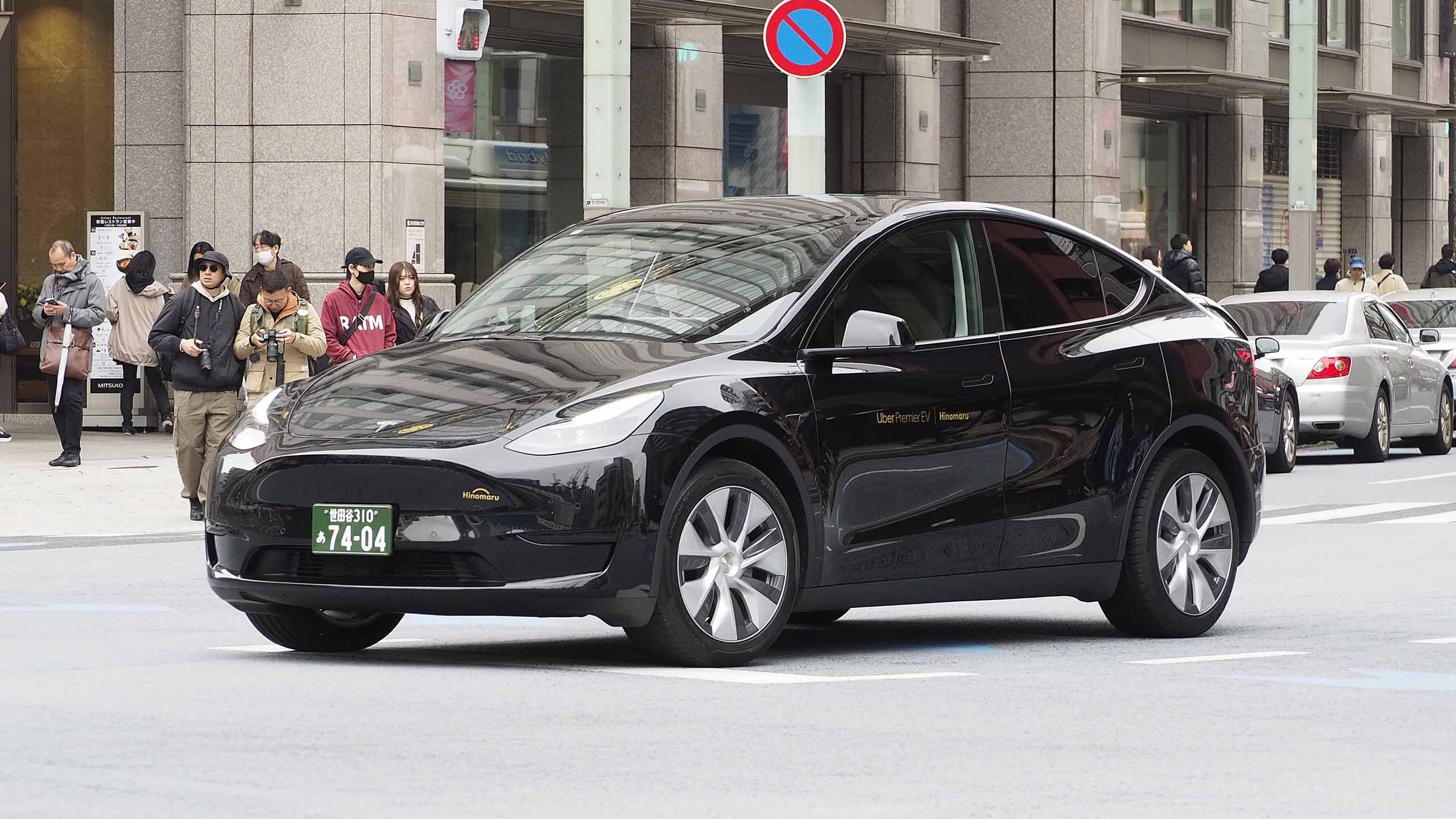
Photo: A Tesla Model Y on a Tokyo street. Photo by Comyu, CC0, via Wikimedia Commons (cropped).Follow @teslaloha on X for more

