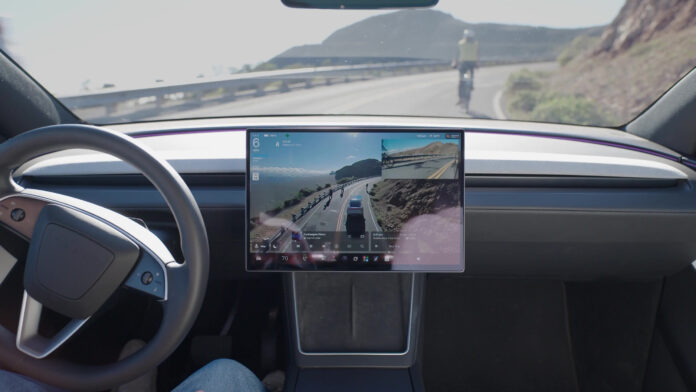

On Sunday, Nov 22 at 6:02 AM ET / 3:02 AM PT (8:02 PM JST), Elon Musk dropped a long, jargon-heavy note on X about how Tesla’s new FSD v15 screen actually gets drawn. He was replying to a first-drive review by Tesla owner Zack (@BLKMDL3). The post is the clearest look yet at the machinery behind Tesla Reality View, and it is easy to bounce off. This is the plain-English version.
In case anyone is curious:
— Elon Musk (@elonmusk) November 22, 2026
We’ve had a ~pixel-perfect world model since last year, which is critical for synthetic data generation.
The (much) smaller version of that in the car is a conditional mean-flow model, based on the recent sequence of Tesla Universal Vision Encoder features…
Lead image: Tesla Reality View on the center screen during a daytime drive on a winding highway, a frame from Tesla’s FSD v15 video. Image: Tesla via X.
Our first look at FSD v15 and Reality View covers the rollout itself, and we explain why Reality View is not a game engine in a separate piece. What follows is a closer read of this one post: the “world model,” the leftover-frame trick, and why the picture can still lag a little.
Two world models, one big and one small
Musk’s first sentence is the one that matters. “We’ve had a ~pixel-perfect world model since last year, which is critical for synthetic data generation.” A world model, in this setting, is software that can imagine a driving scene so convincingly that another program can practice on it. Think of a very serious flight simulator, except it invents the view from cameras instead of a cockpit. “Pixel-perfect” is Musk’s claim that the invented picture is close enough to a real camera image to be useful. Tesla has not published a paper or a demo that would let anyone check that claim, so treat it as the company’s own description.
Synthetic data is the point of that big model. Instead of waiting for the fleet to stumble into a rare mess (a mattress in the lane, a child stepping out from behind a van), Tesla can generate practice video and train FSD on it. The heavy lifting happens in the data center, not in your car.
Then comes the in-car cousin. “The (much) smaller version of that in the car is a conditional mean-flow model,” Musk wrote, “based on the recent sequence of Tesla Universal Vision Encoder features, which are the same ones that are plugged into the 3B encoder model that produces the driving actions.” In everyday language: the car runs a compact relative of the data-center model, and it is steered by what the cameras have just seen, not by a made-up street.
The shared notes, then a fork
Those “Universal Vision Encoder features” are the car’s shorthand for the scene. The encoder looks at the camera feeds and compresses them into a tight set of notes (what’s where, how it’s moving). Tesla’s official release notes, also published by Not a Tesla App, say the same upgraded encoder is shared by FSD, Robotaxi and the Optimus robot. Musk’s new detail is the fork. Those notes go into a roughly 3-billion-parameter model that actually steers, brakes and accelerates. They also split off into a separate model of about 1 billion parameters whose only job is to draw Reality View.
That is why the screen can show the car’s intent, rather than a pretty backdrop alone. The picture and the driving commands start from the same notes. They are still two networks, not one magic program doing both jobs.
Last frame, plus static, then a cleanup
Here is the mechanical trick, in Musk’s words: “We fork off from these UVE features, then run a separate ~1B diffusion model. This takes in the previous reality-view generation with added noise and then denoises it to the current visualization.”
Diffusion, in plain terms, is a way of making a picture by starting with noise (the visual equivalent of TV snow) and cleaning it up step by step until a clear image appears. Tesla’s version does not start from pure snow each time. It takes the last Reality View image, adds some noise, and cleans that up into the new one, using the latest camera notes as a guide. Starting from the previous frame is why the scene stays coherent as you move, instead of flickering into a brand-new hallucination every fraction of a second.
“Conditional” just means “guided by something.” In this case, the guide is the recent sequence of those camera notes. “Mean-flow” is a newer shortcut in this family of image generators. A 2025 research paper of that name, Mean Flows for One-step Generative Modeling, describes a way to jump to a clean image in one or a few steps instead of many slow cleanup passes. Musk used the term for the in-car model. Tesla has not said it implemented that exact paper, and there is no Tesla write-up to compare, so the name is a clue about the approach, not a spec sheet.
The output, still according to Musk, is “a small video chunk (8 images at 36 fps, at the resolution of the UI screen).” Eight frames at 36 frames per second is about two-tenths of a second of video, at the same resolution as the cabin display. “This work is done by 1/2 of a TRIP engine every UVE frame at 18 hz and is spread over 4 cycles.” The car’s vision notes update 18 times a second. Four of those ticks also last about two-tenths of a second, which lines up with the length of each clip. That reading of the numbers is ours, not a Tesla diagram.
What it means, in plain English
- World model: software that can simulate realistic driving scenes. Tesla’s big one lives in the data center. The car runs a much smaller version to draw the screen.
- Synthetic data: practice video the company invents for training, so FSD can learn from situations the fleet has not actually hit yet.
- Universal Vision Encoder (UVE): the car’s eyes plus a very fast note-taker. The same notes feed the driving model and the screen.
- “3B” and “1B”: about 3 billion and 1 billion parameters, the internal dials a network tunes as it learns. The larger one drives. The smaller one draws.
- Diffusion and “denoising”: make a picture by adding noise and then cleaning it up. Tesla starts from the last frame, not from blank static.
- Conditional mean-flow: “conditional” means the picture is guided by what the cameras just saw. “Mean-flow” is a shortcut for getting to a clean image in fewer steps.
- TRIP, 18 Hz, 36 fps: a TRIP is Tesla’s name for the circuits on the AI4 computer that do this kind of math. Vision updates 18 times a second; the screen plays the generated clips at 36 frames per second.
- Latency: the delay between what the cameras see and what the screen shows. If it is high, the picture trails the real world slightly.
The lag is real, and Musk already has a planned cut
“Currently, the latency is a bit high due to compute constraints,” Musk wrote, “but we have ways to interleave newer UVE features along the diffusion transformer layers to cut roughly 35% of the latency.” In everyday terms: the screen can trail reality a little because there is only so much leftover computing power. Tesla’s planned fix is to feed fresher camera notes into the image model as it works, instead of waiting until a clip is finished, which he says should trim about a third of that delay.
The lag shows up on the road, too. In a first-hand review, Teslarati wrote that the delay is noticeable, though not a dealbreaker, and quoted the same 35% line. Not a Tesla App covered the v15 rollout and the official notes, which describe Reality View as a real-time generative view from a virtual camera above the car. Tesla has not published a measured latency figure.
About four minutes later, at 6:06 AM ET / 3:06 AM PT (8:06 PM JST), Musk added why the visualizer only gets half a TRIP: after Tesla moved a tiny decoder into SRAM (very fast memory on the chip), that was all that was left on the second of the car’s two main chips. He also said the TRIP “basically only handles 8-bit int” and has to run one common calculation, softmax, “in emulation mode in 28 steps.” In other words, the leftover engine is built for simple, low-precision whole-number math, and one step has to be done the long way. “AI5 is a gigantic improvement. Roughly 12X more compute,” he finished. Sunday evening he also said AI5 is going to the Optimus robot and cars will stay on AI4, so any lag fix has to land on the computer already in the car.
The EVX Take
The useful part of this post is not the graphics flex. It is the fork. If the screen is built from the same notes the car uses to drive, then a weird picture is a clue that the driving system may be confused, which is exactly what a supervising driver wants to see. That will matter in Japan too, whenever FSD (Supervised) gets a look from regulators who care how a driver is supposed to understand the system’s intent. The catch is the lag Teslarati already noticed. Musk’s 35% cut is the next thing to watch, because he has now said the cars are staying on AI4. The prettier, faster picture has to be squeezed out of the leftover half-accelerator that is already on board, not out of a chip that is heading to a robot.
Follow @teslaloha on X for more

