
Tesla and SpaceX have each picked directors to sit on the special committees negotiating a possible merger, the Financial Times reported on Tuesday, Nov. 24 (Japan time). Three come from Tesla: Robyn Denholm, Kathleen Wilson-Thompson and Jack Hartung. Two come from SpaceX: Roelof Botha and Randy Glein. Reuters, which carried a summary of the FT story, said it could not independently verify the report, and neither company responded to its requests for comment. So this is sourced reporting from people familiar with the talks, not an announcement.
Who’s at the table
The FT says both committees have already hired advisers. Morgan Stanley and Goldman Sachs are working for SpaceX, and Evercore is working for Tesla. According to the report, the bankers are building the financial models that will anchor each side’s negotiating position in an all-stock deal, and they’re studying which parts of the proposed conglomerate overlap.
A few terms, since this story is full of them. A special committee is a group of independent directors who negotiate for shareholders when someone on both sides of a deal (here, Elon Musk) has a conflict. An all-stock deal means no cash changes hands: Tesla holders would receive SpaceX shares. The exchange ratio is the number that decides how many SpaceX shares you get per Tesla share, and it’s where most of the haggling happens.
Investing.com’s write-up of the FT report adds a few more details. Musk is reportedly barred from formally taking part in active negotiations under Texas corporate rules, although the committees can lean on senior executives for information. The talks are said to be heading toward a possible year-end deadline, but people involved cautioned that the committees are not close to agreement. Investing.com puts the combined value at roughly $3.5 trillion. That figure is its own, not a number either company has given.
The hurdles haven’t moved
None of the hard parts got easier today. Tesla needs approval from more than 50% of all possible votes, so shareholders who abstain or don’t vote effectively count as “no.” Musk controls about 84% of the voting rights at SpaceX but roughly 20% at Tesla, per the same write-up, so SpaceX is the easy side of the table. Regulators in the US, China, Europe and the UK would probably want a look. The FT also flags SpaceX’s US defense contracts and Tesla’s dependence on China as the thorny regulatory points.
Musk himself has been careful not to call it done. On SpaceX’s Oct. 20 earnings call he said a merger would be “a good idea,” then added that assuming it’s a certainty “would be overstating it.” We covered Bloomberg’s earlier report that an announcement could come as soon as December, with early 2027 as the slower option. Nothing in today’s report contradicts either date.
What markets are already pricing
Tesla stock closed Monday at $385.46, up 11.46%, according to price-history data. Drive Tesla Canada flagged it as the biggest one-day gain since April 2025, and tied the move to the FSD v15 rollout rather than merger news. Last week, HSBC upgraded Tesla to Hold and raised its target to $359 from $157. Its math blends two values: $212 per share if Tesla stays independent, and $507 per share in a SpaceX takeover that includes a 33% premium to the 30-day average price. In other words, a bank is now putting a number on the merger scenario, and that number is more than double the standalone one.
The EVX Take
What changed today isn’t the odds of a deal. It’s that “talks” now have names, advisers and a clock. When independent directors start meeting and bankers start building models, it usually means the exploring phase is over and the bargaining phase has begun. That’s still a long way from a signed agreement, and the Tesla vote threshold could sink it on its own.
For Japan, the most concrete issue is the one buried in “Tesla’s reliance on China.” The Model 3 and Model Y sold in Japan come out of Giga Shanghai, so however a merged company ring-fences its China business, it wraps around the factory that supplies Japanese buyers. Nothing changes at a Tesla Japan store because of a committee appointment. But if regulators ever force China to be carved out, supply for Japan is the first place a customer would notice. There’s a second thread too: SpaceX’s Starlink already works with KDDI in Japan, and Tesla wants Starlink built into every model by late 2027 (more on that plan here). Under one roof, that kind of tie-up would stop being a partnership and become an internal project.
Sources: the FT report as summarized by Reuters via RTÉ, Investing.com, and Newsweek Japan (Reuters Japanese); HSBC upgrade via Investing.com. Neither Tesla nor SpaceX has filed or announced anything about a merger as of this writing.
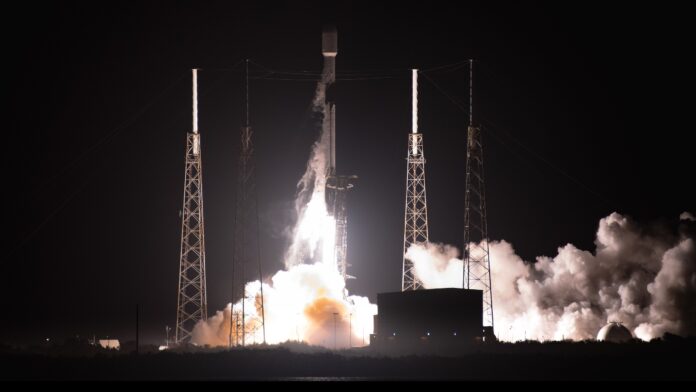
Photo: A SpaceX Falcon 9 launching a Starlink mission, U.S. Space Force photo by Joshua Conti, public domain, via Wikimedia Commons (cropped).Follow @teslaloha on X for more

