
Chinese carmakers now sell more new cars than Japanese carmakers in 39 countries, and 14 of those flipped this year alone, according to a Nikkei analysis of January–September sales data from a U.S. research firm. Germany, Italy and Brazil are among the new ones. Japanese brands still lead in 54 of the 93 countries where the numbers could be compared, but the gap is closing in places Japan has owned for decades.
Nikkei published the analysis on Sunday, Nov. 22 at 5:08 PM JST (3:08 AM ET / 12:08 AM PT), followed by an English version in Nikkei Asia. Chinese outlets picked it up within hours: state news agency Xinhua ran it from Tokyo, the financial site China News Economic (via Huanqiu) carried the country-by-country numbers, and Nikkei’s Chinese edition published the full piece in Chinese. The figures below match across those versions.
Where the lead changed hands
Eight of the 14 new flips are in Europe. In Germany, Europe’s biggest car market, Chinese brands together reached 6% of new-car sales, up 2 points from a year earlier, while Japanese brands slipped 1 point to 5%. BYD’s sales there more than tripled.
Italy moved faster. Chinese brands gained 6 points to 12%, and the driver was Leapmotor, the Hangzhou startup that sells through Stellantis, the owner of Fiat. Leapmotor’s EV sales in Italy rose about elevenfold in January–September, giving it a 25% share of the country’s EV market, according to industry figures cited by Nikkei.
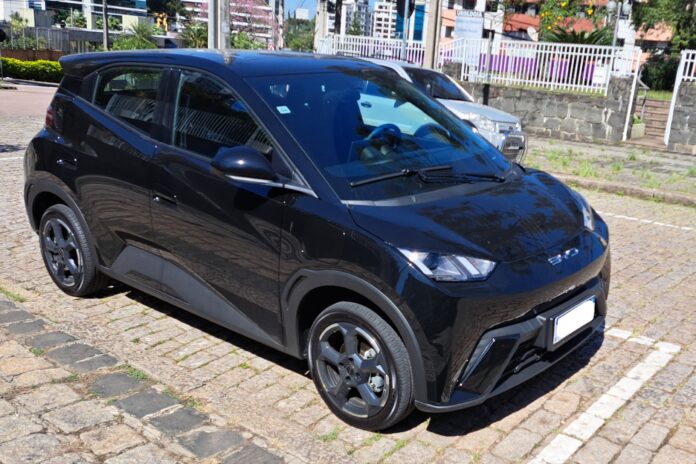
Brazil was the biggest swing of all. China’s share jumped 10 points to 19%, passing Japan, with BYD’s local factory (production started in 2025) doing most of the work. And in 9 of the 14 countries that flipped, Japanese brands didn’t just get passed. Their share actually fell.
China’s older strongholds are the countries moving fastest to EVs, such as Norway, Sweden and Singapore. In Southeast Asia, where Japanese brands have long dominated, the gap narrowed further, Xinhua noted.
Why now
Nikkei’s answer is oil. Prices jumped sharply this year, demand for gasoline cars fell, and EVs, the category Chinese makers are best at, picked up the slack. Facing fiercer competition at home, Chinese brands are also pushing harder abroad and building local factories, and Nikkei puts their overseas sales at 4.34 million cars in January–September, up 51%.
China’s own industry data points the same way. The China Association of Automobile Manufacturers counted 8.205 million vehicles exported from China in January–September, up 65.8%, and 4.006 million of them were new energy vehicles, up 127.9%, according to the industry ministry’s September report. We covered October’s record NEV exports earlier this month.
What it means, in plain English
- Market share: out of every 100 new cars sold in a country, how many came from a group of brands. “Chinese brands at 6% in Germany” means about 6 of every 100 new cars.
- Brand vs. where it’s built: Nikkei compares Chinese brands with Japanese brands, wherever the cars are made. A Toyota built in Europe counts as Japanese. China’s export figure is different. It counts every car shipped out of China, including foreign brands like Tesla’s Shanghai-built Model 3 and Model Y.
- NEV (new energy vehicle): China’s term for battery EVs, plug-in hybrids and fuel cell cars together.
- Points vs. percent: going from 4% to 6% is a 2-point gain, even though it’s half again as many cars.
The EVX Take
For Japan this is bigger than a sales chart. Nikkei’s own warning is that a shrinking share abroad hits the whole supply chain behind it, from steel and resin makers to parts suppliers, and cars are Japan’s single biggest export. Japan’s strength has been hybrids and gasoline cars, and the flips happened where EVs took off, so the fight is really about how fast each market goes electric. Inside Japan the picture looks very different. Chinese brands are still a rounding error here, but they’re getting closer to the mainstream, with BYD’s Racco kei EV on sale and a Chery-backed kei brand testing on Japanese roads. Japanese makers aren’t standing still either. Toyota’s bZ4X is even working with Chinese partners, now running as a driverless robotaxi in Guangzhou. The countries to watch next are in Southeast Asia, Japan’s backyard, where its brands have dominated for decades. If a Thailand or an Indonesia shows up on next year’s list, the problem gets much bigger.
Sources: Nikkei (Nov. 22, 2026, Japanese), Nikkei Asia, Nikkei Chinese edition (Chinese), Xinhua (Chinese), Huanqiu / China News Economic (Chinese), MIIT / CAAM September data (Chinese). Featured image: a black BYD Dolphin Mini (sold as the Seagull in China) parked on a cobblestone street in Brazil. Photo by Mateusmatsuda via Wikimedia Commons, CC BY 4.0.
Follow @teslaloha on X for more

