
The Boring Company now has a signed lease on the curb at Nashville International Airport. Elon Musk’s tunneling company and the Metropolitan Nashville Airport Authority (MNAA) signed a 40-year agreement for a Music City Loop station at the airport, known as BNA, on Wednesday, Nov. 18, and the company announced it at 5:06 p.m. ET / 2:06 p.m. PT on Thursday, Nov. 19 (7:06 a.m. JST Friday, Nov. 20). Its pitch fits in one line: less than 10 minutes from downtown, to a station 22 feet from the terminal entrance.
Twenty-two feet is about seven meters. That’s closer than most taxi ranks, and that’s not a coincidence. According to Aviation Pros, the company will lease a 19,500-square-foot (about 1,800 square meters) covered pickup and drop-off area that taxis and limousines use today. Tunnel portals are planned behind Concourse D, with an existing service road extended to reach them.
Who pays for what
The airport doesn’t put in a dollar of capital. The Boring Company covers design, construction, operations and maintenance, and pays the airport in three ways: a licensing fee that starts at $300,000 a year and rises 3% annually, a $5 fee for every passenger pickup and another $5 for every drop-off, and a one-time $600,000 reimbursement for the airport’s legal, engineering and administrative costs on the deal, per Aviation Pros and airport finance documents summarized by LOOP Nashville.
The base term is 40 years with two five-year options, so up to 50. Airport officials project about $343 million over that full span: roughly $34 million in license fees and $309 million in pickup and drop-off fees. That projection assumes ridership, fee levels and renewals that may or may not happen, so treat it as a model, not a guarantee. It does tell you where the money really is. The per-trip fee is worth about nine times the rent.
Getting here took a while. The Tennessean reports the licensing agreement took 17 months to finalize, ending about nine months in limbo after the terms moved forward in February. An August 2025 draft had floated an annual airport access charge of more than $1.7 million, according to LOOP Nashville, before the two sides settled on the lower base fee plus per-ride charges.
Where the tunnels stand
Music City Loop is planned as twin one-way tunnels running a fleet of company-operated electric vehicles between BNA, downtown and other stops. Two tunnel-boring machines are already working under downtown Nashville. The Boring Company said on Nov. 17 that its third machine, Prufrock-MB3, has arrived and a fourth, Prufrock-MB4, is due within eight weeks. Aviation Pros says the company is targeting an early 2027 launch for the system, but no firm opening date has been set, and Fox 17 notes station design and permitting were still underway as of the company’s Oct. 1 update.
The model is the one the company has been scaling in Las Vegas, where the Vegas Loop carries riders in Tesla vehicles and is now entitled for 123 stations after Clark County approved 19 more in August. The company is also tunneling in San Antonio. Tesla’s own driverless push, from Cybercab rides in Dallas to the Assisted Driving approval in Italy today, is the obvious long-term partner for a road network with no cross traffic and no weather.
The EVX Take
The interesting part isn’t the tunnel. It’s the deal structure: a private builder takes all the construction risk, the airport gets rent plus a cut of every ride, and the public pays nothing up front. Japan does airport access the opposite way, with big, slow public rail projects, and the timing this week is almost funny. On Monday, Nov. 16, JR East started boring the roughly 2.3 km shield tunnel for its Haneda Airport Access Line, which will cut Tokyo Station to Haneda to about 18 minutes when it opens in fiscal 2031, the Nikkei reported. Tokyo doesn’t need a Loop. Its rail is excellent. But plenty of Japanese regional airports depend on buses and private cars, and a pay-per-ride model where the operator funds the dig is at least worth a look for local governments that can’t afford a new rail spur. Nashville will be the test of whether the per-trip math holds up outside the Vegas Strip.
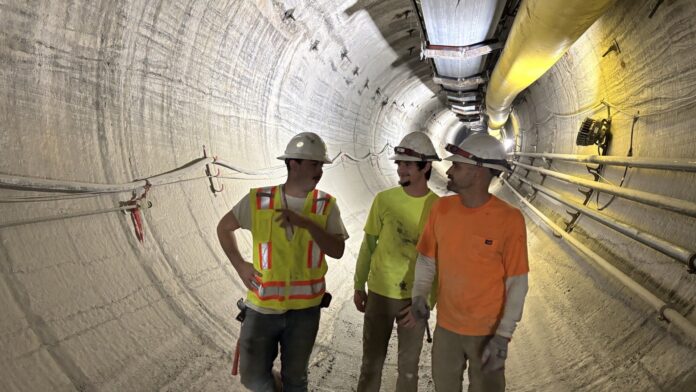
Sources: The Boring Company on X, Aviation Pros, The Tennessean, WSMV, Fox 17, LOOP Nashville, Nikkei (Japanese). Featured image: Boring Company crew members walking through a tunnel, from the company’s Nov. 17 Nashville post. Photo: The Boring Company (@boringcompany) on X (cropped).

